

What Is the Nernst Equation Calculator?
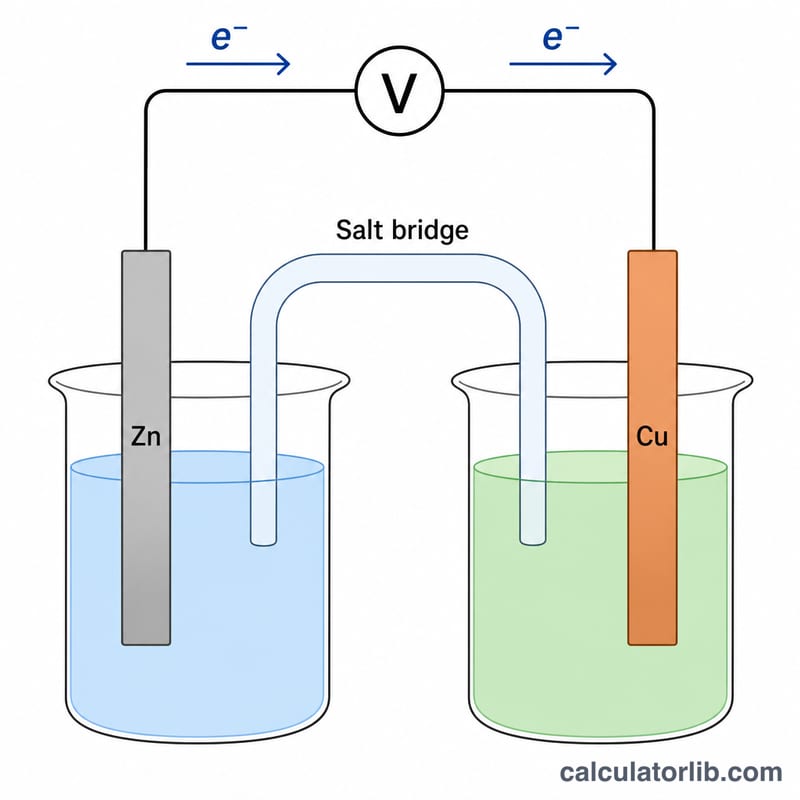
This calculator finds the cell potential (electromotive force, EMF) of an electrochemical or concentration cell using the Nernst equation at 25°C (298.15 K). It tells you how the actual cell voltage differs from the standard potential once concentrations move away from standard conditions.
How to Use It
Enter three values: the standard cell potential E° in volts, the number of electrons transferred in the balanced reaction (\(n\)), and the reaction quotient \(Q\) (the ratio of product to reactant activities). The tool returns the cell potential \(E\), along with \(\log(Q)\) and the Nernst correction term so you can see exactly how the voltage shifts.
The Formula Explained
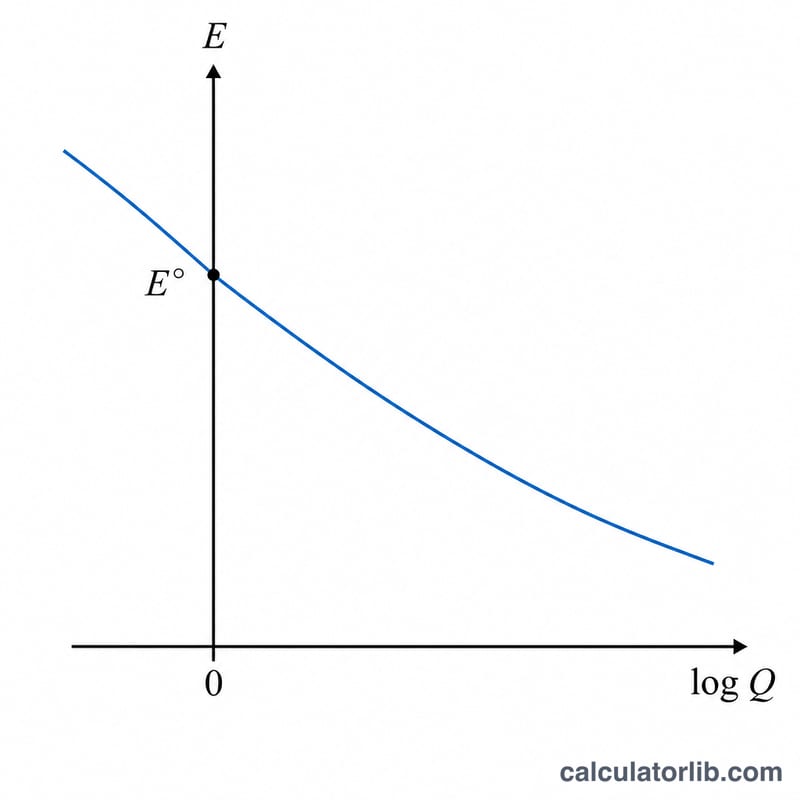
At 25°C the Nernst equation simplifies to $$E = \text{E}^\circ - \frac{0.0592}{\text{n}} \log_{10}\!\left(\text{Q}\right)$$ The constant 0.0592 V comes from \((RT/F)\cdot\ln(10)\) evaluated at 298.15 K. When \(Q = 1\), \(\log Q = 0\) and \(E\) equals E°. When products build up (\(Q\) greater than 1) the term is positive and the voltage drops; when reactants dominate (\(Q\) less than 1) the term is negative and the voltage rises.
Worked Example
Suppose E° = 1.10 V, \(n = 2\), and \(Q = 10\). Then \(\log Q = 1\), so the correction is $$\frac{0.0592}{2}\cdot 1 = 0.0296 \text{ V}$$ The cell potential is $$E = 1.10 - 0.0296 = 1.0704 \text{ V}$$ The higher reaction quotient slightly lowers the voltage, just as Le Chatelier intuition predicts.
FAQ
Why 0.0592 and not 0.0257? The 0.0592 factor is used with base-10 logarithm (\(\log\)), while 0.0257 V is \(RT/F\) used with natural log (\(\ln\)). This calculator uses the log form.
What if E° is zero? For a concentration cell the two electrodes are identical, so E° = 0 and the voltage comes entirely from the \(-(0.0592/n)\cdot\log Q\) term driven by the concentration difference.
Does temperature matter? Yes. The 0.0592 constant is valid only at 25°C. At other temperatures recompute \((RT/F)\cdot\ln(10)\) for the new temperature.