
What is De Moivre's Theorem?
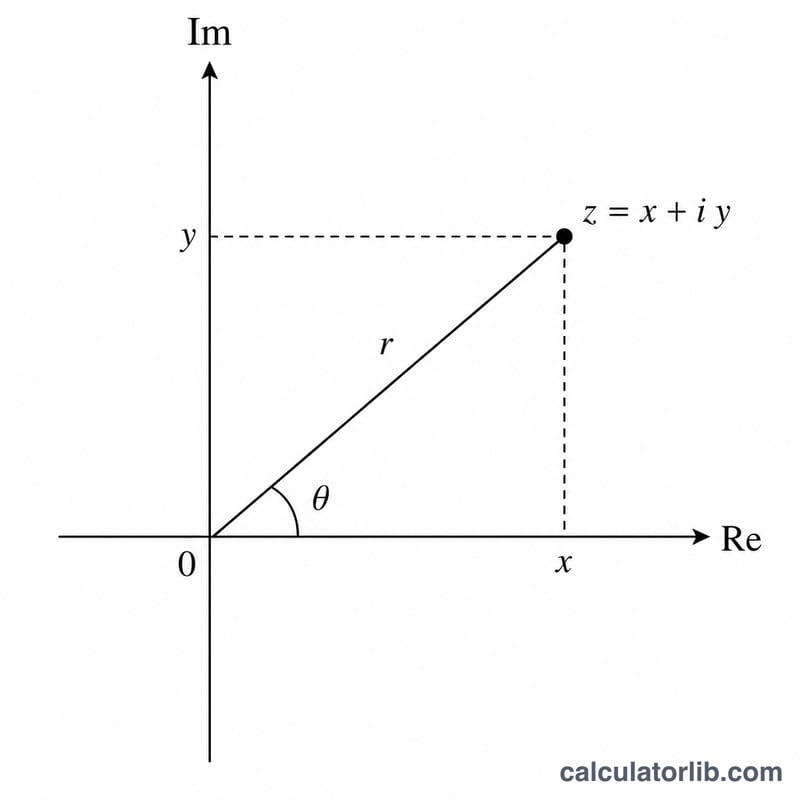
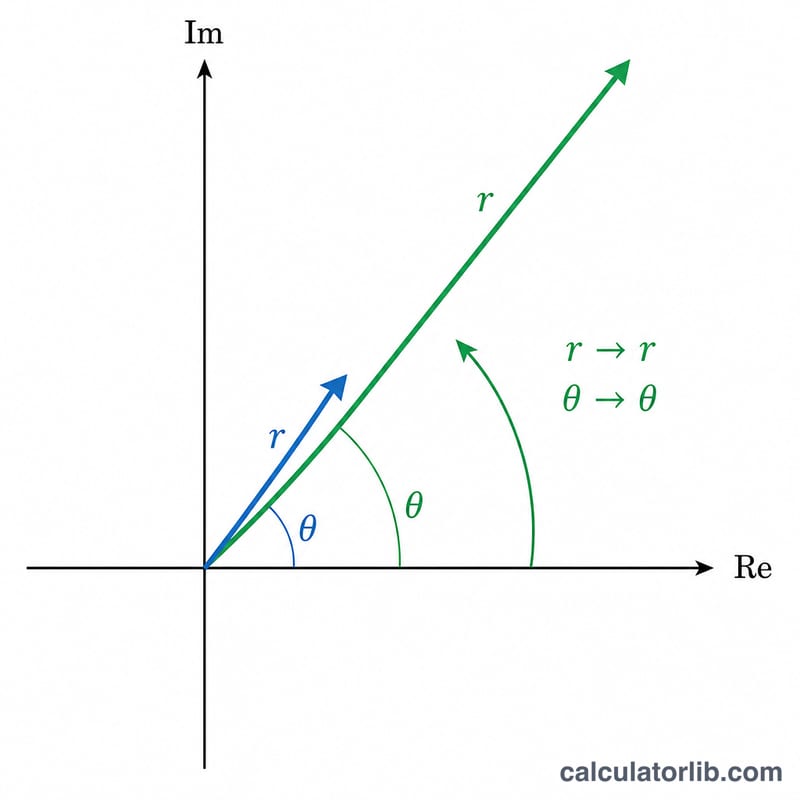
De Moivre's theorem is a powerful identity in complex number theory that lets you raise a complex number written in polar form to any power without repeated multiplication. If a complex number has modulus r and argument θ, then raising it to the power n simply raises the modulus to \(r^{n}\) and multiplies the angle by \(n\). This calculator does that instantly and also converts the answer back into the familiar rectangular form \(a + bi\).
How to use this calculator
Enter the modulus r (the distance from the origin), the angle θ (the argument), the power n, and choose whether your angle is in degrees or radians. The tool returns the new modulus \(r^{n}\), the new angle \(n\theta\), and the real and imaginary parts of the result.
The formula explained
The theorem states: $$\left(r\left(\cos\theta + i\cdot\sin\theta\right)\right)^{n} = r^{n}\left(\cos\!\left(n\theta\right) + i\cdot\sin\!\left(n\theta\right)\right)$$ The modulus is raised to the power n, while the angle is multiplied by n. Converting to rectangular form gives \(a = r^{n}\cdot\cos\!\left(n\theta\right)\) and \(b = r^{n}\cdot\sin\!\left(n\theta\right)\).
Worked example
Take \(\left(2\left(\cos 30° + i\cdot\sin 30°\right)\right)^{3}\). The new modulus is \(2^{3} = 8\) and the new angle is \(3 \times 30° = 90°\). So the result is $$8\left(\cos 90° + i\cdot\sin 90°\right) = 8\left(0 + i\cdot 1\right) = 0 + 8i$$
FAQ
Does n have to be a whole number? De Moivre's theorem holds exactly for integer powers. Non-integer powers give one valid root but complex numbers have multiple roots in general.
Degrees or radians? Either works — just pick the matching unit. The output angle is reported in the same unit you chose.
What if r is negative? Modulus is normally non-negative; a negative r is interpreted literally in the power \(r^{n}\), which may produce unexpected signs for non-integer n.