
What This Calculator Does
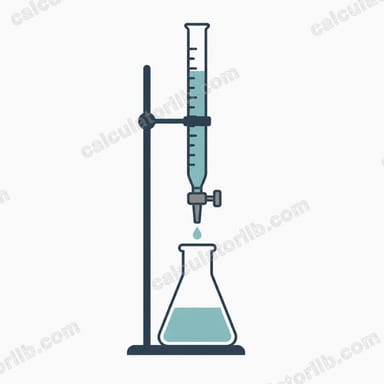
When you mix a strong monoprotic acid (like HCl) with a strong monobasic base (like NaOH), they neutralize each other mole-for-mole. This tool computes the pH of the resulting solution by determining which reactant is in excess and how much remains after neutralization. It assumes complete dissociation, monoprotic/monobasic species, no temperature correction, and that volumes are additive.
How to Use It
Enter the acid concentration (Ca) and volume (Va), then the base concentration (Cb) and volume (Vb). The calculator finds the moles of each, subtracts the smaller from the larger to get the excess, divides by the total combined volume to get the leftover ion concentration, and converts that to pH.
The Formula Explained
Moles of acid = \(\text{Ca} \times \text{Va}\); moles of base = \(\text{Cb} \times \text{Vb}\). The excess moles = \(|\text{Ca}\cdot\text{Va} - \text{Cb}\cdot\text{Vb}|\). Dividing the excess by the total volume \((\text{Va} + \text{Vb})\) gives the molarity of the leftover ion. If acid is in excess, this is [H+] and
$$\text{pH} = -\log_{10}\!\left(\frac{|n_a - n_b|}{V_a + V_b}\right)$$If base is in excess, this is [OH-], so \(\text{pOH} = -\log_{10}[\text{OH}^-]\) and \(\text{pH} = 14 - \text{pOH}\), giving
$$\text{pH} = 14 + \log_{10}\!\left(\frac{|n_a - n_b|}{V_a + V_b}\right)$$If they are exactly equal, the mixture is neutral:
$$\text{pH} = 7 \quad \text{when}\quad \text{Ca}\cdot\text{Va} = \text{Cb}\cdot\text{Vb}$$(pH 7 at 25 degrees C).
Worked Example
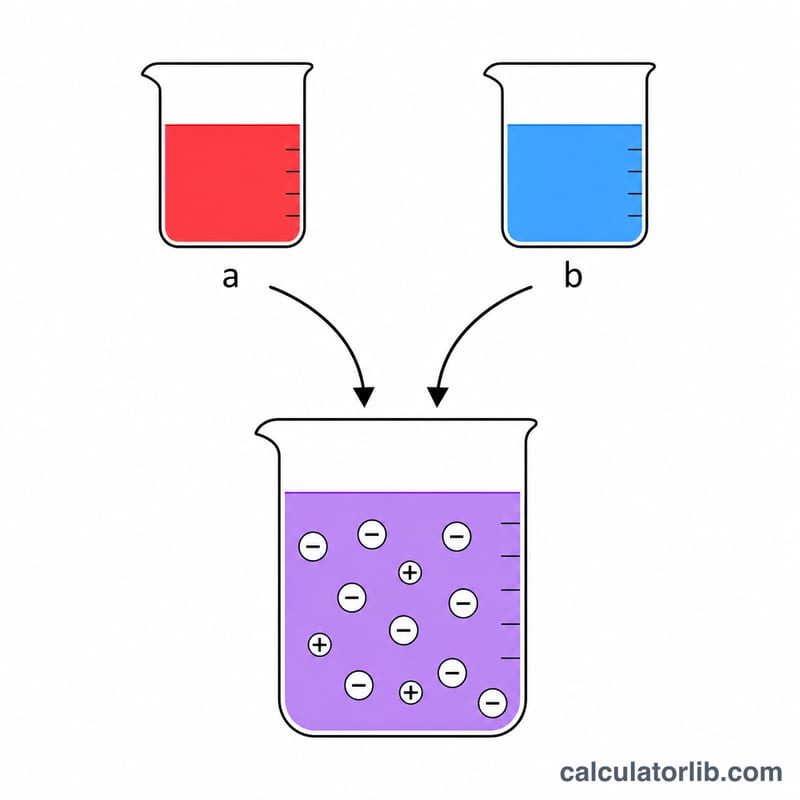
Mix 0.05 L of 0.1 mol/L HCl with 0.05 L of 0.05 mol/L NaOH. Acid moles = 0.005, base moles = 0.0025. Excess = 0.0025 mol of H+. Total volume = 0.1 L, so [H+] = 0.025 mol/L.
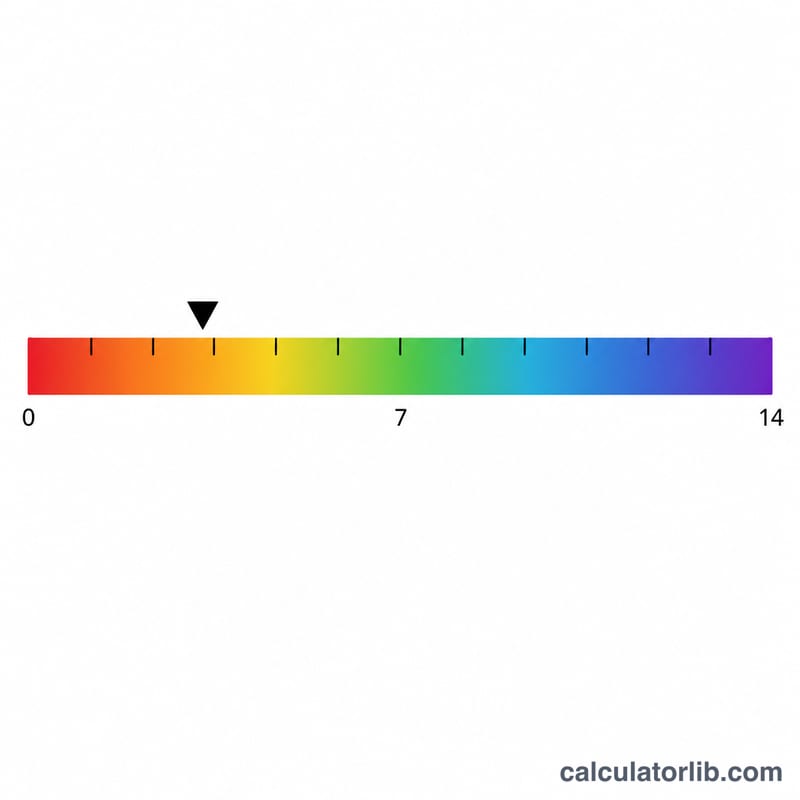
$$\text{pH} = -\log_{10}(0.025) = 1.602$$The solution is acidic.
FAQ
Does this work for weak acids or bases? No. Weak acids and bases only partially dissociate and require their Ka/Kb and a buffer calculation. This tool is for strong acids and strong bases only.
What if the acid and base exactly neutralize? The result is pH 7 because only water and a neutral salt remain at 25 degrees C.
Why divide by total volume? Mixing two solutions dilutes everything, so the leftover ions are spread across the combined volume \((\text{Va} + \text{Vb})\).