
What This Calculator Does
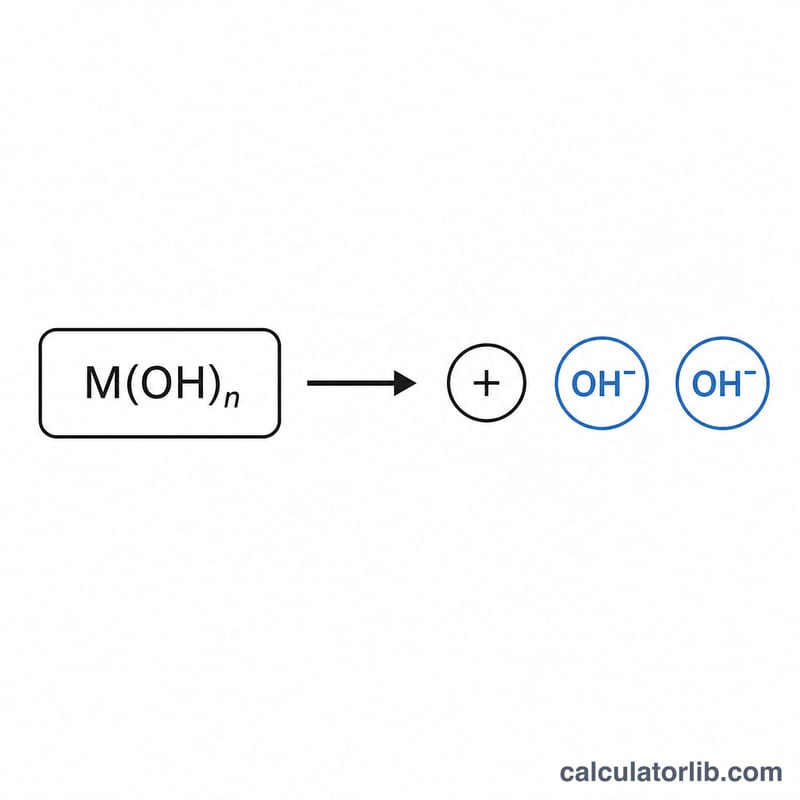
A strong base dissociates completely in water, so the hydroxide ion concentration equals the base concentration multiplied by the number of hydroxide groups it releases. This tool computes the resulting pOH and pH of the solution at 25 °C, where the autoionization of water fixes \(\text{pH} + \text{pOH} = 14\).
How to Use It
Enter the molar concentration of the base in mol/L. Then enter the number of hydroxide ions released per formula unit (n): use 1 for NaOH or KOH, and 2 for Ca(OH)₂, Ba(OH)₂ or Sr(OH)₂. The calculator returns the hydroxide concentration, pOH and pH instantly.
The Formula Explained
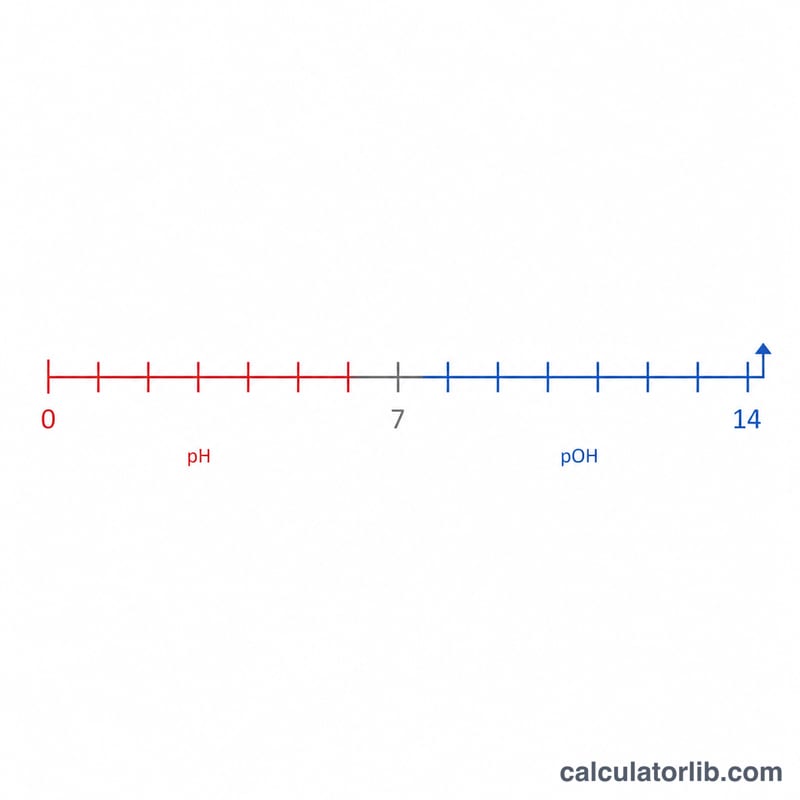
The hydroxide concentration is \(\left[\text{OH}^-\right] = C \times n\). Taking the negative base-10 logarithm gives \(\text{pOH} = -\log_{10}(C \cdot n)\). Because water at 25 °C has \(K_w = 1\times10^{-14}\), the relationship \(\text{pH} + \text{pOH} = 14\) lets us convert:
$$\text{pH} = 14 - \text{pOH}$$A higher hydroxide concentration produces a higher pH (more basic).
Worked Example
Suppose you dissolve Ca(OH)₂ to a concentration of 0.01 mol/L. Each formula unit releases 2 hydroxide ions, so
$$\left[\text{OH}^-\right] = 0.01 \times 2 = 0.02 \ \text{mol/L}$$Then
$$\text{pOH} = -\log_{10}(0.02) \approx 1.70$$$$\text{pH} = 14 - 1.70 = 12.30$$The solution is strongly basic.
FAQ
Does this work for weak bases? No. It assumes 100% dissociation, which only holds for strong bases such as NaOH, KOH, and the alkaline-earth hydroxides. Weak bases require an equilibrium (Kb) calculation.
Why is the temperature 25 °C? The constant 14 comes from Kw at 25 °C. At other temperatures Kw changes and the sum \(\text{pH} + \text{pOH}\) differs.
What value of n should I use? It equals the number of OH⁻ groups in the formula: 1 for monohydroxide bases like NaOH, 2 for dihydroxide bases like Ca(OH)₂.