

What is the Overtime Pay Calculator?
This calculator estimates the extra income you earn from working overtime. Enter your regular hourly rate, the number of overtime hours you worked, and the overtime multiplier (commonly time-and-a-half at 1.5× or double time at 2×). It instantly shows your overtime pay for the period plus projected monthly and yearly totals so you can budget around that extra income.
How to use it
1. Enter your regular hourly rate. 2. Enter the overtime hours you expect to work in a typical pay period (you can use quarter-hour steps). 3. Pick your overtime multiplier. The calculator returns your overtime pay and your effective overtime hourly rate, then estimates the monthly figure (using an average of 4.33 weeks per month) and the annual figure (52 weeks).
The formula explained
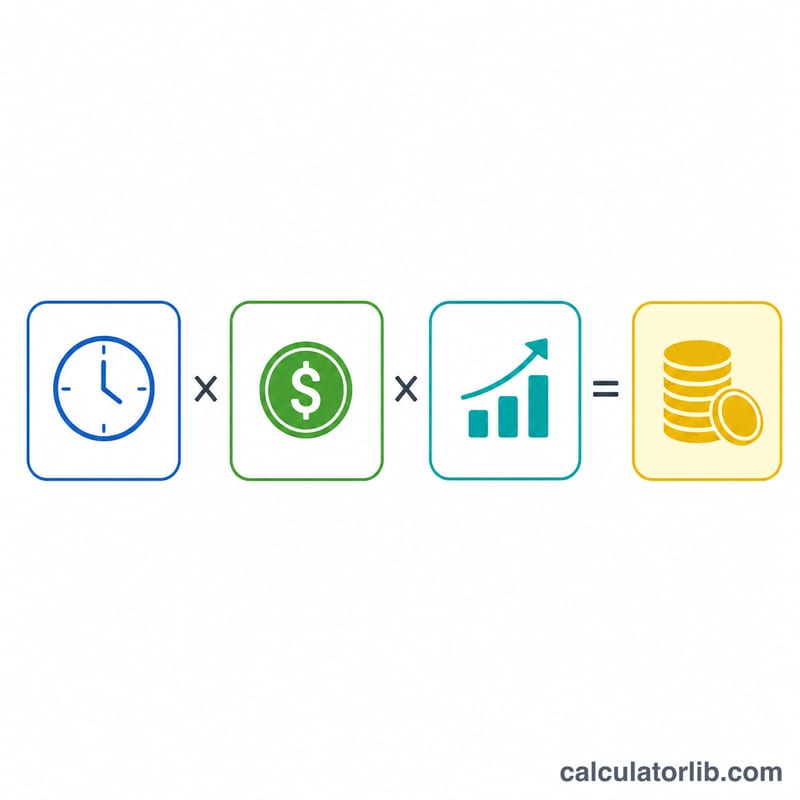
The core formula is $$\text{Overtime Pay} = \text{Overtime Hours} \times \text{Hourly Rate} \times \text{Multiplier}$$. The multiplier reflects the premium employers pay for overtime: \(1.5\times\) means you earn 50% more per hour, while \(2\times\) doubles your rate. Your overtime hourly rate is simply \(\text{Hourly Rate} \times \text{Multiplier}\).
Worked example
Suppose you earn $20/hour and work 10 overtime hours at time-and-a-half (\(1.5\times\)). Your overtime rate is \(\$20 \times 1.5 = \$30\)/hour. Overtime pay $$= 10 \times \$20 \times 1.5 = \$300$$ for that period. Over a month that is roughly \(\$300 \times 4.33 \approx \$1{,}299\), and across a year about \(\$300 \times 52 = \$15{,}600\).
FAQ
Does this include my regular pay? No — it shows only the income from overtime hours, so you can see the extra money those hours add.
Which multiplier should I use? Many jurisdictions require time-and-a-half (\(1.5\times\)) beyond 40 hours/week, but double time (\(2\times\)) may apply on holidays or after very long shifts. Check your local rules or employment contract.
How are monthly and yearly figures estimated? They assume you work the same overtime every week: monthly multiplies by 4.33 weeks and yearly by 52 weeks. Adjust if your overtime varies.