
What it does
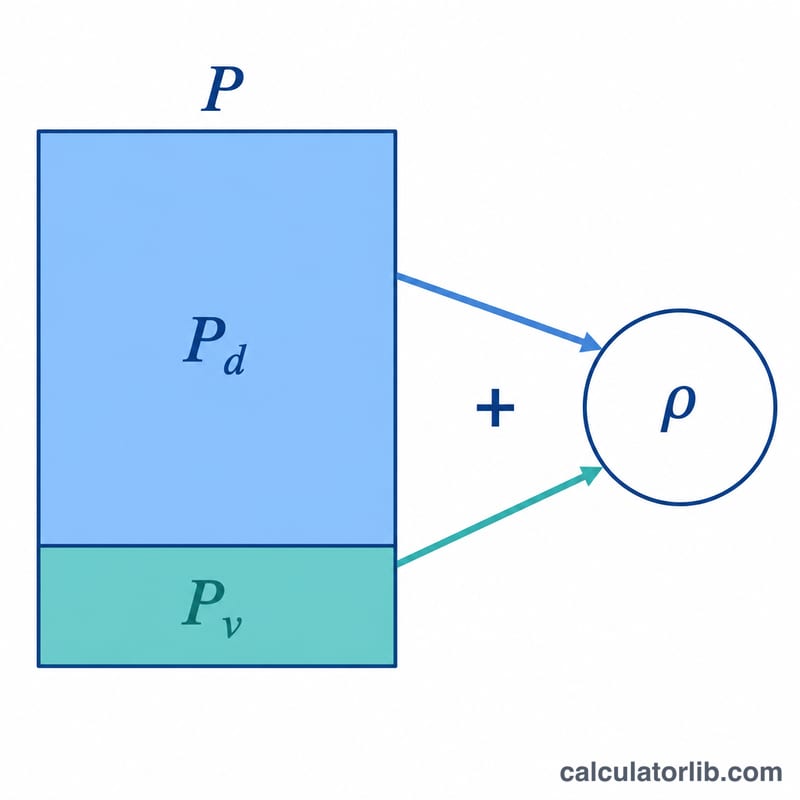
This calculator finds the density of humid air using the specific gas constant method. Instead of treating air as a single gas, it splits the total pressure into a dry-air partial pressure and a water-vapor partial pressure, then sums the contribution of each to the overall density. This gives a more accurate result than the simple dry-air formula, especially in warm, moist conditions.
How to use it
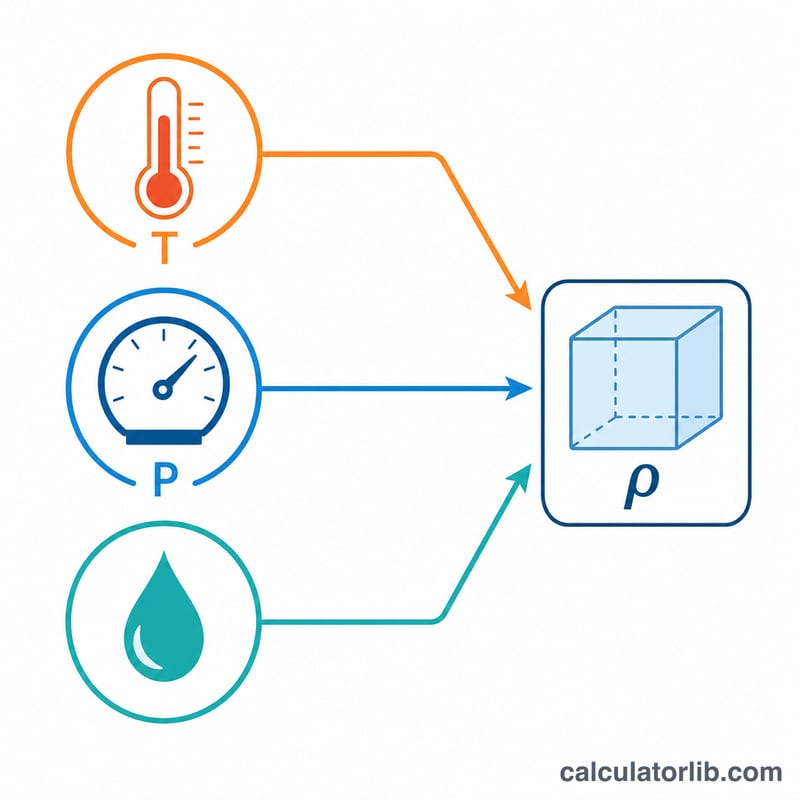
Enter the air temperature in degrees Celsius, the local barometric pressure in hectopascals (hPa, equal to millibars), and the relative humidity as a percentage. The calculator returns the air density in kilograms per cubic meter along with the absolute temperature, the vapor partial pressure, and the dry-air partial pressure.
The formula explained
Air density is $$\rho = \frac{P_d}{R_d\,T} + \frac{P_v}{R_v\,T}$$ where \(R_d = 287.058\) J/(kg·K) is the specific gas constant for dry air, \(R_v = 461.495\) J/(kg·K) is the constant for water vapor, and \(T\) is temperature in kelvin (\(T = t\,°\text{C} + 273.15\)). The vapor pressure \(P_v\) comes from the saturation vapor pressure \(P_{sat}\) (computed with the Tetens equation) multiplied by the relative humidity fraction. The dry pressure \(P_d\) is the total pressure minus \(P_v\).
Worked example
At 30 °C, 1013.25 hPa and 50% humidity: \(T = 303.15\) K. \(P_{sat} = 6.1078 \times 10^{7.5\cdot30/267.3} \approx 42.43\) hPa, so \(P_v = 0.5 \times 42.43 \times 100 \approx 2121.3\) Pa. \(P_d = 101325 - 2121.3 \approx 99203.7\) Pa. Then $$\rho = \frac{99203.7}{287.058\cdot303.15} + \frac{2121.3}{461.495\cdot303.15} \approx 1.1409 + 0.01516 \approx 1.156\ \text{kg/m}^3.$$
FAQ
Why include humidity? Water vapor is less dense than dry air, so humid air is slightly lighter than dry air at the same temperature and pressure.
What units does pressure use? Enter pressure in hPa (hectopascals); 1 hPa = 1 mbar = 100 Pa. Standard sea-level pressure is 1013.25 hPa.
Which saturation formula is used? The Tetens equation, a widely used approximation accurate to within a fraction of a percent over normal atmospheric temperatures.