
What is a Unix Timestamp?
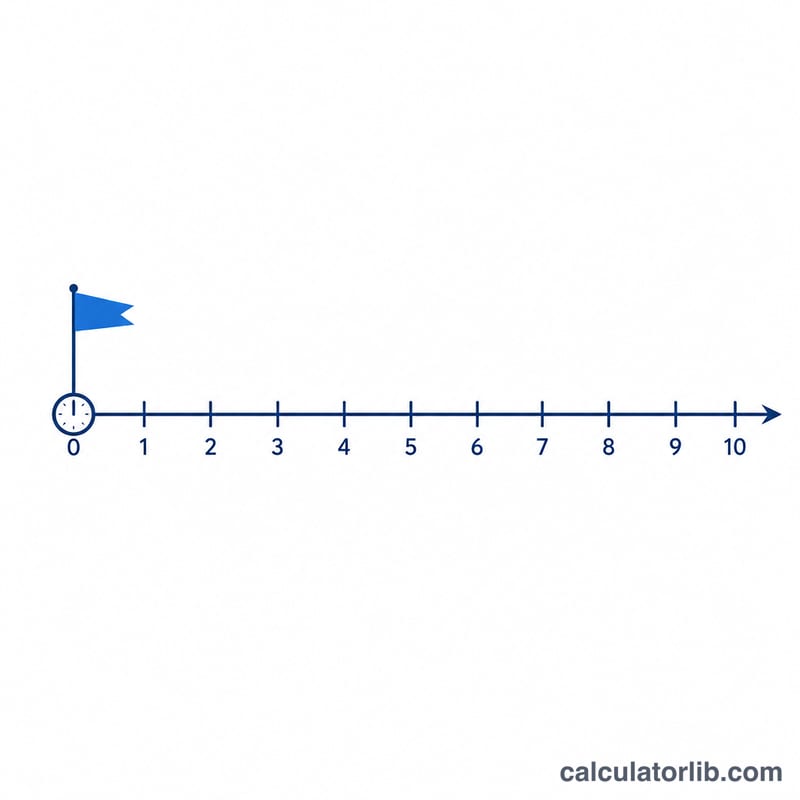
A Unix timestamp (also called epoch time or POSIX time) is the number of seconds that have elapsed since 00:00:00 UTC on 1 January 1970, not counting leap seconds. It is the universal way computers store a moment in time, independent of time zones and calendar formatting. This calculator takes a timestamp in milliseconds (the unit returned by most programming languages, e.g. JavaScript's Date.now()) and converts it to seconds, minutes and days since the epoch.
How to Use It
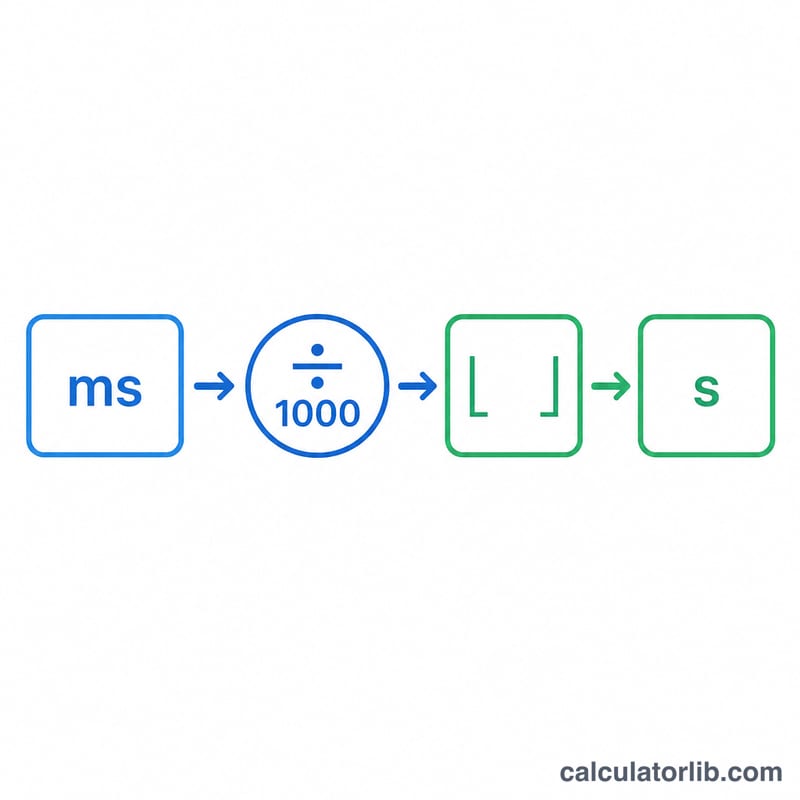
Enter your Unix time in milliseconds into the field and submit. The tool floor-divides by 1000 to give whole Unix seconds — the most common form used by databases, APIs and Linux's date +%s. The result table also shows the original millisecond value plus elapsed minutes and days for quick sanity checks.
The Formula Explained
The core conversion is $$\text{Seconds} = \left\lfloor \frac{\text{Time (ms)}}{1000} \right\rfloor$$ Dividing by 1000 converts milliseconds to seconds, and the floor removes the fractional part so you get a whole-second timestamp. Minutes use \(\left\lfloor \frac{M}{60000} \right\rfloor\) and days use \(\left\lfloor \frac{M}{86400000} \right\rfloor\), since one day has 86,400 seconds = 86,400,000 ms.
Worked Example
Suppose \(M = 1{,}700{,}000{,}000{,}000\). Then $$\text{Seconds} = \left\lfloor \frac{1{,}700{,}000{,}000{,}000}{1000} \right\rfloor = 1{,}700{,}000{,}000 \text{ seconds}$$ which corresponds to 14 November 2023. Minutes since epoch = \(\left\lfloor \frac{1{,}700{,}000{,}000{,}000}{60000} \right\rfloor = 28{,}333{,}333\), and days = \(\left\lfloor \frac{1{,}700{,}000{,}000{,}000}{86{,}400{,}000} \right\rfloor = 19{,}675\).
FAQ
Why seconds and not milliseconds everywhere? Older systems and many APIs (Unix, Postgres, JWT exp claims) store seconds, while browsers and Java use milliseconds. Converting between them is just multiplying or dividing by 1000.
What about leap seconds? Unix time ignores leap seconds, so the count is a clean linear measure — convenient for arithmetic but not perfectly aligned with astronomical UTC.
Will this break in 2038? Systems storing the second count in a signed 32-bit integer overflow on 19 January 2038. Modern 64-bit systems are unaffected.