
What this calculator does (Florida / United States)
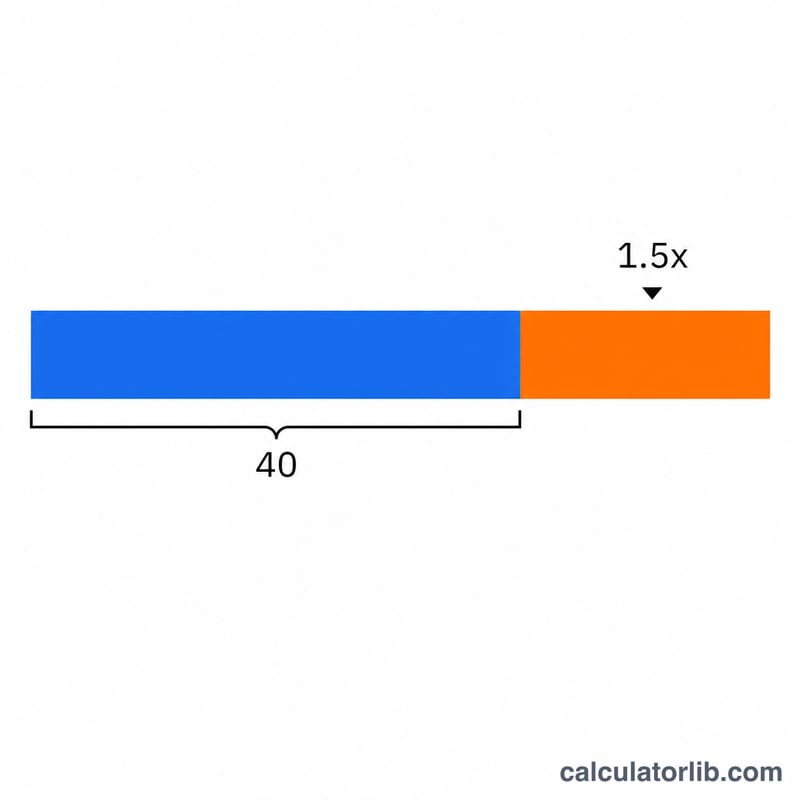
This tool estimates your gross weekly pay in Florida, including overtime. Florida does not have its own overtime statute, so it follows the federal Fair Labor Standards Act (FLSA): non-exempt employees must be paid at least 1.5× their regular hourly rate for all hours worked over 40 in a single workweek. There is no daily overtime rule in Florida — overtime is based purely on the weekly total over 40 hours. This estimate is for general guidance only and does not account for taxes, exemptions, or special pay arrangements.
How to use it
Enter your regular hourly rate and the total number of hours you worked in the week. The calculator automatically splits your hours into regular (up to 40) and overtime (everything above 40), applies the 1.5× multiplier to the overtime portion, and sums them into your total gross weekly pay.
The formula explained
Regular pay = the lesser of your hours or 40, multiplied by your rate. Overtime pay = any hours above 40, multiplied by 1.5 times your rate. Total pay is the sum of both. If you work 40 hours or fewer, there is no overtime and the formula reduces to hours × rate.
$$\text{Pay} = (\min(H,40) \times R) + (\max(H-40,0) \times 1.5 \times R)$$
$$R_{OT} = 1.5 \times R$$
Worked example
Suppose you earn $20.00/hour and work 50 hours in a week. Regular pay = \(40 \times \$20 = \$800\). Overtime hours = \(50 - 40 = 10\), paid at $30/hour (\(1.5 \times \$20\)) = $300. Total weekly gross pay = \(\$800 + \$300 =\) $1,100.
$$\text{Pay} = (40 \times \$20) + (10 \times 1.5 \times \$20) = \$800 + \$300 = \$1{,}100$$

Income and jobs: United States
Average income and unemployment in United States compared with the world, from the World Bank: a benchmark for the figures you enter above.
- GNI per capita 2025
- 88,810 USD
- GDP per capita, PPP 2025
- 90,027 intl. $
- World: 25,704
- Unemployment 2025
- 4.2%
- World: 4.8%
Latest change Up +7.1% 2025: 88,810 USD, against 82,910 USD in 2024. CalculatorLib computes this change from the two published figures.
In 2025, gross national income per person in United States was 88,810 US dollars a year, about 7,401 US dollars a month. World: 14,244 USD
| Year | GNI per capita (USD) | GDP per capita, PPP (intl. $) | Unemployment |
|---|---|---|---|
| 2025 | 88,810 | 90,027 | 4.2% |
| 2024 | 82,910 | 86,170 | 4.0% |
| 2023 | 79,950 | 82,587 | 3.6% |
| 2022 | 77,230 | 78,009 | 3.7% |
| 2021 | 71,510 | 71,441 | 5.3% |
| 2020 | 64,630 | 64,465 | 8.1% |
| 2019 | 65,840 | 65,228 | 3.7% |
| 2018 | 63,040 | 62,876 | 3.9% |
| 2017 | 58,860 | 60,048 | 4.4% |
| 2016 | 56,830 | 57,977 | 4.9% |
GNI per capita (Atlas method) is the average of all income in the economy, not a typical salary; PPP dollars adjust for local prices.
Income tax and social security: United States
- Top income tax rate 2025
- 43.65%
- from 8.7 × the average wage
- Employee social security 2025
- 7.65% · 1.45%
In 2025, the top statutory personal income tax rate in United States (central and local government combined) was 43.65%. It applies from 8.7 times the average wage of 73,520 USD, that is from about 642,101 USD a year.
Employee social security contribution rates for successive earnings bands, lowest band first; the band limits are not shown.
Top income tax rates in OECD countries
| Country | Top rate | Applies from (× average wage) | Year |
|---|---|---|---|
| Japan | 55.95% | 7.7 | 2025 |
| France | 55.37% | 12.9 | 2025 |
| South Korea | 49.5% | 19.0 | 2025 |
| Germany | 47.48% | 4.4 | 2025 |
| United Kingdom | 45% | 2.2 | 2025 |
| United States | 43.65% | 8.7 | 2025 |
| Türkiye | 40.76% | 5.6 | 2025 |
| Mexico | 35% | 20.6 | 2025 |
The top rate is the statutory rate on the highest earnings, not the rate most workers pay. OECD figures cover OECD member countries only.
United States and other countries
GNI per capita in current US dollars (Atlas method) — each country’s latest published year.
- United States 88,810 USD (2025)
- France 48,630 USD (2025)
- Japan 38,340 USD (2025)
- South Korea 37,880 USD (2025)
- Saudi Arabia 36,070 USD (2025)
- Türkiye 16,300 USD (2025)
- Russia 15,960 USD (2025)
- World 14,244 USD (2025)
- China 14,230 USD (2025)
- Mexico 13,730 USD (2025)
- Vietnam 4,970 USD (2025)
- India 2,760 USD (2025)
No published figure yet for Taiwan.
Years can differ between rows: each figure is shown with its own year. The same World Bank indicator for every country.
Latest figure: 2025 Data last updated 2026-10-18 · current
Source: The World Bank Group CC BY 4.0; OECD, Tax Database CC BY 4.0
Monthly figures are computed by CalculatorLib from these data. The top-rate threshold in national currency (multiple × average wage) is computed by CalculatorLib from these data.
Source details and methodology
- The World Bank Group — World Development Indicators (NY.GNP.PCAP.CD, NY.GDP.PCAP.PP.CD, SL.UEM.TOTL.ZS)
- OECD, Tax Database — Top statutory personal income tax rate; employee social security contribution rates
FAQ
Does Florida have daily overtime? No. Florida follows the FLSA, which only requires overtime after 40 hours in a workweek, not after 8 hours in a day.
Who qualifies for overtime? Non-exempt employees. Certain salaried executive, administrative, and professional employees may be exempt under the FLSA.
Is this my take-home pay? No — this is gross pay before federal income tax, Social Security, Medicare, and any other deductions.