
What This Calculator Does
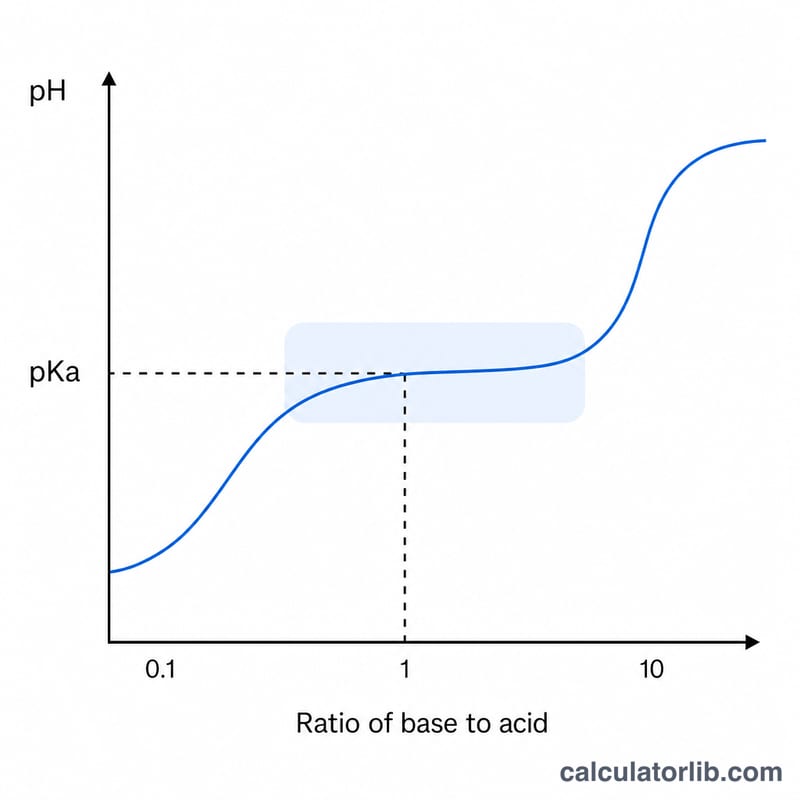
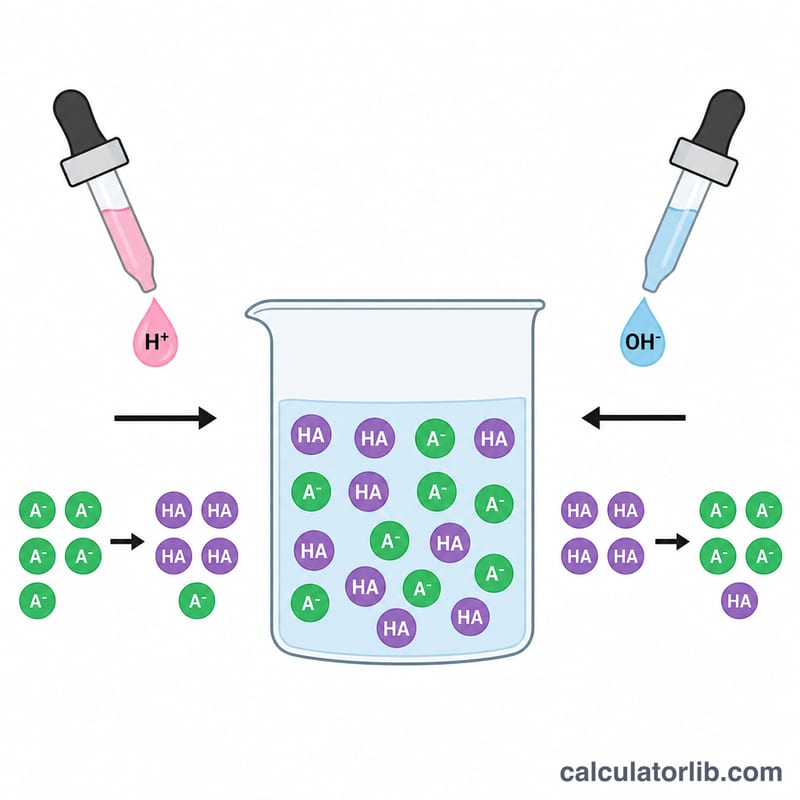
This tool predicts how the pH of a buffer solution changes when you add a strong acid or a strong base. A buffer resists pH change because it contains a weak acid (HA) and its conjugate base (A⁻) in comparable amounts. Adding strong acid or base shifts the ratio of these two species, and the new pH is found with the Henderson-Hasselbalch equation. This is a universal chemistry tool and applies anywhere.
How to Use It
Enter the buffer pKa, the moles of conjugate base (A⁻) and weak acid (HA) present before the addition, then choose whether you are adding strong acid (H⁺) or strong base (OH⁻) and how many moles. The calculator applies the stoichiometric shift and returns the new pH and pOH. Because the ratio of moles is used, you may also enter concentrations or millimoles as long as both components share the same units.
The Formula Explained
Strong acid reacts with the conjugate base: A⁻ + H⁺ → HA, so the base decreases and the acid increases. Strong base reacts with the weak acid: HA + OH⁻ → A⁻ + H₂O, so the acid decreases and the base increases. The new pH is then:
$$\text{pH} = \text{p}K_a + \log_{10}\!\left(\frac{\text{n}_{A^-} - \text{n}_{added}}{\text{n}_{HA} + \text{n}_{added}}\right)$$
This assumes the strong reagent is fully consumed and that neither buffer component runs out. If one component is depleted, the buffer capacity is exceeded and the result is no longer reliable.
Worked Example
A buffer has pKa 4.74 with 0.10 mol HA and 0.10 mol A⁻. Add 0.02 mol strong acid. The acid becomes 0.12 mol and the base becomes 0.08 mol. $$\text{pH} = 4.74 + \log_{10}\!\left(\frac{0.08}{0.12}\right) = 4.74 + \log_{10}(0.6667) = 4.74 - 0.176 = 4.564.$$
FAQ
Why does pH barely change? The log of a ratio changes slowly, which is exactly why buffers stabilize pH near the pKa.
What if I add too much strong acid? If the added moles meet or exceed a buffer component, that component is consumed, the buffer breaks, and the calculator flags a warning — the solution then behaves like a strong acid or base.
Does volume matter? No — because the equation uses a mole ratio, the shared dilution volume cancels out.