
What Is the Hall Coefficient?
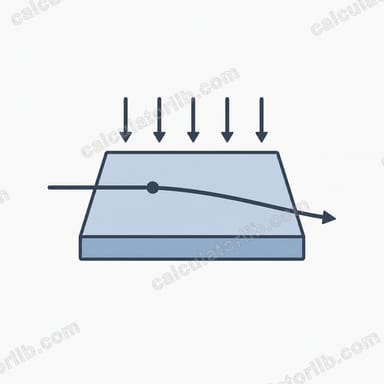
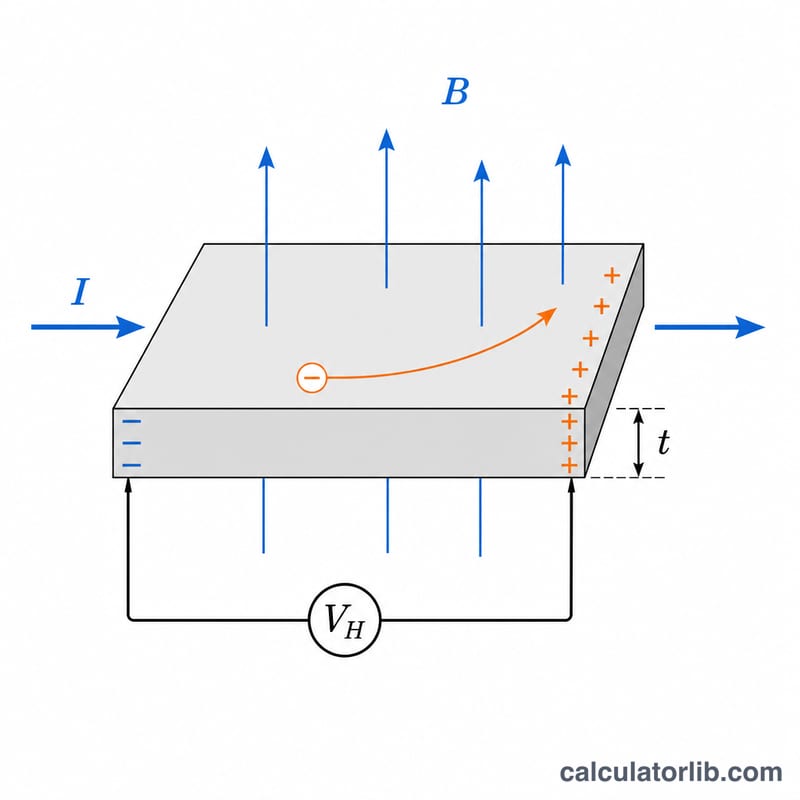
The Hall coefficient (\(R_H\)) describes how a current-carrying conductor or semiconductor responds when placed in a perpendicular magnetic field. The moving charge carriers are deflected sideways, building up a measurable transverse voltage called the Hall voltage. The Hall coefficient relates this voltage to the experimental parameters and reveals both the sign and density of the charge carriers — a positive \(R_H\) indicates hole conduction, a negative value indicates electron conduction.
How to Use This Calculator
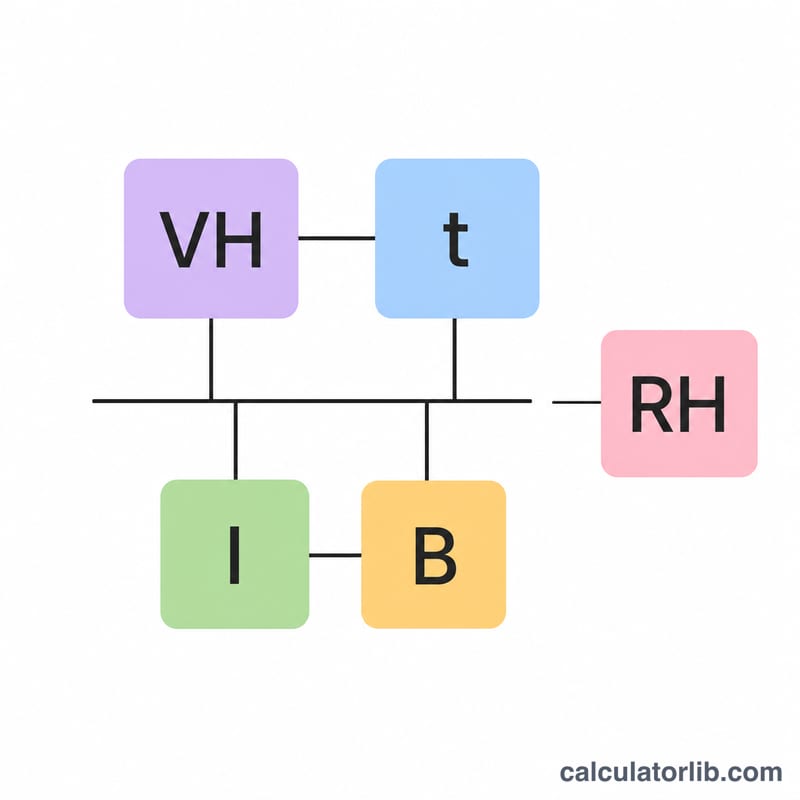
Enter four measured quantities in SI units: the Hall voltage \(V_H\) in volts, the sample thickness \(t\) in metres (the dimension parallel to the magnetic field), the current \(I\) in amperes, and the magnetic flux density \(B\) in teslas. The calculator returns \(R_H\) in cubic metres per coulomb (m³/C). Make sure every value uses base SI units so the result is dimensionally correct.
The Formula Explained
The governing equation is:
$$R_H = \frac{\text{Hall Voltage } V_H \cdot \text{Thickness } t}{\text{Current } I \cdot \text{Field } B}$$
Here \(V_H \cdot t\) scales the measured voltage by the sample thickness, while the product \(I \cdot B\) in the denominator accounts for the driving current and the applied field. The carrier density \(n\) can then be found from \(n = 1 / (R_H \cdot q)\), where \(q\) is the elementary charge.
Worked Example
Suppose \(V_H = 1\times10^{-4}\) V, \(t = 1\times10^{-3}\) m, \(I = 0.01\) A and \(B = 0.5\) T. Then $$R_H = \frac{1\times10^{-4} \times 1\times10^{-3}}{0.01 \times 0.5} = \frac{1\times10^{-7}}{0.005} = 2\times10^{-5} \text{ m}^3/\text{C}.$$ This positive value would indicate p-type (hole) conduction.
FAQ
What units should I use? Use SI base units (volts, metres, amperes, teslas) so \(R_H\) comes out in m³/C.
Why is the thickness, not the width, used? Thickness is the dimension along the magnetic field direction, which sets the cross-section the deflected carriers cross.
Can \(R_H\) be negative? Yes. A negative Hall coefficient means electrons (n-type) dominate conduction; positive means holes (p-type).