
What is the Coefficient of Restitution?
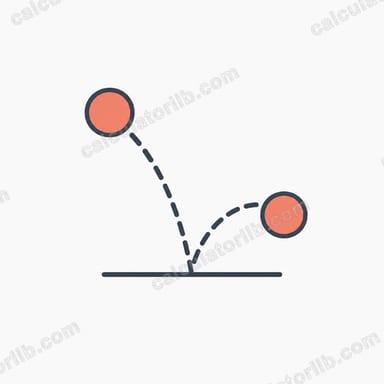
The coefficient of restitution (e) is a dimensionless number between 0 and 1 that measures how "bouncy" a collision is. It compares the relative velocity of two objects after a collision to their relative velocity before. An e of 1 describes a perfectly elastic collision where no kinetic energy is lost, while an e of 0 describes a perfectly inelastic collision where the objects move together afterward. Most real collisions fall somewhere in between.
How to Use This Calculator
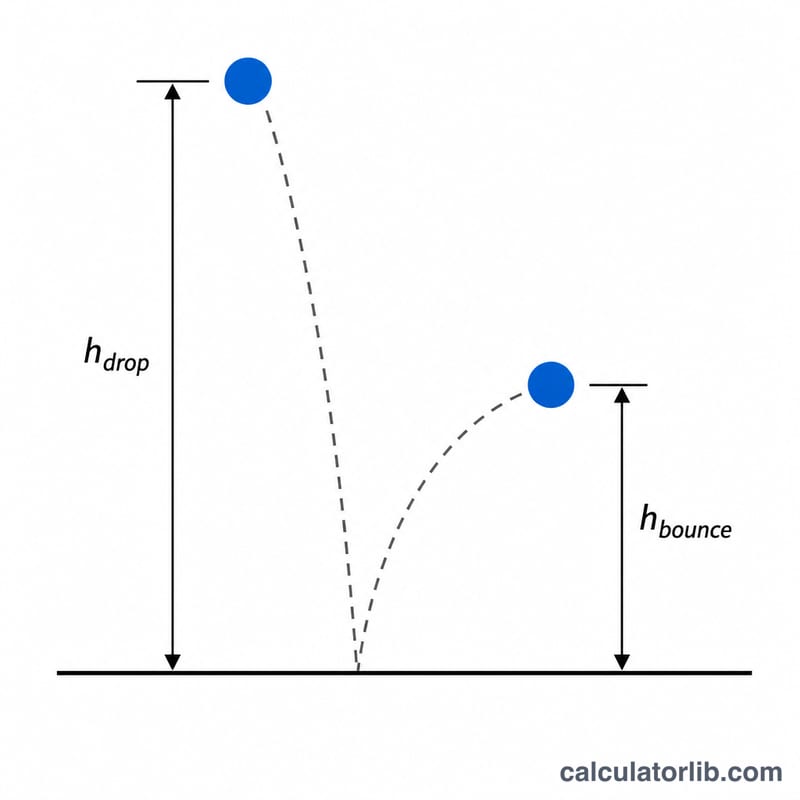
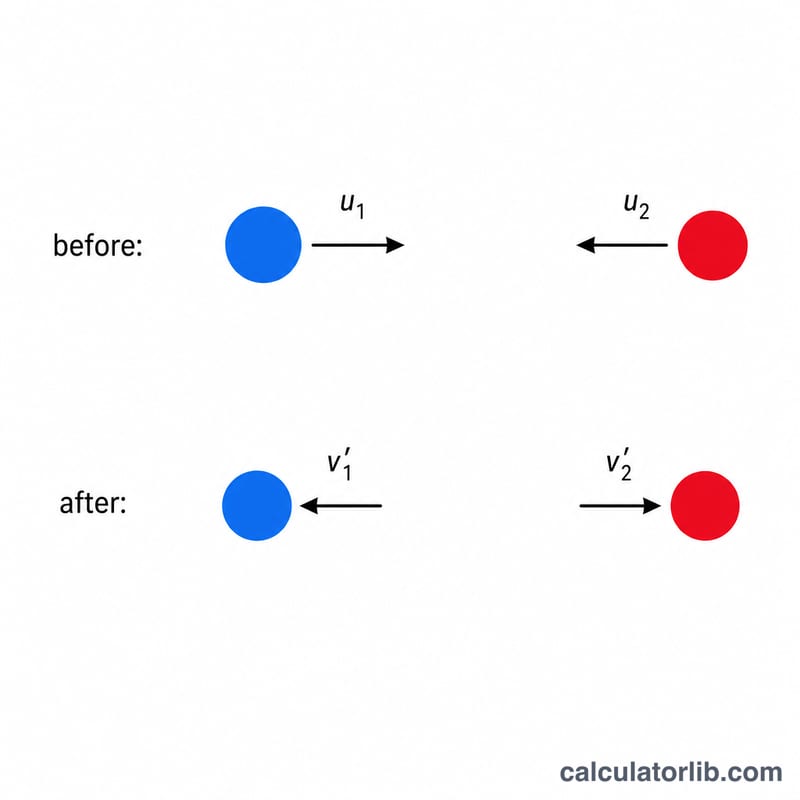
Choose a method. Use From velocities if you know the speeds of both objects before and after the collision: enter u1, u2 (before) and v1', v2' (after). Use From drop/bounce height if you bounce a single object off a fixed floor: just enter the drop height and the measured bounce height. The calculator returns e instantly.
The Formula Explained
The general definition is \(e = \dfrac{\text{v2}^{\prime} - \text{v1}^{\prime}}{\text{u1} - \text{u2}}\), the ratio of separation speed to approach speed. For a ball dropped from rest, the impact speed is \(\sqrt{2g\cdot\text{h}_{\text{drop}}}\) and the rebound speed is \(\sqrt{2g\cdot\text{h}_{\text{bounce}}}\); the g and 2 cancel, leaving the convenient form $$e = \sqrt{\dfrac{\text{h}_{\text{bounce}}}{\text{h}_{\text{drop}}}}$$
Worked Example
Drop a basketball from 1 m and it bounces back to 0.64 m. Then $$e = \sqrt{\frac{0.64}{1}} = \sqrt{0.64} = 0.8$$ So 80% of the approach speed is recovered on rebound.
FAQ
Can e be greater than 1? Not for ordinary collisions — that would mean energy was created. Values above 1 only appear in special cases like explosive or powered collisions.
Why is the height version a square root? Because height depends on the square of speed (energy \(\propto v^2\)), so the speed ratio is the square root of the height ratio.
What units should I use? e is dimensionless, so any consistent units work for velocity or height — just use the same unit for both inputs.