
What this calculator does
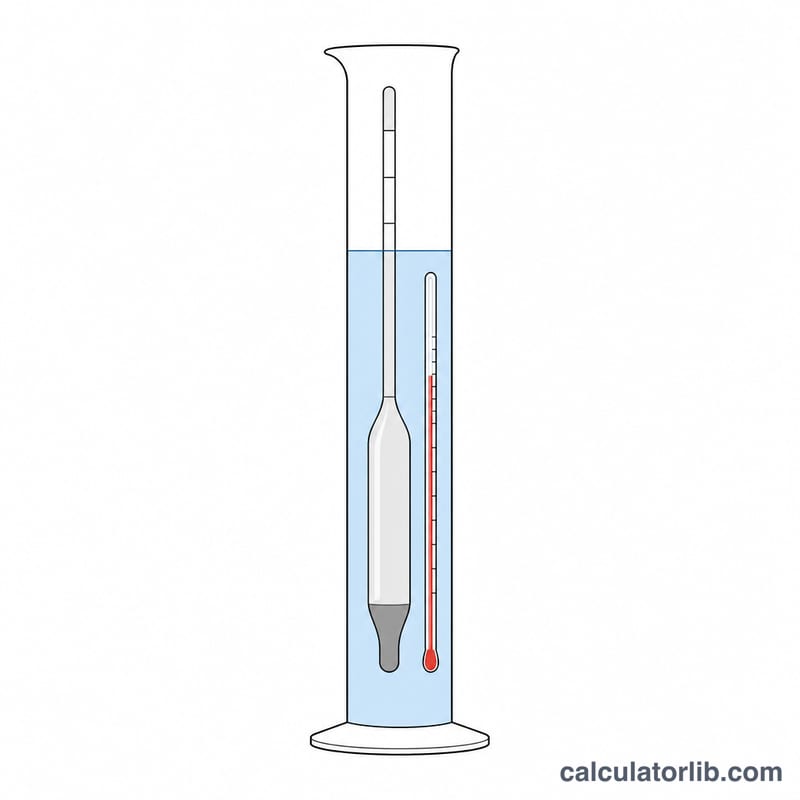
A hydrometer measures the specific gravity (SG) of a liquid by how high it floats. But hydrometers are calibrated to read correctly at one fixed temperature — commonly 20°C (68°F). If your sample is warmer or cooler than that, the liquid density changes and the reading drifts. This calculator applies a temperature correction so you get the true specific gravity at the calibration reference, which is essential for accurate brewing, winemaking, and lab measurements.
How to use it
Enter the specific gravity your hydrometer shows, the actual temperature of the sample, and the temperature your hydrometer is calibrated to (check the instrument or its instructions — usually 20°C). The tool returns the corrected SG plus the size of the adjustment applied.
The formula explained
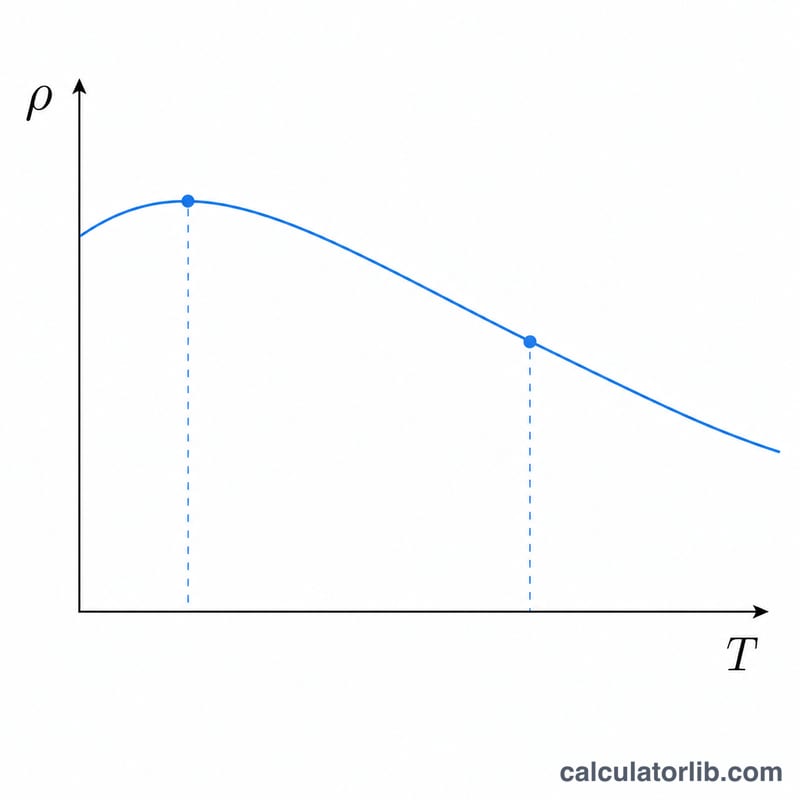
The correction multiplies your reading by the ratio of water density at the two temperatures. Density is estimated with a third-order polynomial in degrees Celsius: $$\rho(T) = 1.00130346 - 1.34722124\times 10^{-4}\,T + 2.04052596\times 10^{-6}\,T^{2} - 2.32820948\times 10^{-9}\,T^{3}$$. The corrected gravity is $$\text{SG}_{corr} = \text{SG} \cdot \frac{\rho(\text{T}_{sample})}{\rho(\text{T}_{calib})}$$ Warmer-than-calibration samples read low, so the correction nudges the value up; cooler samples get nudged down.
Worked example
Suppose a hydrometer calibrated at 20°C reads 1.050, but the wort is at 30°C. \(\rho(30) \approx 0.99847\) and \(\rho(20) \approx 0.99905\), giving a ratio of about 0.99942. The corrected SG is $$1.050 \times 0.99942 \approx 1.0494$$ — slightly lower, confirming the warm reading was inflated.
FAQ
What calibration temperature should I use? Most modern hydrometers are calibrated at 20°C; older or US instruments may use 15.6°C (60°F). Use whatever is printed on yours.
Does this work for high-gravity wort or wine? It is a close approximation. The polynomial models water density, so very high-sugar musts have a tiny extra error, but it is well within practical brewing tolerance.
Why does my correction look small? Within a few degrees of calibration the adjustment is tiny; it only matters meaningfully once the temperature gap exceeds about 5–10 degrees.