What this calculator does
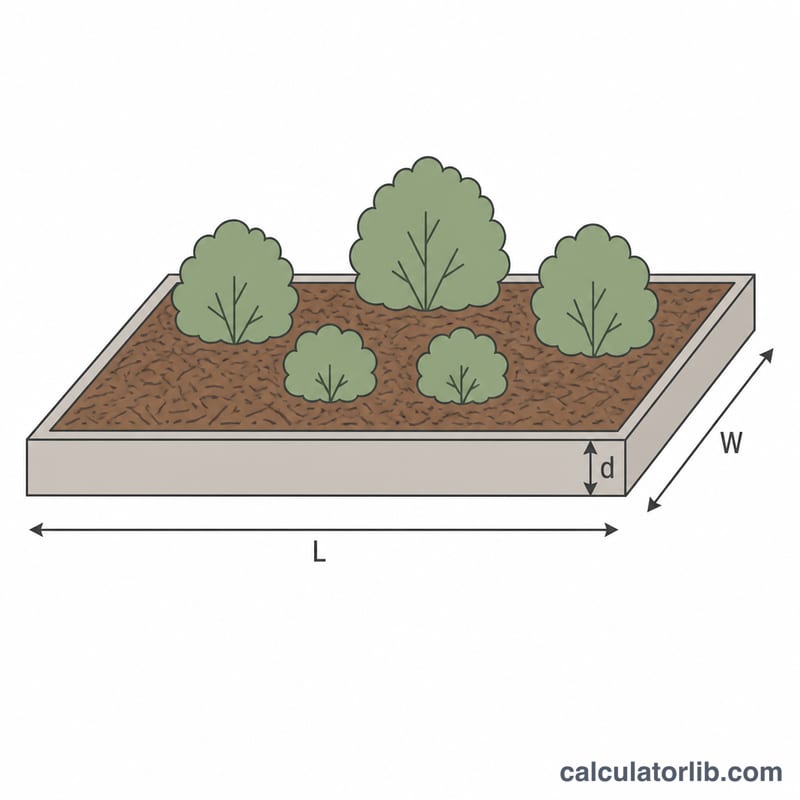
The Mulch Quantity Calculator turns three simple measurements - bed length, bed width and the depth you want to spread - into the volume of mulch you must buy. It reports the answer in cubic yards (how bulk mulch is sold from a landscape yard), in cubic feet, and as a whole number of bags, so you can compare buying loose material against bagged material. Measurements use feet and inches; depth is entered in inches because that is how spread depth is normally specified.
How to use it
Measure the bed and enter the length and width in feet. Enter the depth you want in inches - 2 to 3 inches suits annual beds and vegetable gardens, 3 to 4 inches suits shrub borders and weed suppression. Enter the volume printed on the bag you plan to buy (2 cubic feet is the most common size) and the bulk price per cubic yard if you want a cost estimate. For an L-shaped bed, split it into rectangles and add the results.
The formula explained
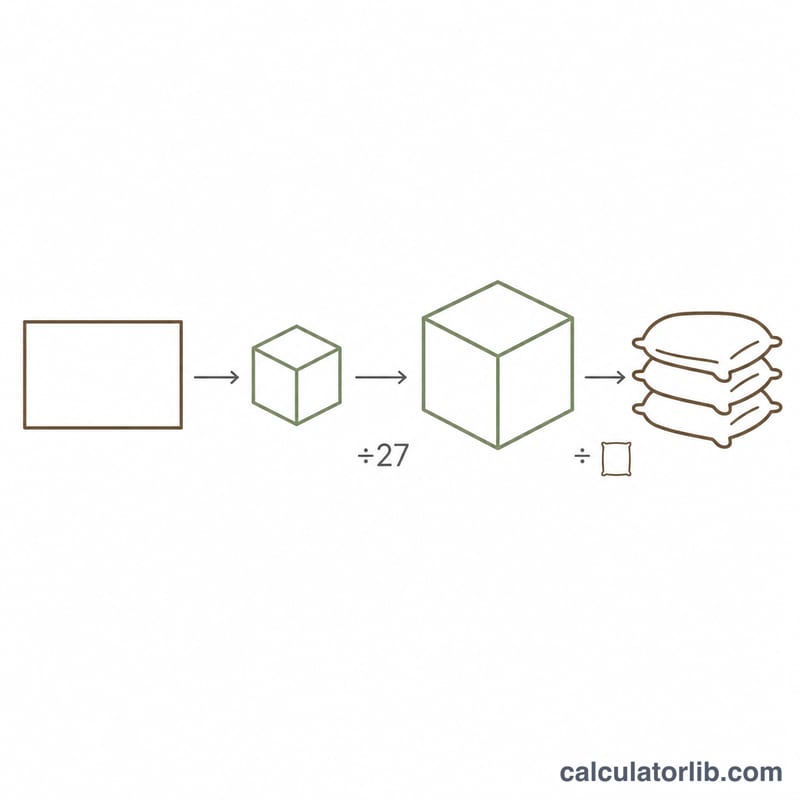
Mulch volume is just area times depth, with two unit conversions. Area is \(L \times W\) in square feet. Depth in inches becomes feet as \(D/12\). Cubic feet become cubic yards by dividing by 27, since one cubic yard is \(3 \times 3 \times 3\) feet.
$$V_{yd^3} = \frac{L \times W \times \frac{D}{12}}{27}$$Here \(L\) = bed length in feet, \(W\) = bed width in feet and \(D\) = spread depth in inches. Bags are counted as \(N = \lceil V_{ft^3} / B \rceil\), where \(B\) is the cubic feet per bag.
Worked example
A bed 20 ft long and 10 ft wide is to be covered 3 inches deep:
$$V_{ft^3} = 20 \times 10 \times \frac{3}{12} = 50\,\text{cu ft}$$$$V_{yd^3} = \frac{50}{27} = 1.85\,\text{cu yd}$$With 2 cubic foot bags that is \(50 / 2 = 25\) bags. At a bulk price of 45 per cubic yard the load costs about 83.33.
Recommended Mulch Depth by Bed Type and Mulch Material
Depth is the input that drives everything else in the calculation: at a fixed bed area, going from 2 in to 4 in exactly doubles the volume, the number of bags and the bulk cost. The depths below reflect common North American landscape and arboriculture practice (the 3–6 in trunk-clearance rule follows International Society of Arboriculture guidance); local horticultural advice may differ in your climate, and in most countries outside the US/Canada mulch is sold in litres or cubic metres rather than cubic feet and bags.
By application
| Bed type / application | Recommended depth | Notes |
|---|---|---|
| Annual flower and vegetable beds | 1–2 in | Shallow so soil warms in spring and seedlings can push through; replenish mid-season. |
| Perennial beds | 2–3 in | Keep mulch off crowns and emerging shoots to avoid rot. |
| Shrub and foundation borders | 3–4 in | Deeper layer suppresses weeds between widely spaced plants; pull back from stems. |
| Around trees (root-flare kept clear) | 2–4 in | Spread as a wide flat ring out toward the drip line — never a cone piled against the trunk. |
| Garden paths and walkways | 4–6 in | Compacts under foot traffic; the deeper layer is for footing, not plant health. |
| Slopes and banks | 2–3 in | Use coarse, interlocking material; deep loose layers wash downhill in heavy rain. |
By mulch material
| Material | Typical depth | Why |
|---|---|---|
| Fine-textured: shredded bark, finely ground wood, compost | 2–3 in | Fine particles knit together and compact, so a thick layer can shed water or stay soggy and starve roots of air. |
| Coarse: bark nuggets, wood chips, pine straw | 3–4 in | Large, loose particles settle noticeably and let water through, so they need more depth for the same weed suppression. |
| Stone, gravel and rock | 2–3 in | Dense and permanent; deeper layers add weight and cost without extra benefit. |
Two rules that override the table: keep mulch pulled back 3–6 in from tree trunks and plant stems so bark can dry, and do not let the total accumulated depth over a root zone exceed about 4 in. Before topping up an existing bed, measure what is already there and add only the difference — that difference, not the target depth, is the number to enter in the calculator.
Mulch Volume and Coverage Conversions
These conversions are exact for the US customary units used by North American mulch suppliers (cubic yards, cubic feet and 2/3 cu ft bags). Elsewhere, mulch is typically sold in litres or cubic metres; for reference, 1 cu yd ≈ 0.765 m³ and 1 cu ft ≈ 28.3 litres.
Volume equivalents
| 1 cubic yard equals | Value |
|---|---|
| Cubic feet | 27 cu ft |
| Bags of 2 cu ft | 13.5 bags |
| Bags of 3 cu ft | 9 bags |
| Bags of 4 cu ft | 6.75 bags |
Coverage per cubic yard by spread depth
Coverage area is \(27 \div (D/12)\) square feet, where \(D\) is depth in inches.
| Depth | Area covered by 1 cu yd | Area covered by one 2 cu ft bag |
|---|---|---|
| 1 in | 324 sq ft | 24 sq ft |
| 2 in | 162 sq ft | 12 sq ft |
| 3 in | 108 sq ft | 8 sq ft |
| 4 in | 81 sq ft | 6 sq ft |
Depth conversion factors (inches to feet)
| Depth in inches | Depth in feet (D ÷ 12) |
|---|---|
| 1 in | 0.0833 ft |
| 2 in | 0.1667 ft |
| 3 in | 0.2500 ft |
| 4 in | 0.3333 ft |
| 6 in | 0.5000 ft |
Area of a round bed or tree ring
Rectangular beds use \(A = L \times W\). For circles use:
$$A = \pi r^2$$A 3 ft radius ring is \(\pi \times 3^2 = 28.3\) sq ft; a 5 ft radius ring is \(\pi \times 5^2 = 78.5\) sq ft. For a ring around an existing trunk, subtract the small inner circle you leave clear. For irregular beds, split the shape into rectangles and part-circles, add the areas, then divide the total by the width you enter to get an equivalent length.
Quick field check: divide your bed area in square feet by the coverage figure for your chosen depth. A 250 sq ft bed at 3 in is \(250 \div 108 = 2.3\) cubic yards — matching the calculator to the nearest hundredth.
FAQ
How deep should mulch be? Two to three inches blocks most weed germination while letting water through. More than four inches can suffocate shallow roots and hold excess moisture against stems.
Should I order extra? Yes - add 5 to 10 percent. Mulch settles, beds are rarely perfectly rectangular, and a partly empty wheelbarrow always loses some.
How much does a cubic yard weigh? Bark and wood chips typically run 400 to 800 pounds per cubic yard dry, heavier when wet, which matters for delivery and for what your vehicle can carry.