
What This Calculator Does
This tool tells you how many bags of mulch you need to cover a rectangular garden bed at a chosen depth. Spreading mulch by guesswork usually leads to either too few bags (and a return trip to the store) or a stack of leftovers. By entering your bed's dimensions and the size of the bags you're buying, you get an exact, rounded-up bag count plus the total volume of mulch in cubic feet.
How to Use It
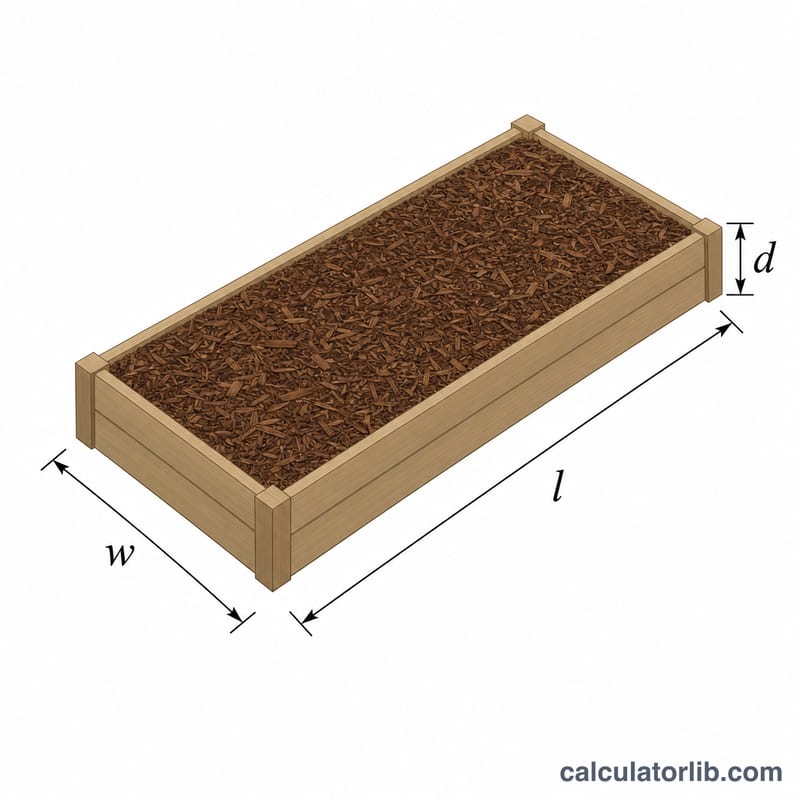
Measure the length and width of your bed in feet. Decide how deep you want the mulch — 2 to 3 inches is typical for most ornamental beds, while 3 to 4 inches helps suppress weeds. Enter the bag size printed on the product, commonly 2 cubic feet in the US. The calculator converts your inches of depth into feet, multiplies out the volume, and divides by the bag size, rounding up to the next whole bag.
The Formula Explained
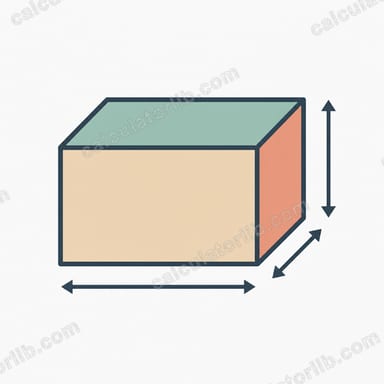
The volume of mulch needed is length \(\times\) width \(\times\) depth. Because depth is entered in inches but length and width are in feet, the depth is divided by 12 to convert it to feet. That volume (in cubic feet) is then divided by the bag size and rounded up, since you can't buy a fraction of a bag: $$\text{Bags} = \left\lceil \dfrac{\text{Length (ft)} \times \text{Width (ft)} \times \dfrac{\text{Depth (in)}}{12}}{\text{Bag Size (ft}^3)} \right\rceil$$
Worked Example
Suppose your bed is 10 ft long, 4 ft wide, and you want 3 inches of mulch using 2 cu ft bags. Depth in feet is \(3/12 = 0.25\) ft. Volume = \(10 \times 4 \times 0.25 = 10\) cubic feet. Bags = \(10 / 2 = 5\) exactly, so you need 5 bags.
FAQ
How deep should mulch be? Two to three inches is standard; deeper than four inches can suffocate plant roots.
My bag is in liters or cubic yards — what now? Convert to cubic feet first: 1 cubic yard = 27 cubic feet, and 1 cubic foot ≈ 28.3 liters.
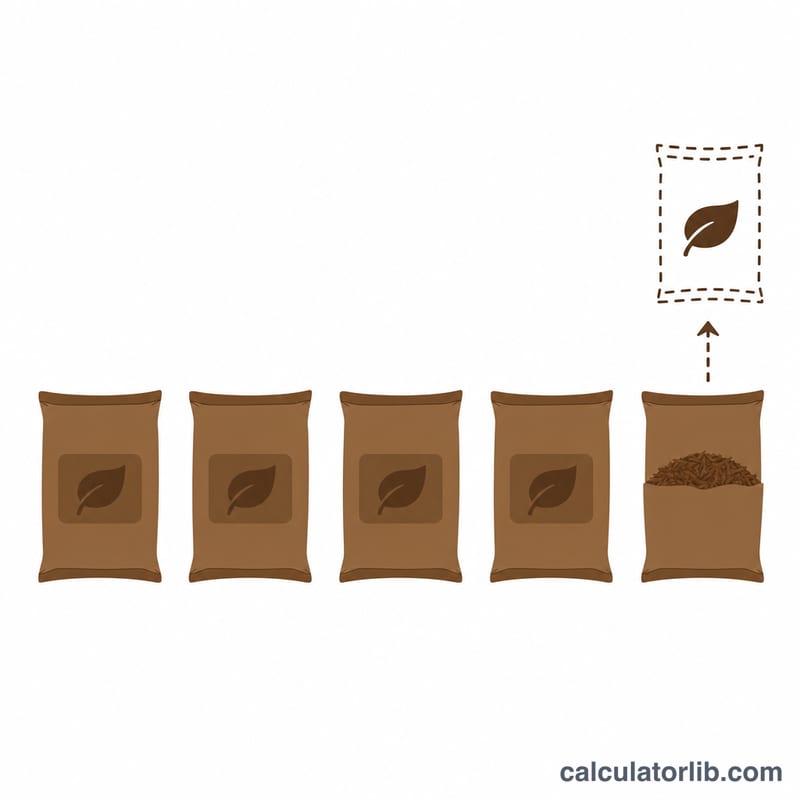
Should I round up? Yes — the calculator always rounds up so you have full coverage, with a little extra for settling and uneven spots.