
What this mulch calculator does
This tool plans a complete mulching project. Enter the bed area and the depth of mulch you want, and it returns the volume in cubic feet and cubic yards, the number of bags to buy, the bulk cubic yards to order, the estimated weight, and the total cost for both bag and bulk buying methods. Units are US customary (square feet, inches, cubic feet, cubic yards, pounds), but the underlying math is universal and metric input options are provided.
How to use it
Choose your bed area and its unit (square feet, square yards or square meters). Set the mulch depth and its unit (inches, feet or centimeters). For a brand-new installation keep the 10% settling allowance; for an annual top-up choose none. Pick your bag size (2.0 or 3.0 cubic feet are common), and optionally add a price per bag, a bulk price per cubic yard, and the mulch density so you can compare costs and estimate weight.
The formula explained
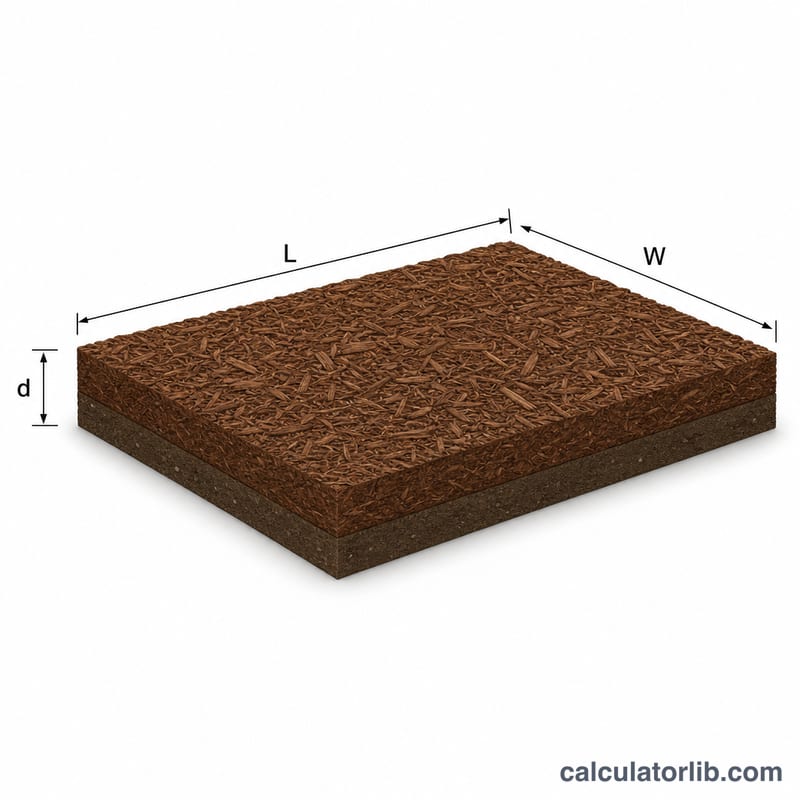
First everything is normalized: area to square feet and depth to feet (inches divide by 12). Volume in cubic feet is area times depth times the settling factor.
$$\text{Volume (ft}^3\text{)} = \text{Area (ft}^2\text{)} \times \text{Depth (ft)} \times \text{Settling}$$
Cubic yards is that divided by 27, because a cubic yard is \(3\times3\times3 = 27\) cubic feet.
$$V_{yd^3} = \frac{V_{ft^3}}{27}$$
Bags needed is the volume divided by bag size, rounded up since you cannot buy a partial bag.
$$\text{bags} = \lceil V_{ft^3} / b \rceil$$
Weight is cubic yards times density.
$$W = V_{yd^3} \times \rho$$
Bulk orders are rounded up to the nearest half yard, as many suppliers sell in 0.5-yard increments.
Worked example
For a 200 ft² bed, 3 inches deep, new install (x1.10), 2.0 cu ft bags at $4.50, bulk at $35/yd³, density 600 lb/yd³: depth = 0.25 ft, raw volume = 50 ft³, with settling = 55 ft³ = 2.04 yd³. Bags = \(\lceil 55/2.0 \rceil = 28\) bags = $126.00. Bulk rounded = 2.5 yd³ = $87.50. Weight = \(2.04 \times 600 = \) about 1,222 lb (0.61 tons). Here bulk is cheaper.
FAQ
How deep should mulch be? Most plant beds use 2-3 inches, trees and shrubs and new beds 3-4 inches, and playground fall zones 6-12 inches.
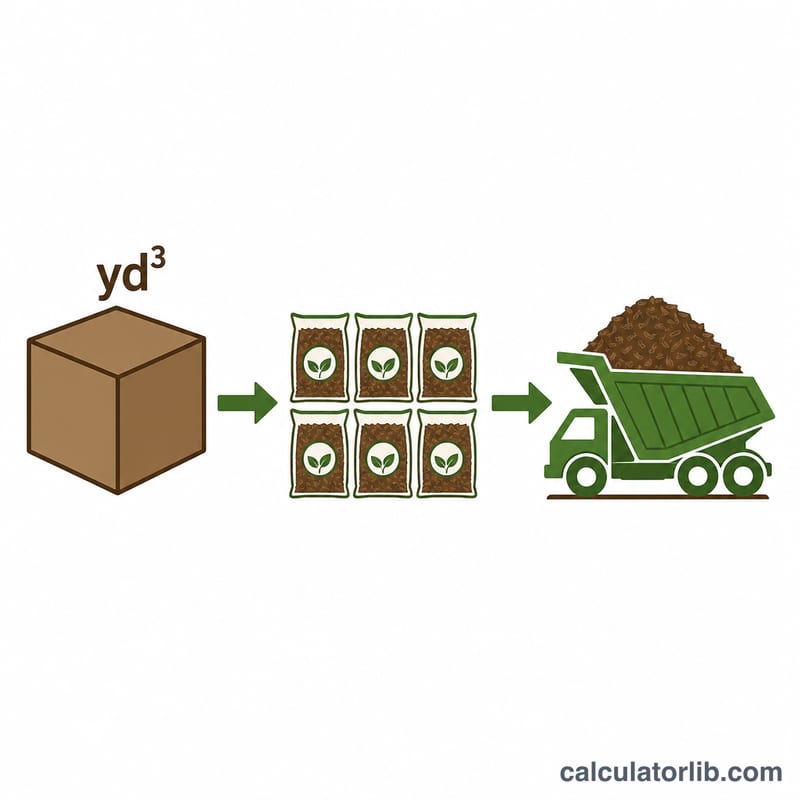
How many bags are in a cubic yard? 27 / bag size: 13.5 for 2.0 cu ft bags and 9 for 3.0 cu ft bags.
Why does the weight vary? Bulk density depends heavily on mulch type and moisture (roughly 400-900 lb/yd³). Confirm the figure with your local supplier for accurate weight.