
What This Calculator Does
Estimate exactly how much mulch you need for a garden bed, landscape area, or planting zone — in cubic feet, cubic yards, or cubic meters — plus the weight, the number of bags required, and the total cost. Pick the shape that matches your space, enter dimensions and desired mulch depth, and the calculator does the geometry for you.
The Math (It's Just Volume)
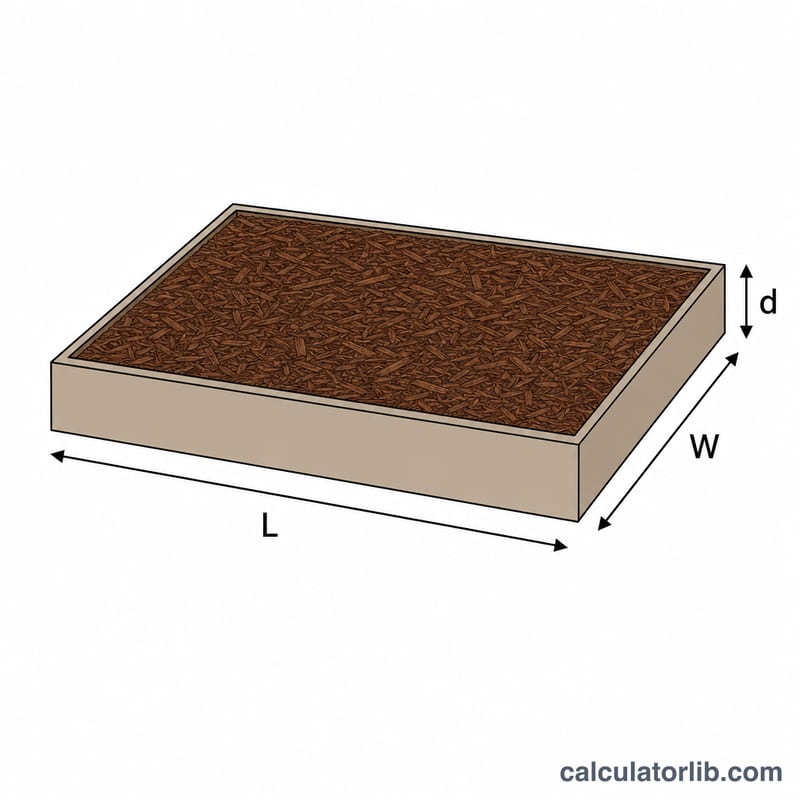
Mulch volume = surface area × depth, with both in the same units of length. Different shapes give different area formulas:
- Rectangle / Square: \( A = L \times W \)
- Circle: \( A = \pi \left( \frac{D}{2} \right)^2 \)
- Triangle: \( A = \frac{b \times h}{2} \)
- Total Area: Skip the geometry — enter square feet or square meters directly.
Once volume is known, the calculator converts to cubic feet, cubic yards (the unit landscaping suppliers usually quote), and cubic meters.
Worked Example
Rectangular bed 10 ft × 10 ft, mulch depth 3 inches:
- $$ A = 10 \times 10 = 100 \text{ sq ft} $$
- $$ \text{Depth} = 3 \text{ in} = \frac{3}{12} \text{ ft} = 0.25 \text{ ft} $$
- $$ V = 100 \times 0.25 = 25 \text{ cu ft} $$
- $$ = \frac{25}{27} = \mathbf{0.926 \text{ cubic yards}} $$
- At ~600 lbs/cu yd density, weight ~ 555 lbs
- At 2 cu ft per bag, you need 13 bags (rounded up).
Recommended Mulch Depth
The right depth depends on the mulch type and the existing soil cover:
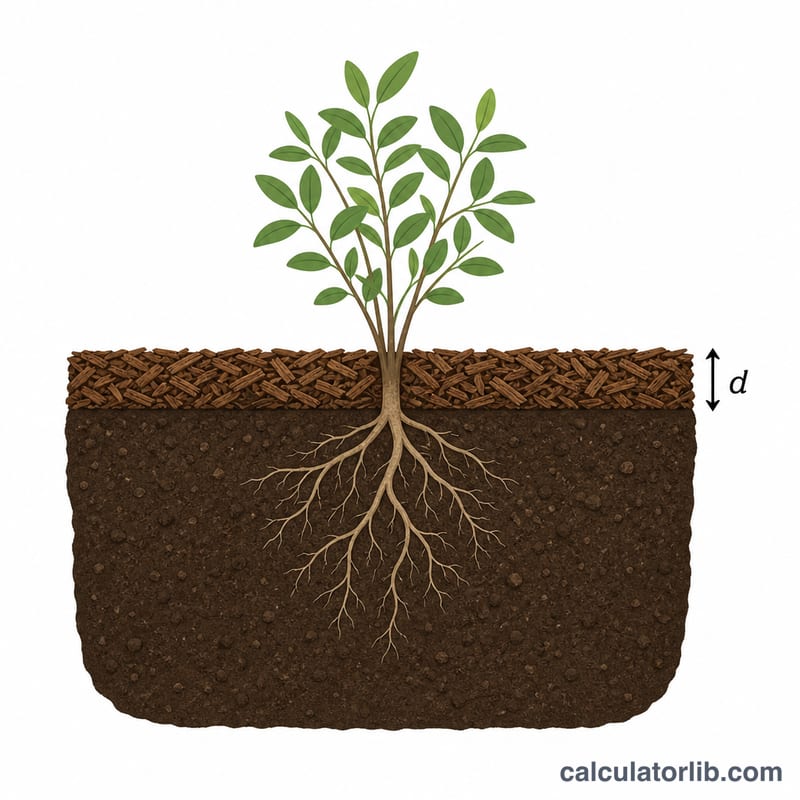
- Wood chips, bark mulch: 2–4 inches. Less and weeds break through; more and roots can suffocate.
- Pine straw, leaves: 3–6 inches (settles thinner over time).
- Stone / gravel: 1–2 inches (decorative use only — doesn't decompose).
- Refresh layer: 1–2 inches added each spring on top of partially decomposed previous layer.
Always keep mulch a few inches away from tree trunks and plant stems — "volcano mulching" against bark traps moisture and invites rot.
Bulk vs Bagged Mulch
Bulk mulch is cheaper per cubic yard but requires a truck or trailer to haul, plus muscle to move it from driveway to beds. Best for jobs over ~3 cubic yards. Bagged mulch is more convenient (typically 2 cu ft bags) and lets you stage installation room-by-room, but costs roughly 2–3× as much per cu yd. The break-even is usually around 5–7 cu yd depending on local prices.
Mulch Density & Weight
This calculator assumes a typical wood-mulch density of ~600 lbs/cu yd (~22 lbs/cu ft, ~360 kg/cu m). Actual density varies:
- Hardwood mulch: 800–1,000 lbs/cu yd (denser)
- Pine bark / softwood mulch: 400–600 lbs/cu yd
- Pine straw: very light, ~50 lbs/cu yd
- Compost / soil-mulch blends: 1,000–1,400 lbs/cu yd (much heavier)
Use the weight figure to plan your truck load, wheelbarrow trips, and back capacity.
Tips for Estimating
- Round up. A bag or two extra is much better than running short halfway through a bed.
- Account for compaction. Mulch settles 10–20% in the first month. Lay it slightly thicker than the target depth.
- Measure irregular beds in pieces. Break a curved or odd-shaped area into rectangles, circles, and triangles, total each, and sum the volumes.
- Don't oversize. Mulch over 4 inches deep can starve roots of oxygen and harbor pests.
Volume Unit Conversions for Mulch
Mulch volume is quoted in cubic feet (bagged) or cubic yards (bulk). The conversions below let you switch between units and estimate how many bags equal a bulk yard.
| From | Equals |
|---|---|
| 1 cubic yard (yd³) | 27 cubic feet (ft³) |
| 1 cubic yard (yd³) | ≈ 0.7646 cubic meters (m³) |
| 1 cubic meter (m³) | ≈ 35.31 cubic feet (ft³) |
| 1 cubic meter (m³) | ≈ 1.308 cubic yards (yd³) |
| 1 cubic foot (ft³) | ≈ 0.03704 cubic yards (yd³) |
Bag sizes and how many fill a cubic yard:
| Bag size | Bags per cubic yard |
|---|---|
| 2 cu ft | 27 ÷ 2 = 13.5 bags |
| 3 cu ft | 27 ÷ 3 = 9 bags |
So a single cubic yard replaces about 13½ of the 2 cu ft bags or 9 of the 3 cu ft bags. Since you cannot buy a half bag, round up to 14 of the smaller bags.
Coverage per Cubic Yard at Common Depths
Coverage depends entirely on how deep the mulch is spread. Because area = volume ÷ depth, the square footage covered by a fixed volume shrinks as depth increases. The figures below use 1 cubic yard (27 ft³) and one 2 cu ft bag, with depth in inches converted to feet (e.g. 3" = 0.25 ft).
| Depth | Sq ft per cubic yard (27 ft³) | Sq ft per 2 cu ft bag |
|---|---|---|
| 1" (0.0833 ft) | ≈ 324 ft² | ≈ 24 ft² |
| 2" (0.1667 ft) | ≈ 162 ft² | ≈ 12 ft² |
| 3" (0.25 ft) | ≈ 108 ft² | ≈ 8 ft² |
| 4" (0.3333 ft) | ≈ 81 ft² | ≈ 6 ft² |
A 3-inch depth is the most common recommendation for landscape beds, giving roughly 108 ft² per cubic yard. To find coverage at any depth, divide the volume in cubic feet by the depth in feet.
How Much to Order
Use these practical rules once the calculator gives you a base volume:
- Add about 10% extra. Mulch settles, beds are rarely perfectly flat, and edges are uneven, so an extra 10% prevents a second trip. For thicker first-time applications or sloped ground, consider 15%.
- Round up to whole units. Mulch is sold by the bag or by fixed bulk increments. Always round up — buying 13.5 bags is not possible, so order 14; for bulk, round up to the nearest delivery increment (often ½ or 1 cubic yard).
- Compare bags vs. bulk. Bags are convenient for small jobs and easy to handle, but bulk mulch is usually cheaper per cubic foot. Once you need roughly 3 cubic yards or more (about 40 of the 2 cu ft bags), bulk delivery typically saves money and labor — factor in any delivery fee when comparing.
- Check refresh depth. When topping up existing beds, you usually only need to bring the layer back to 2–3 inches, so measure the remaining mulch and order for the difference rather than a full depth.
This is general guidance for planning purposes; confirm exact pricing, bag sizes, and delivery increments with your supplier before ordering.