
What this calculator does
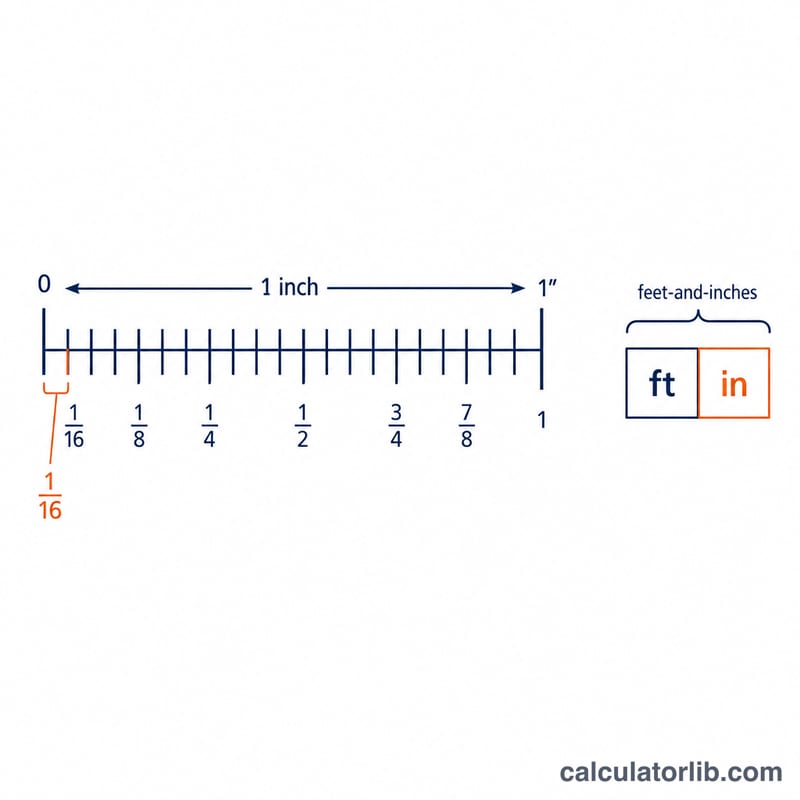
This tool converts a length in centimeters (cm) to inches (in). It gives you two things at once: the precise decimal value and a practical fractional reading rounded to the nearest 1/8, 1/16, 1/2 or any denominator you choose. When the result is 12 inches or more, it also splits the answer into feet and inches, the way a tape measure reads.
The formula
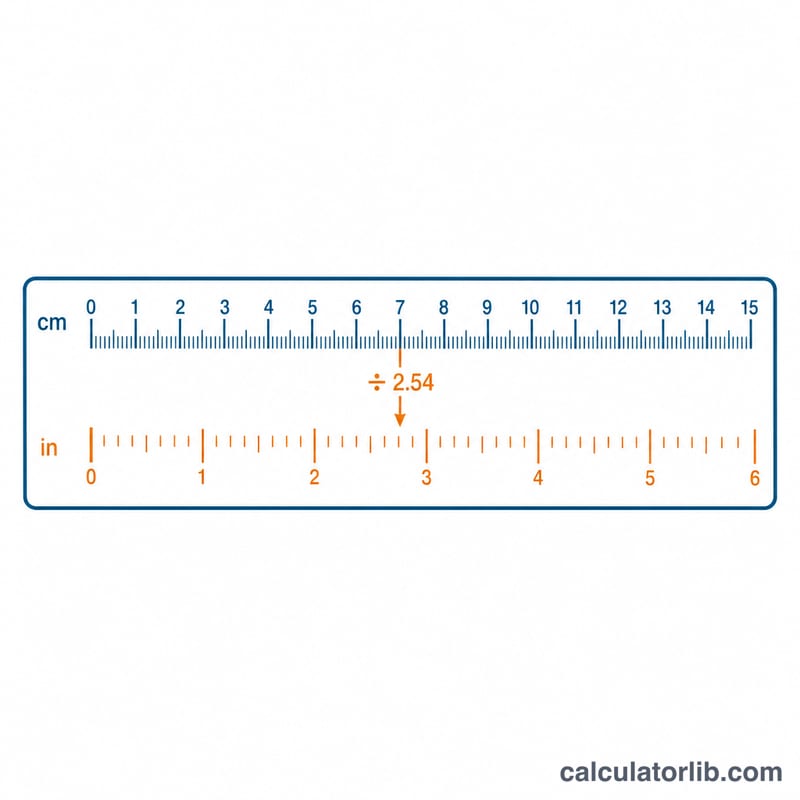
The conversion is exact. Since 1959 the inch has been defined internationally as exactly 2.54 centimeters, so:
$$\text{inches} = \dfrac{\text{cm}}{2.54}$$
To produce a fraction, take the part after the decimal point, multiply it by your chosen denominator n, round to the nearest whole number to get the numerator, then reduce the numerator/denominator by their greatest common divisor. For example \(4/8\) becomes \(1/2\) and \(12/16\) becomes \(3/4\).
How to use it
Enter the number of centimeters and pick the fraction precision (the "1/n" value). A value of 8 rounds to the nearest eighth of an inch; 16 rounds to the nearest sixteenth. Press calculate to see the decimal inches, the approximate fraction, and (for longer lengths) the feet-and-inches form.
Worked example
Convert 18 cm to the nearest 1/8 inch. First, \(18 / 2.54 = 7.086614\) inches. The whole part is 7 and the fractional part is 0.086614. Multiply by 8: \(0.086614 \times 8 = 0.6929\), which rounds to 1. So the numerator is 1 and the fraction is \(1/8\). The answer is 7 1/8 in.
FAQ
Is 2.54 an approximation? No. One inch equals exactly 2.54 cm by international definition, so the decimal result is exact apart from display rounding.
Why does my fraction look different from a simple n/denominator? The fraction is reduced to lowest terms, so \(6/8\) is shown as \(3/4\).
Can I enter negative values? Yes. The sign is carried through to both the decimal and the fractional output.