What this calculator does
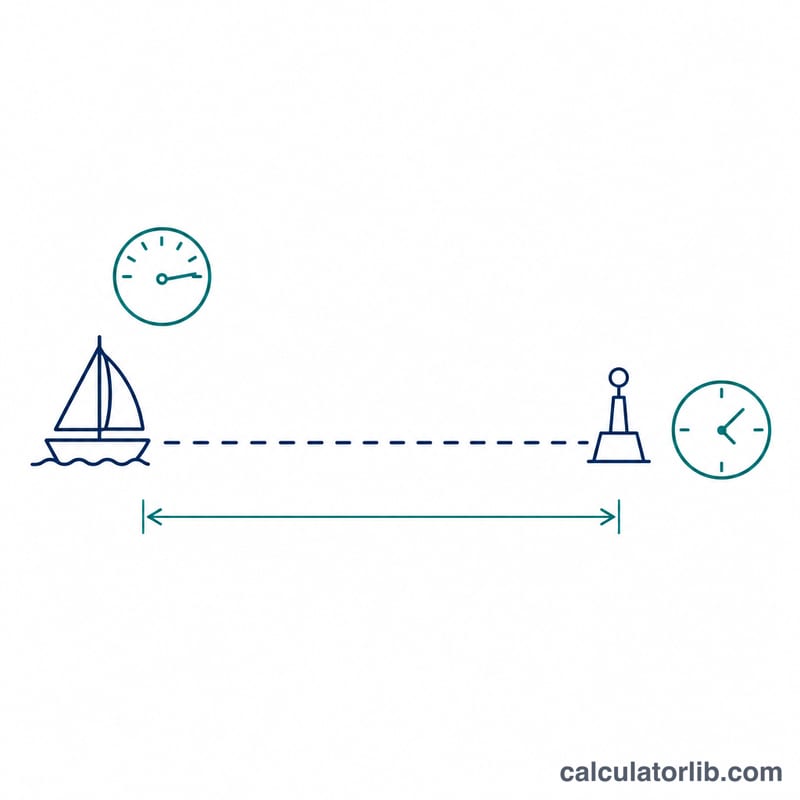
The Nautical Mile Travel Time Calculator turns a passage distance and a planned boat speed into an estimated time under way. Because one knot is defined as exactly one nautical mile per hour, marine speed and distance units cancel cleanly and the arithmetic stays simple. The tool works for any vessel anywhere in the world — sailing yacht, motor cruiser, ferry or cargo ship — since nautical miles and knots are international units.
How to use it
Enter the rhumb-line or route distance in nautical miles (read it off your chart plotter or measured route) and the speed you realistically expect to make good in knots. The result shows the total decimal hours plus a days / hours / minutes breakdown, and converts the distance and speed to kilometres and km/h for shore-side planning.
The formula explained
Passage time is the classic rate equation, with \(d\) = distance in nautical miles and \(v\) = speed over ground in knots:
$$t = \frac{d}{v}$$The decimal hours are then split for a watch schedule using total minutes \(m = 60t\):
$$D = \left\lfloor \frac{m}{1440} \right\rfloor,\qquad H = \left\lfloor \frac{m \bmod 1440}{60} \right\rfloor,\qquad M = m \bmod 60$$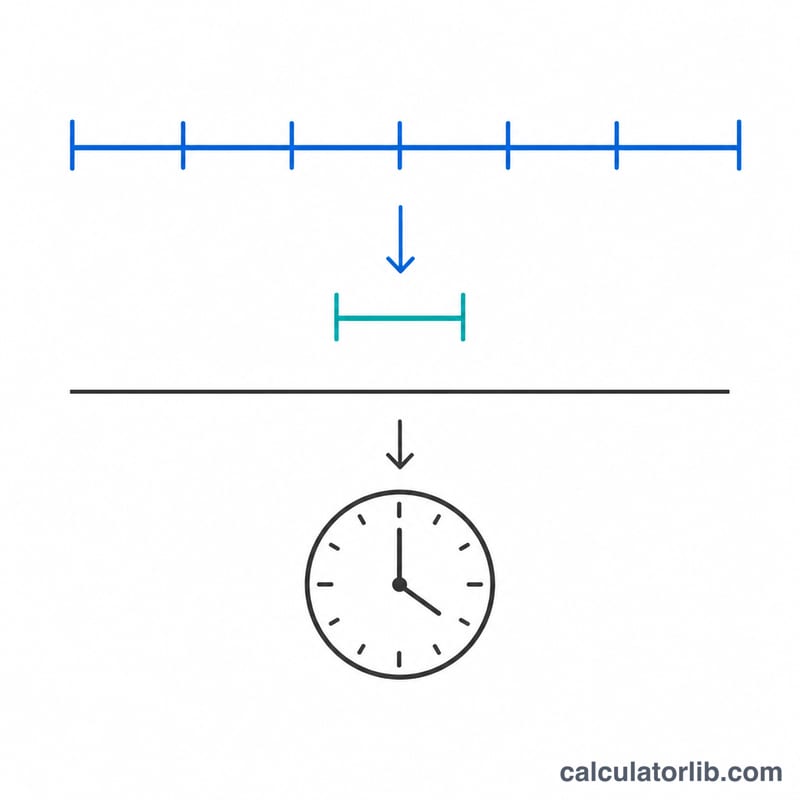
Worked example
You plan a 1,000 NM offshore leg at an average speed over ground of 18 knots:
$$t = \frac{1000}{18} = 55.56\,\text{hours}$$That is \(55.56 \times 60 = 3333\) minutes, which splits into 2 days, 7 hours and 33 minutes of continuous steaming — before any allowance for weather routing, current or a fuel stop.
Nautical Mile and Knot Conversion Table
The nautical mile is an international unit: since 1929 it has been defined as exactly 1,852 metres, a value used by the BIPM, the IHO and the IMO worldwide. The statute mile and mile per hour used in the right-hand columns are US/UK customary units and are not used in navigation practice; they appear here only for conversion.
| Quantity | Exact / defined value |
|---|---|
| 1 nautical mile (NM) | 1,852 m exactly = 1.852 km |
| 1 NM in statute miles | ≈ 1.15078 statute miles (1,852 ÷ 1,609.344) |
| 1 NM in UK admiralty (sea) miles | ≈ 0.99936 admiralty mile (the old British 6,080 ft = 1,853.184 m unit, obsolete since 1970) |
| 1 NM in feet | ≈ 6,076.12 ft |
| 1 knot (kn) | 1 NM per hour = 1.852 km/h exactly |
| 1 knot in mph | ≈ 1.15078 mph |
| 1 knot in m/s | ≈ 0.514444 m/s (1,852 ÷ 3,600) |
Speed conversions
| Knots | km/h | mph | m/s |
|---|---|---|---|
| 1 | 1.85 | 1.15 | 0.51 |
| 5 | 9.26 | 5.75 | 2.57 |
| 10 | 18.52 | 11.51 | 5.14 |
| 15 | 27.78 | 17.26 | 7.72 |
| 20 | 37.04 | 23.02 | 10.29 |
| 25 | 46.30 | 28.77 | 12.86 |
Distance conversions
| Nautical miles | Kilometres | Statute miles |
|---|---|---|
| 1 | 1.852 | 1.151 |
| 10 | 18.52 | 11.51 |
| 100 | 185.2 | 115.08 |
| 1,000 | 1,852 | 1,150.78 |
The unit exists because 1 NM ≈ 1 minute of latitude: 1° of latitude spans about 60 NM, so on a Mercator chart you can measure distance directly off the latitude scale at the side of the chart, never the longitude scale along the top or bottom. The correspondence is approximate because the Earth is an oblate spheroid — one minute of latitude is about 1,843 m near the equator and about 1,862 m near the poles, which is why the fixed 1,852 m value was adopted.
To convert this calculator's output yourself: enter distance in NM and speed in knots. If your speed is given in km/h, divide by 1.852 first; if in mph, divide by 1.15078; if in m/s, divide by 0.514444.
Key Marine Navigation Terms
- Nautical mile (NM, nmi)
- The standard unit of distance at sea, defined internationally as exactly 1,852 m (about 1.151 statute miles). It corresponds closely to one minute of latitude, which is why chart distances are read off the latitude scale.
- Knot (kn)
- One nautical mile per hour, equal to 1.852 km/h or about 0.5144 m/s. Saying "knots per hour" is incorrect — the "per hour" is already in the unit.
- Speed over ground (SOG)
- Actual speed relative to the seabed, in knots, as reported by GPS. This is the speed to enter in a passage-time calculation, because it is the one that closes distance along the route.
- Speed through water (STW)
- Speed relative to the surrounding water, in knots, measured by a paddlewheel, electromagnetic or Doppler log. STW drives fuel burn and hull performance; it differs from SOG whenever there is current — a 6 kn STW against a 2 kn foul current gives 4 kn SOG.
- Rhumb line distance
- The distance along a track of constant compass bearing (a loxodrome), which plots as a straight line on a Mercator chart. It is easy to steer but slightly longer than the shortest path on long east–west passages.
- Great circle distance
- The shortest path between two points on the globe, measured along a circle whose centre is the centre of the Earth, expressed in NM (1 arc-minute of great circle ≈ 1 NM). The saving over a rhumb line is negligible on short legs but can be tens or hundreds of NM on ocean crossings at high latitudes.
- Set and drift
- The current's direction (set, in degrees true — the direction it flows toward) and its speed (drift, in knots). Set and drift are the vector difference between your water track and your ground track, and they are the main reason SOG differs from STW.
- ETA (estimated time of arrival)
- The clock time you expect to arrive: departure time plus the computed passage time. Always state the time zone or use UTC, and re-compute it underway as actual SOG changes.
- Passage / leg
- A passage is a complete voyage from one port to another; a leg is one segment of it between two waypoints, over which speed and course can reasonably be treated as constant. Passage time is the sum of the individual leg times plus stoppages.
- Hull speed
- An approximate maximum efficient displacement speed in knots, commonly estimated as \(V \approx 1.34\sqrt{L_{WL}}\) with waterline length in feet (equivalently \(V \approx 2.43\sqrt{L_{WL}}\) with \(L_{WL}\) in metres). It is a rule of thumb, not a physical limit — planing and multihull craft routinely exceed it, and few displacement boats average it over a passage.
- Decimal hours vs d/h/m
- The raw division \(T = d / v\) gives decimal hours, where the fraction is a decimal of an hour, not minutes: 7.75 h is 7 h 45 m, not 7 h 75 m. Converting via \(M = 60 \times T\) minutes and then splitting into days, hours and minutes avoids this common planning error.
- Speed made good (SMG / VMG)
- The effective speed of advance along the intended track, in knots, once tacking, current and course deviations are accounted for. It is always less than or equal to SOG when you are not heading straight at the destination, and it is the honest number to use for a realistic ETA on a beating or dog-legged passage.
FAQ
Is a nautical mile the same as a land mile? No. One nautical mile is 1,852 metres, about 1.15 statute miles, and matches one minute of latitude, which is why charts use it.
Should I use speed through water or speed over ground? For arrival planning use speed over ground, because a two-knot favourable current on a 1,000 NM leg saves roughly five hours.
How much margin should I add? Many navigators add 10–20% to the calculated time to cover sea state, tidal gates and slowing for a daylight arrival.