
What is a per diem travel allowance?
A per diem ("per day") is a fixed daily amount an employer or organization pays to cover meals, incidentals, and sometimes lodging while an employee travels for work. Instead of itemizing every receipt, the traveler simply receives the daily rate for each day on the road. This calculator turns your trip length and daily rate into a clean total, and optionally applies the common rule of paying only 75% of the rate on the first and last day of travel.
How to use the calculator
Enter the total number of travel days and the daily per diem rate set by your employer or travel policy. If your policy reduces the first and last day to 75% (a widespread convention because partial travel days rarely require full meals), tick the checkbox. The result shows the total allowance, how it splits between full-rate and partial-rate days, and the effective average reimbursement per day.
The formula explained
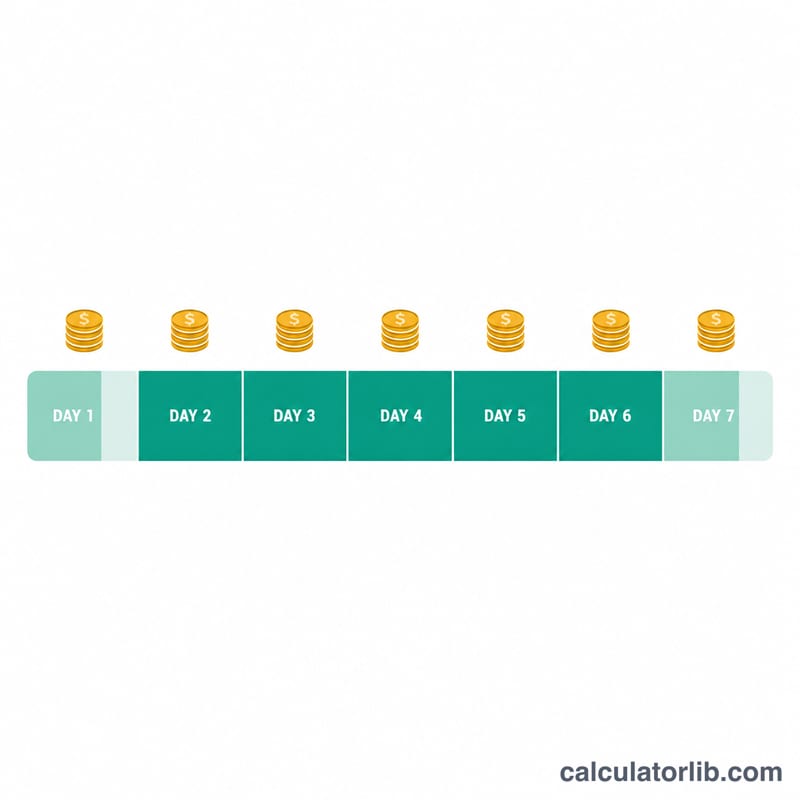
The basic formula is simply total = days × daily rate. When the 75% first/last day rule applies and the trip is two or more days, the two travel days are paid at 75% while the remaining middle days are paid in full:
$$\text{total} = (\text{days} - 2) \times \text{rate} + 2 \times (\text{rate} \times 0.75)$$For a single-day trip with the rule enabled, only one partial day applies, giving \(0.75 \times \text{rate}\).
Worked example
Suppose you travel for 5 days with a $100 daily rate and apply the 75% first/last day rule. The 3 middle days pay \(3 \times \$100 = \$300\). The first and last day pay \(2 \times (\$100 \times 0.75) = \$150\). Your total is $$\$300 + \$150 = \$450,$$ an average of $90 per day.

FAQ
Does the 75% rule always apply? No — it depends on your organization's travel policy. Many U.S. federal and corporate policies use it, but others pay the full rate every day.
Is per diem taxable? Generally per diem within published allowance limits is not taxable income, but amounts above the standard rate may be. Check your local tax rules.
Does this include lodging? Only if your daily rate is meant to cover lodging. Many policies pay lodging separately from the meals-and-incidentals per diem; set the rate accordingly.