What this calculator does
This calculator solves the classic navigation triangle of speed, time and distance using nautical units. Speed is in knots (nautical miles per hour), distance is in nautical miles (NM), and time is in hours and minutes. Choose which quantity you want, enter the other two, and the result appears instantly, along with conversions to km/h, mph and kilometres.
How to use it
Select what to solve for. If you want distance, enter your speed and the time underway. If you want speed, enter the distance and the time. If you want time (an ETA duration), enter the distance and your planned speed. The field you are solving for is ignored. Time is entered as hours plus minutes, so 5 h 30 min is 5 and 30.
The formula explained
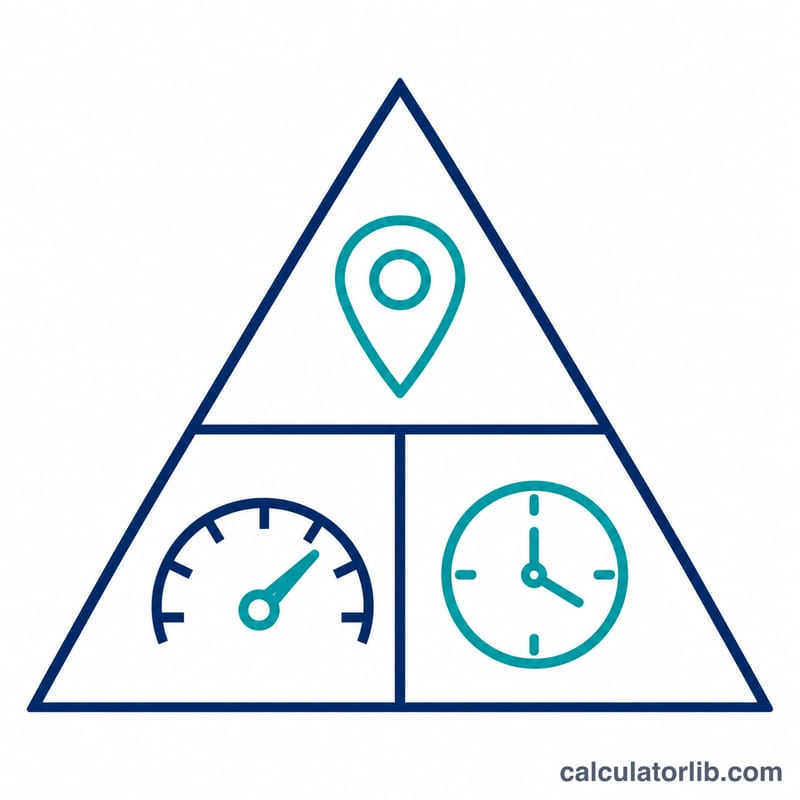
Because a knot is defined as one nautical mile per hour, no unit conversion is needed:
$$d = s \times t$$Here \(d\) = distance in nautical miles, \(s\) = speed in knots and \(t\) = time in hours. Rearranged, \(s = d / t\) and \(t = d / s\). Minutes are converted with \(t = h + m/60\).
Worked example
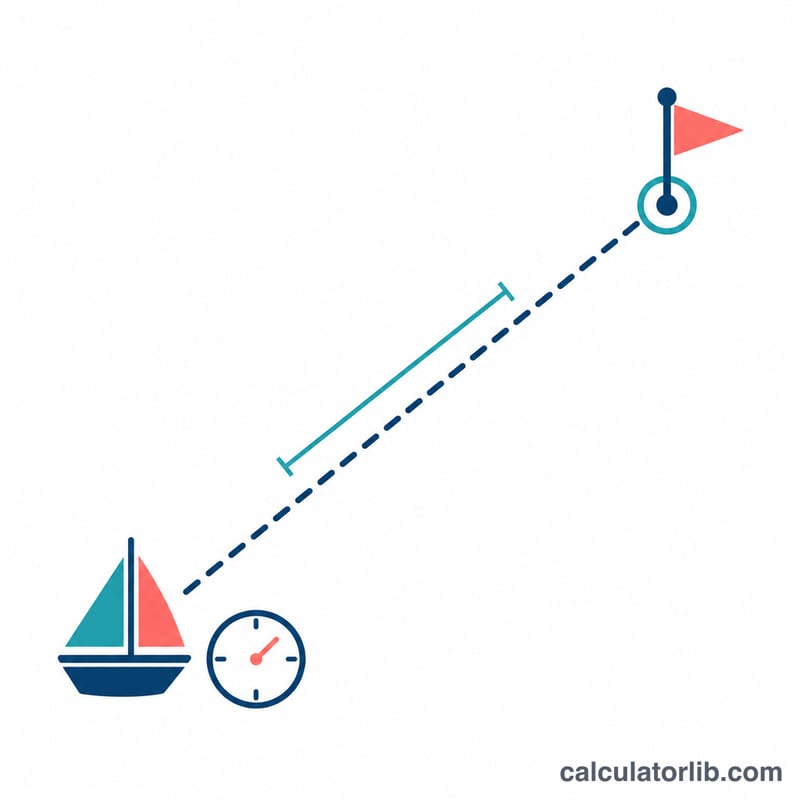
A sailboat motors at 6 knots for 5 hours 30 minutes. The time in hours is 5.5, so:
$$d = 6 \times 5.5 = 33\,\text{nautical miles}$$In kilometres this is \(33 \times 1.852 = 61.1\) km.
Knots to km/h and mph Conversion Table
A knot is one nautical mile per hour. The international nautical mile is defined as exactly 1,852 metres, so the constants below apply worldwide.
- 1 NM = 1.852 km = 1.15078 statute miles
- 1 kn = 1.852 km/h = 1.15078 mph
| Speed (kn) | km/h | mph |
|---|---|---|
| 3 | 5.56 | 3.45 |
| 5 | 9.26 | 5.75 |
| 6 | 11.11 | 6.90 |
| 8 | 14.82 | 9.21 |
| 10 | 18.52 | 11.51 |
| 15 | 27.78 | 17.26 |
| 20 | 37.04 | 23.02 |
| 25 | 46.30 | 28.77 |
| 30 | 55.56 | 34.52 |
Values are rounded to two decimals. To convert, multiply knots by 1.852 for km/h or by 1.15078 for mph.
Passage Time Comparison at Different Speeds
The table shows the time needed for a 60 NM passage in still water, with no current or wind effects. Time = Distance ÷ Speed.
| Vessel type | Speed (kn) | Calculation | Time |
|---|---|---|---|
| Small sailboat | 4 | 60 ÷ 4 = 15.0 h | 15 h 0 min |
| Cruising sailboat | 6 | 60 ÷ 6 = 10.0 h | 10 h 0 min |
| Displacement motor cruiser | 8 | 60 ÷ 8 = 7.5 h | 7 h 30 min |
| Planing powerboat | 15 | 60 ÷ 15 = 4.0 h | 4 h 0 min |
| Fast powerboat | 25 | 60 ÷ 25 = 2.4 h | 2 h 24 min |
The speeds are typical examples only. Real passage times change with current, wind, sea state and engine load. Tidal streams in particular can add or remove hours on a long passage.
Calculating Passage Time by Hand
- Convert to decimal hours. Decimal time = hours + minutes ÷ 60. For 2 h 40 min: \(2 + \frac{40}{60} = 2.6667\) h.
- Apply the distance formula or a rearrangement. \(d = s \times t\), \(s = \frac{d}{t}\), \(t = \frac{d}{s}\), with d in nautical miles, s in knots and t in hours. Example: at 7.5 kn for 2 h 40 min, \(d = 7.5 \times 2.6667 = 20\) NM, which is 20 NM.
- Convert decimal hours back to hours and minutes. Keep the whole number as hours and multiply the fractional part by 60. For 4.75 h: 0.75 × 60 = 45, so 4 h 45 min.
- Use the 60 rule for short legs. \(d = \frac{s \times \text{minutes}}{60}\). At 6 kn for 20 minutes: \(\frac{6 \times 20}{60} = 2\) NM. At 6 kn you cover 1 NM every 10 minutes.
ETA example: a 27 NM leg at 6 kn gives \(t = \frac{27}{6} = 4.5\) h, which is 4 h 30 min (0.5 × 60 = 30). Departing at 08:15, the ETA is 12:45.
FAQ
Is this speed over ground or through the water?
The calculator uses whatever speed you enter. For realistic planning use speed over ground, which accounts for current and tide. Speed through the water ignores them.
Why nautical miles?
One nautical mile equals one minute of latitude, about 1.852 km, which makes chart work simple.
Does it include fuel, tide or weather?
No. It is a straight calculation, so add safety margins for tidal streams, weather and delays.