What is a sprinkler precipitation rate?
The precipitation rate is how quickly your sprinklers apply water to the lawn, measured in inches per hour. Knowing it lets you water to a specific depth instead of guessing at run times. This calculator uses US units (gallons per minute, square feet, inches).
How to use the calculator
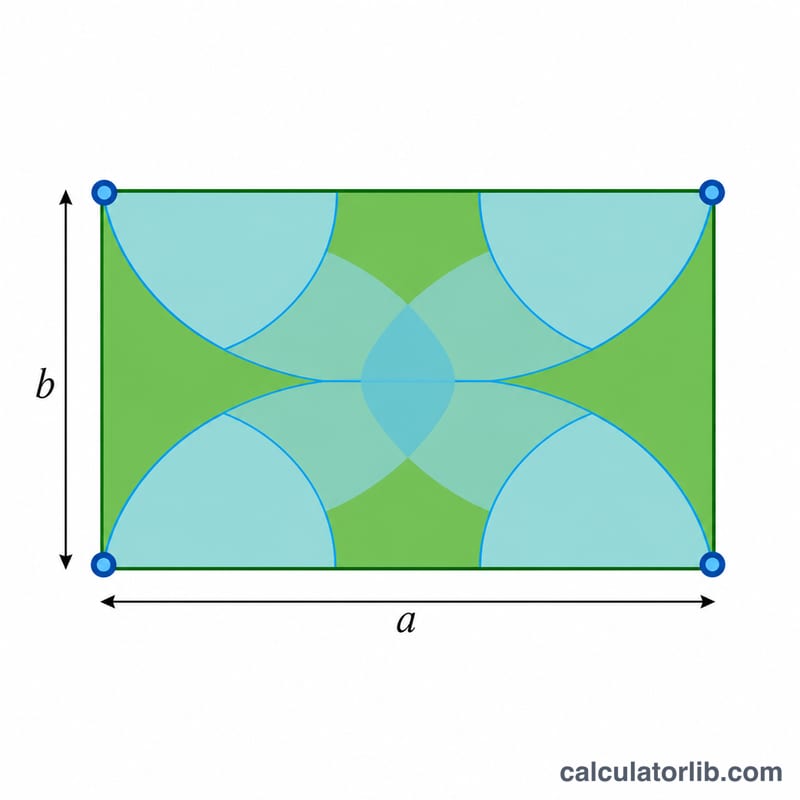
Enter the flow of each head in gallons per minute, the number of heads on the zone, the area the zone covers, the depth of water you want to apply, and an application efficiency. Efficiency accounts for wind, evaporation and overspray; 70-85% is typical for spray and rotor heads. The tool returns the precipitation rate, total zone flow, run time and gallons used per cycle.
The formula explained
One gallon is 231 cubic inches, so one GPM spread over one square foot (144 square inches) delivers \(60 \times 231 / 144 = 96.25\) inches per hour.
$$PR = \frac{96.25 \times Q}{A}$$Here \(Q\) is total zone flow in GPM and \(A\) is the area in square feet. The run time follows from the target depth \(D\) in inches and efficiency \(E\) as a decimal:
$$t = \frac{D}{PR \times E} \times 60$$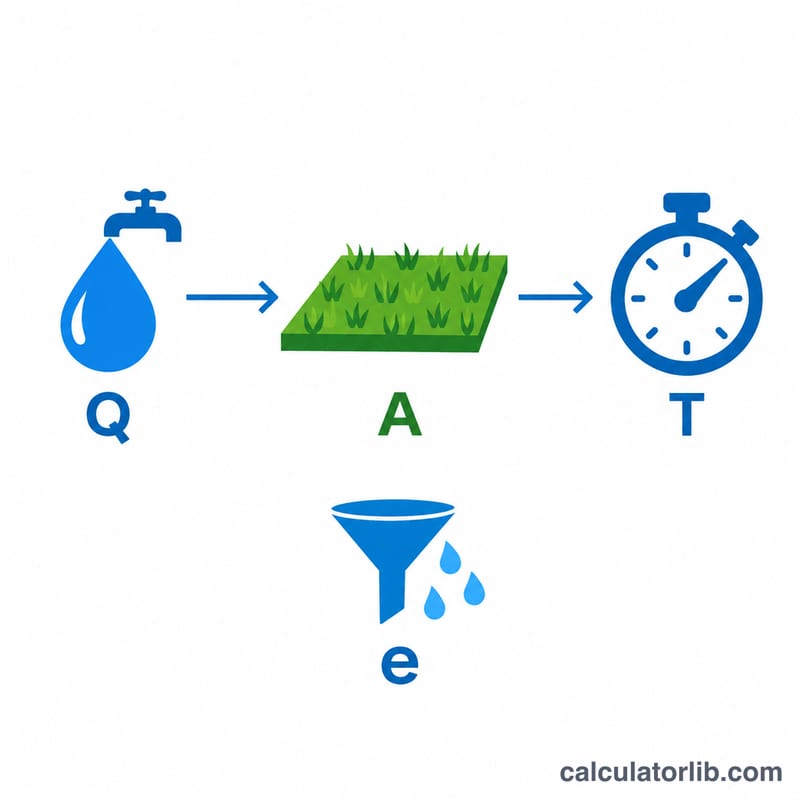
Worked example
A zone has 4 heads at 2.5 GPM each over 1,000 sq ft, and you want 0.5 inch at 80% efficiency.
$$Q = 4 \times 2.5 = 10\,\text{GPM}$$$$PR = \frac{96.25 \times 10}{1000} = 0.9625\,\text{in/hr}$$$$t = \frac{0.5}{0.9625 \times 0.8} \times 60 \approx 38.96\,\text{min}$$Water used is about \(38.96 \times 10 \approx 389.6\) gallons per cycle.
Typical Precipitation Rates and Soil Infiltration Rates
The tables below give approximate values in inches per hour. Published sources vary, and real values depend on nozzle, pressure, spacing, slope, soil compaction and turf condition. A catch-can test of your own zone is more reliable than any typical figure.
| Sprinkler type | Typical precipitation rate (in/hr, approx.) |
|---|---|
| Fixed spray heads | about 1.5-2 |
| Rotors (gear-driven) | about 0.4-0.75 |
| Rotary nozzles (e.g. MP Rotator type) | about 0.4-0.6 |
| Drip emitters | Depends on emitter flow (gallons per hour) and emitter spacing, so calculate it for your layout |
| Soil type | Approximate infiltration rate (in/hr) |
|---|---|
| Sand | about 2.0 |
| Sandy loam | about 1.0 |
| Loam | about 0.5 |
| Clay loam | about 0.3 |
| Clay | about 0.1-0.2 |
Infiltration rates drop as soil becomes wet, compacted or sloped, and the figures above are rough guides for bare, moderately dry soil.
Interpreting Your Precipitation Rate and Run Time
Compare the rate with your soil. If the precipitation rate is higher than the soil's infiltration rate, water arrives faster than the ground can absorb it. The excess pools or runs off onto sidewalks and streets. A common remedy is cycle-and-soak: split the total run time into several shorter cycles with rest periods between them so each application soaks in. The calculator gives the total run time needed, and how you split it depends on your soil, slope and sprinkler type.
Low rate means long run times. Run time is inversely proportional to precipitation rate. A zone applying 0.5 in/hr needs about 60 minutes to deliver 0.5 inch at 100% efficiency. A zone applying 1.5 in/hr needs only about 20 minutes. Low-rate heads such as rotors and rotary nozzles therefore need longer cycles, but they are less likely to cause runoff.
The efficiency assumption matters. The run time is divided by efficiency as a fraction. Going from 80% to 70% efficiency raises the run time by a factor of 80/70, about 14%. Efficiency reflects losses from wind, evaporation, overspray and uneven coverage. A realistic value therefore depends on how well your system is designed and maintained.
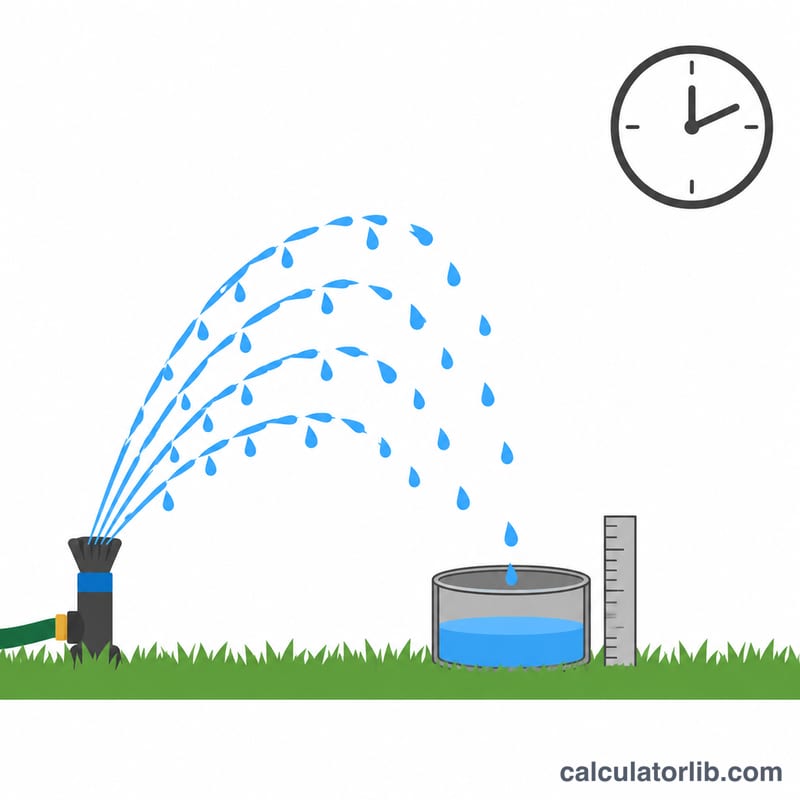
Check it with a catch-can test. Place several straight-sided cans across the zone and run the system for a measured time, such as 15 minutes. Measure the average depth and scale it to one hour. For example, 0.25 inch in 15 minutes is 1.0 in/hr. If the measured rate differs noticeably from the calculated one, trust the measurement. Uneven catch amounts also suggest the efficiency you entered may be too high.
FAQ
How much water does a lawn need?
Most lawns need about 1 to 1.5 inches per week including rainfall, applied in one or two deep sessions.
Can I check the result with a catch-can test?
Yes. Place straight-sided cans across the zone, run it for 15 minutes, measure the average depth and multiply by four to get inches per hour.
Why use different zones for different head types?
Spray heads often apply 1.5 in/hr or more while rotors apply around 0.5 in/hr. Mixing them on one zone causes uneven watering.