What this calculator does
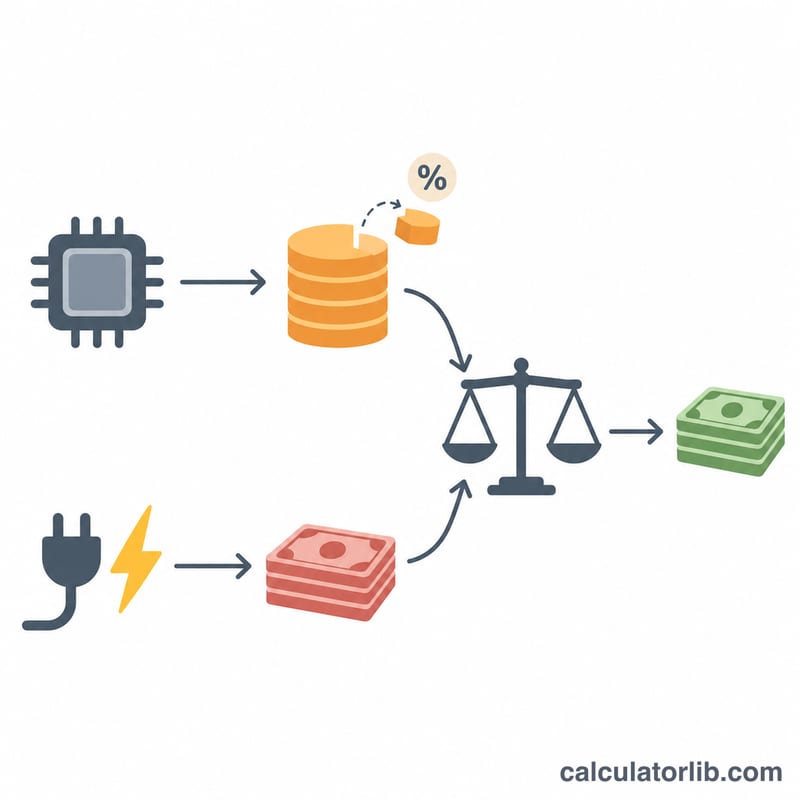
Monero (XMR) uses the RandomX proof-of-work algorithm, which is designed to run well on ordinary CPUs. That makes home mining possible, but whether it pays depends on your hash rate, your electricity price and the XMR price. This calculator gives an estimate of how many coins you will mine, what they are worth, what the power costs and your net profit per day and over any number of days.
How to use it
Enter your hash rate in H/s, which you can read from your miner software (a modern desktop CPU does roughly 5,000–20,000 H/s). Enter the current network hash rate in GH/s and the block reward. Monero is now in tail emission, so each block pays a fixed 0.6 XMR plus small transaction fees. Then add your pool fee, the wall-socket power draw of your rig in watts, your electricity price per kWh, the XMR price and how many days you want to estimate.
The formula
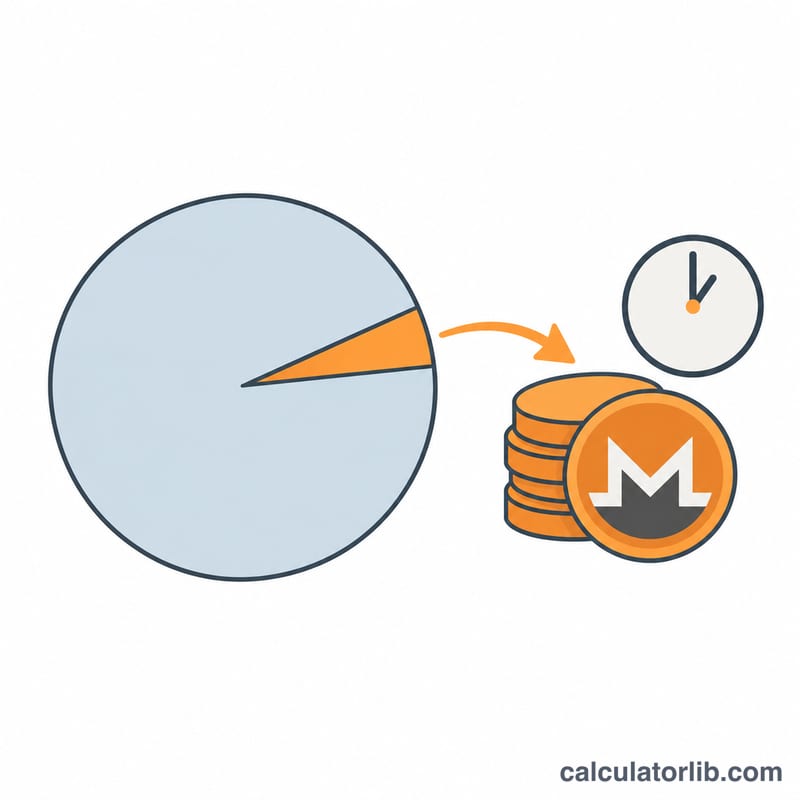
A new Monero block arrives about every 120 seconds, which gives 720 blocks a day. Your expected share of those blocks equals your share of the total hash rate:
$$P_{day} = \frac{H}{N} \times 720 \times R \times (1 - f) \times p - \frac{W}{1000} \times 24 \times c$$Here \(H\) is your hash rate, \(N\) is the network hash rate (in the same unit), \(R\) is the block reward, \(f\) is the pool fee as a fraction, \(p\) is the XMR price, \(W\) is the power draw in watts and \(c\) is the electricity price per kWh. Multiply by the number of days \(d\) to get the total for the period.
Worked example
Take a 15,000 H/s CPU on a 5 GH/s network with a 0.6 XMR reward, a 1% pool fee, a 150 W power draw, electricity at 0.12 per kWh and XMR at 150.
$$X_{day} = \frac{15000}{5 \times 10^{9}} \times 720 \times 0.6 \times 0.99 = 0.00128304\,\text{XMR}$$$$P_{day} = 0.00128304 \times 150 - 0.15 \times 24 \times 0.12 = 0.192456 - 0.432 = -0.239544$$In this example the rig loses about 0.24 a day, or about 7.19 over 30 days. Mining only pays here with cheaper power or a higher XMR price.
Interpreting Your Result
An expected average, not a guaranteed payout. The net profit shown is the statistical expectation over a long period. Blocks are found at random, and pool payouts depend on the pool's reward method and minimum payout threshold, so actual daily earnings vary around this figure. The longer the period, the closer actual results tend to come to the estimate, provided network hash rate and price stay the same.
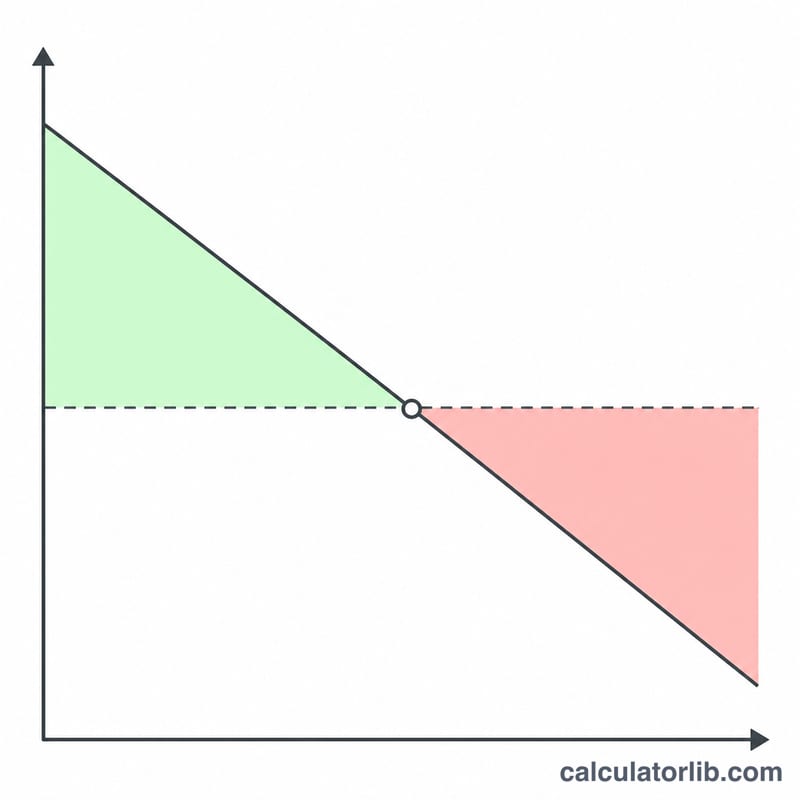
Negative result. A negative net profit means the electricity used costs more than the expected market value of the XMR mined in the same period. At the given inputs, each day of mining loses that amount compared with not mining.
Break-even. Break-even is where expected revenue equals electricity cost and net profit is zero. Below the break-even electricity price the result is positive. Above it the result is negative. The break-even price per kWh is daily revenue divided by daily energy use in kWh.
What moves revenue. Expected XMR mined is proportional to your hash rate divided by the network hash rate. Doubling your hash rate doubles expected XMR. Revenue in currency is also proportional to the XMR price. If the network hash rate rises while your hardware stays the same, your share shrinks and revenue falls. If it drops, your share grows. Pool fee and block reward scale revenue in the same direct way. Electricity cost depends only on power draw, electricity price and time, so it does not change with any of these factors.
What is not included. The result counts only mining revenue minus electricity. It leaves out hardware purchase cost and depreciation, extra cooling or ventilation, internet and other overheads, transaction or exchange fees, and taxes. How mining income is taxed depends on the country. Including any of these would lower the net figure.
This is a factual description of how the estimate works. It is general information, not financial or investment advice.
FAQ
Why do my real payouts differ from the estimate?
Finding blocks is random, and the network hash rate, the price and transaction fees all change. The result is the long-run average you can expect, not a guaranteed figure.
Should I use the power figure from the CPU specification?
No. Measure the whole system at the wall with a plug-in power meter. The CPU TDP leaves out the motherboard, RAM, fans and power-supply losses.
What is the break-even electricity price?
Divide daily revenue by daily kWh. Any electricity price below that figure makes mining profitable.