What is the Outboard Motor Fuel Economy Calculator?
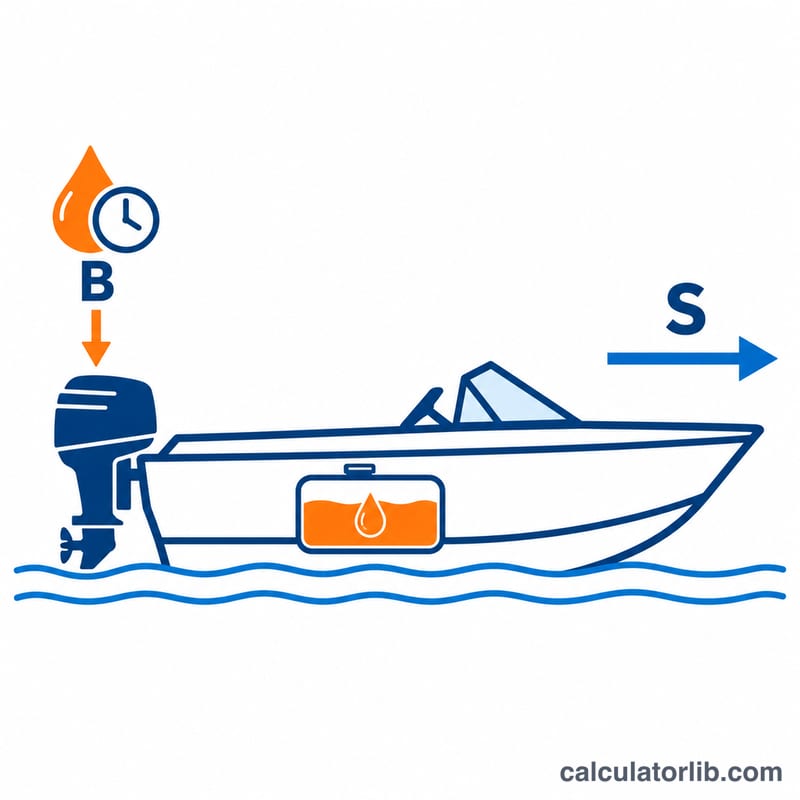
This calculator converts two numbers you can read from a fuel-flow gauge or an engine manufacturer test chart, fuel burn rate and boat speed, into practical figures: fuel economy, range, endurance, and the fuel and cost needed for a planned trip. It works in any consistent unit set, such as gallons and miles per hour, or litres and km/h.
How to use it
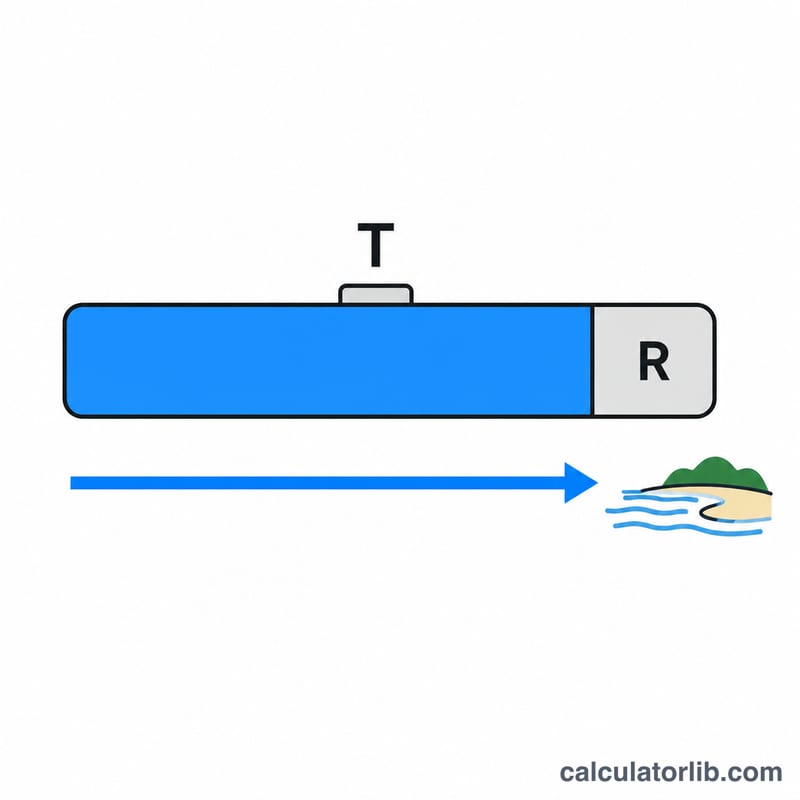
Enter the fuel burn rate (fuel volume per hour) and the speed you hold at that burn rate. Add your tank capacity and a safety reserve, commonly 20 to 33 percent, so you never plan to run the tank dry. Optionally enter a trip distance and fuel price to see trip fuel and cost. Use burn and speed measured at the same throttle setting, since economy changes greatly with RPM.
The formula explained
Fuel economy is speed divided by fuel burn rate:
$$E = \frac{v}{b}$$where \(v\) is speed and \(b\) is fuel burn per hour. Range is \(R = E \times T\) with \(T\) the tank capacity, and usable range is \(R \times (1 - r/100)\) for a reserve of \(r\) percent. Endurance in hours is \(T / b\).
Worked example
A 150 hp outboard burns 10 gal/h at 25 mph with a 50 gal tank and a 20% reserve.
$$E = \frac{25}{10} = 2.5\,\text{mpg}$$$$R = 2.5 \times 50 = 125\,\text{mi}, \quad R_{use} = 125 \times 0.8 = 100\,\text{mi}$$For a 40-mile trip you need \(40 \times 0.4 = 16\) gallons, and the run takes \(40/25 = 1.6\) hours.
Typical Fuel Reserve Guidelines and Burn Rates
The reserve percentage you enter in the calculator should reflect your conditions, not just a habit. These are general boating rules of thumb, not legal requirements.
Reserve rules of thumb
- Rule of thirds: use 1/3 of your fuel to go out, 1/3 to come back and keep 1/3 as reserve. This is a reserve of about 33%. It suits offshore trips, unfamiliar waters, strong currents, or any trip where weather could change.
- Minimum 10-20% reserve: for short trips in calm, familiar inshore water, many boaters keep at least 10-20% of the tank in hand. Going below this leaves little margin for headwinds, detours, or a fuel gauge that reads inaccurately.
- Raise the reserve if you carry heavy loads, expect rough water, or plan to troll or idle for long periods. Fuel gauges on portable and built-in tanks are often imprecise, especially at the low end.
Approximate full-throttle burn rates
At wide-open throttle (WOT), a typical gasoline outboard burns very roughly 0.08-0.10 US gallons per hour for each horsepower. This is an approximation based on a fuel consumption of about 0.5 lb of fuel per horsepower-hour, and gasoline weighs about 6 lb per US gallon. Real figures vary with engine type (two-stroke, four-stroke, direct injection), propeller, hull, load, and trim.
| Engine size (approx.) | WOT burn (US gal/h, approx.) | WOT burn (L/h, approx.) |
|---|---|---|
| 9.9 hp | 0.8-1.0 | 3-4 |
| 25 hp | 2-2.5 | 8-9.5 |
| 50 hp | 4-5 | 15-19 |
| 90 hp | 7-9 | 27-34 |
| 150 hp | 12-15 | 45-57 |
| 250 hp | 20-25 | 76-95 |
| 300 hp | 24-30 | 91-114 |
Burn at cruising speed is usually much lower than at WOT, often about half or less of the WOT figure at mid-range rpm. This is why your cruise-speed economy matters more than the WOT numbers above.
Use authoritative data
Treat this table only as a rough sanity check. The authoritative sources are the manufacturer's fuel-flow charts for your exact engine and an onboard fuel-flow meter, or your own measured fill-ups. Enter the burn rate at the speed you actually plan to run, with the same units for burn, tank, and distance.
Example: at a burn of 10 gal/h and a speed of 25 knots, economy is 25 ÷ 10 = 2.5 nautical miles per gallon. With a 50-gallon tank and a 33% reserve, usable range is 2.5 × 50 × (1 − 0.33) ≈ 83.8 nautical miles.
This is general information, not a substitute for your engine manual or professional marine advice. Always plan for conditions and keep a margin for the unexpected.
FAQ
Why is my real-world economy lower?
Wind, waves, hull fouling, heavy loads and trim all raise fuel burn compared with test-chart values. Treat the result as an estimate and keep a generous reserve.
Which speed should I use?
Use speed through the water or GPS speed over ground in the same units as your distance. Current changes GPS-based economy, so average both directions on a round trip.
Does it work for two-stroke and four-stroke engines?
Yes. Only the measured burn rate and speed matter, not the engine type.