What this calculator does
This calculator is based on the United States National Electrical Code (NEC) 125% continuous-load rule. It estimates the main breaker rating needed for a panel from the total connected load, supply voltage, phase and the share of the load that runs continuously (3 hours or more). Local codes, utility rules and a full NEC Article 220 load calculation may give a different answer, so have a licensed electrician confirm the final size.
How to use it
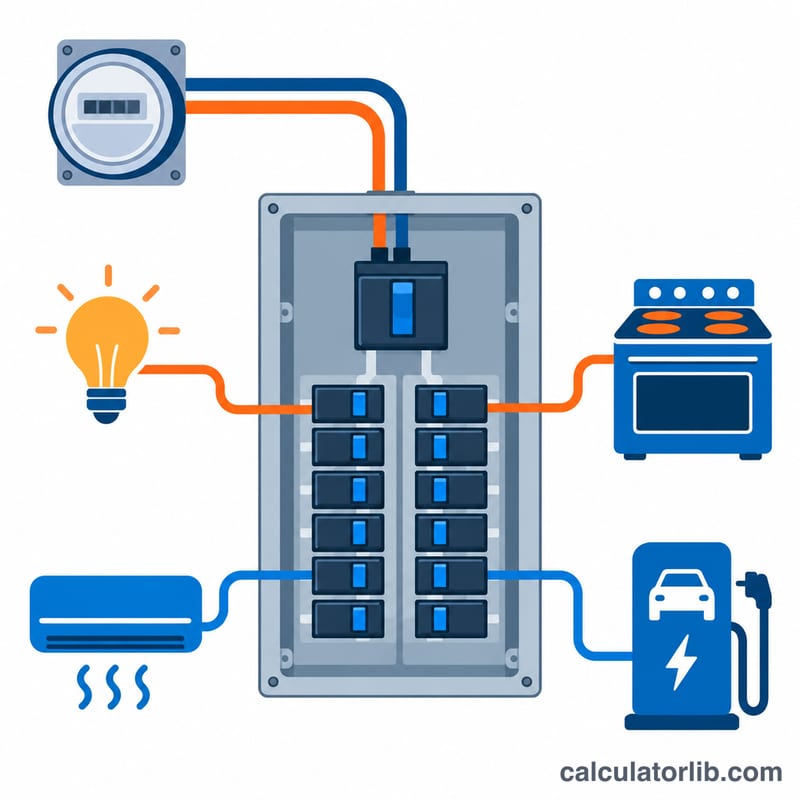
Enter the total load in watts, choose the supply voltage and phase, then enter the percentage of the load that is continuous (lighting, EV chargers, heating). The tool returns the load current, the required rating after the continuous-load adjustment, and the next standard breaker size.
The formula explained
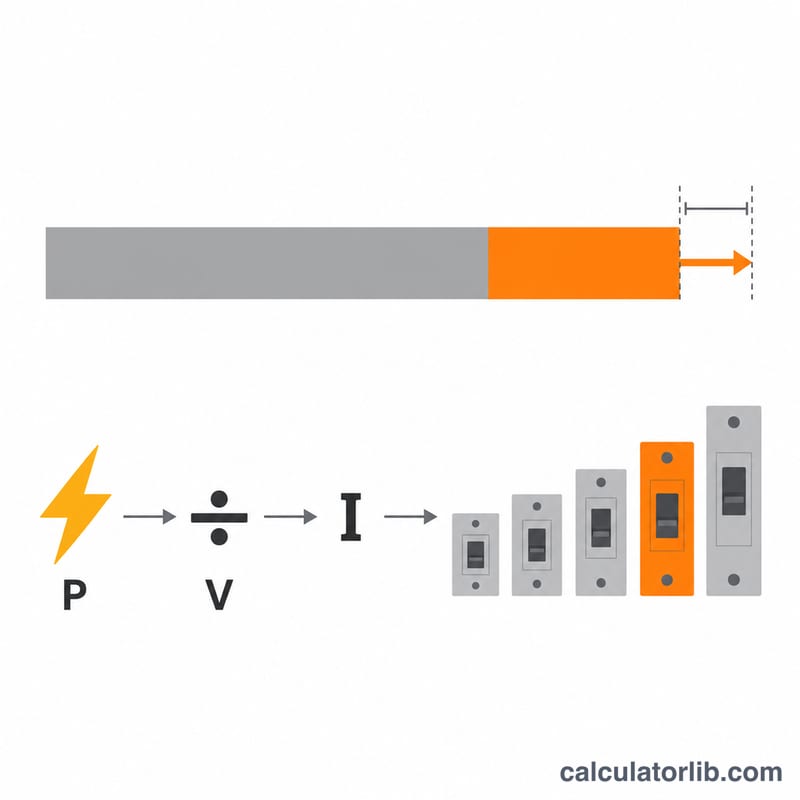
First find the load current, where \(P\) is power in watts, \(V\) is voltage and \(k\) is 1 for single-phase or \(\sqrt{3}\) for three-phase:
$$I_{\text{load}} = \frac{P}{V \times k}$$Continuous loads must be sized at 125%. With \(c\) as the continuous fraction:
$$I_{\text{req}} = I_{\text{load}} \times (1 + 0.25\,c)$$The result is rounded up to the next standard size: 100, 110, 125, 150, 175, 200, 225, 250, 300, 400 A and so on.
Worked example
A 24,000 W single-phase 240 V service where half of the load is continuous:
$$I_{\text{load}} = \frac{24000}{240 \times 1} = 100\,\text{A}$$$$I_{\text{req}} = 100 \times (1 + 0.25 \times 0.5) = 112.5\,\text{A}$$The next standard size above 112.5 A is 125 A, so a 125 A main breaker is needed.
Standard Breaker Sizes and Typical Matching Conductor/Panel Ratings
This calculator follows the United States National Electrical Code (NEC). Under NEC 240.6(A), overcurrent devices come in standard ampere ratings. After the calculator finds the required current, it rounds up to the next standard size in this list:
| Range | Standard ratings (A) per NEC 240.6(A) |
|---|---|
| Small | 15, 20, 25, 30, 35, 40, 45 |
| Medium | 50, 60, 70, 80, 90, 100, 110, 125 |
| Large | 150, 175, 200, 225, 250, 300, 350, 400, 450 |
| Very large | 500, 600, 700, 800, 1000, 1200 |
Common residential service sizes in the US: 100, 125, 150, 200 and 400 A. Many newer single-family homes use 200 A. Smaller or older homes often have 100 A, and larger homes or those with heavy electrification may need 400 A.
Conductors and panels: The main breaker, the service conductors and the panel bus rating must all be coordinated. Conductor size depends on NEC Table 310.12 (for certain dwelling-unit services and feeders) or Table 310.16, plus the insulation type, terminal temperature ratings, ambient temperature and installation conditions. This article does not list conductor sizes. A licensed electrician must verify them, and the local authority having jurisdiction may require a permit and inspection.
The panel's bus rating and listed maximum main breaker size also limit the choice. A main breaker can never exceed the rating marked on the panel.
Main Breaker Size for Common Load Scenarios
Each row uses the load current \(I = \dfrac{P}{V \times k}\), where \(k = 1\) for single-phase and \(k = \sqrt{3} \approx 1.732\) for three-phase. The required current is \(I_{req} = I\,(1 + 0.25\,c)\), where \(c\) is the continuous share as a fraction. The result is then rounded up to the next standard breaker size.
| Total load | Voltage / phase | Continuous share | Load current I | Required amps Ireq | Main breaker |
|---|---|---|---|---|---|
| 12,000 W | 240 V single-phase | 0% | 50.0 A | 50.0 A | 50 A |
| 18,000 W | 240 V single-phase | 25% | 75.0 A | 79.69 A | 80 A |
| 24,000 W | 240 V single-phase | 100% | 100.0 A | 125.0 A | 125 A |
| 36,000 W | 240 V single-phase | 50% | 150.0 A | 168.75 A | 175 A |
| 50,000 W | 208 V three-phase | 50% | 138.8 A | 156.1 A | 175 A |
| 100,000 W | 480 V three-phase | 80% | 120.3 A | 144.3 A | 150 A |
Worked example (36,000 W, 240 V single-phase, 50% continuous):
$$I = \frac{36000}{240 \times 1} = 150\ \text{A}$$
$$I_{req} = 150 \times (1 + 0.25 \times 0.5) = 150 \times 1.125 = 168.75\ \text{A}$$
The next standard size at or above 168.75 A is 175 A.
Three-phase check (50,000 W, 208 V, 50% continuous): \(I = 50000 / (208 \times 1.732) \approx 138.8\) A, and \(I_{req} = 138.8 \times 1.125 \approx 156.1\) A, so a 175 A breaker is the next standard size.
These figures are estimates only. They are not a full NEC Article 220 load calculation, which applies demand factors and specific rules for appliances, HVAC, EV chargers and other loads.
Key Terms: Continuous Load, Connected Load and Main Breaker
- Continuous load: a load expected to run at maximum current for 3 hours or more, such as lighting in a commercial space or an EV charger. The NEC generally requires the overcurrent device to carry 125% of it.
- Non-continuous load: a load that runs for shorter periods, so it counts at 100% of its current.
- Connected load vs demand load: connected load is the sum of the ratings of everything that could be connected. Demand load is the realistic maximum after applying NEC demand factors, because not everything runs at once. This calculator uses the connected load you enter.
- Main breaker vs branch breaker: the main breaker protects the whole panel and disconnects all power to it. Branch breakers protect individual circuits, such as a 20 A kitchen outlet circuit.
- Panel bus rating: the maximum current the panel's busbars are built to carry (for example 100, 125, 200 or 400 A). The main breaker must not exceed it.
- Single-phase vs three-phase: single-phase is typical of US homes, with 120/240 V split-phase. Three-phase uses three alternating currents offset in time and is common in commercial and industrial buildings. Its current is calculated with a factor of √3.
- Line voltage: the supply voltage of the system, such as 120/240 V (residential), 208 V (commercial three-phase, 120/208 V), 277 V or 480 V (commercial and industrial, 277/480 V).
- 80% rating rule: a standard breaker should carry a continuous load of no more than 80% of its rating. This is mathematically the same as sizing the breaker at 125% of the continuous load, since \(1 / 1.25 = 0.8\). Breakers and assemblies listed for 100% continuous operation are an exception.
This is general information, not a substitute for a licensed electrician or local code requirements.
FAQ
Why 125% for continuous loads?
Breakers should not carry more than 80% of their rating continuously, which is the same as sizing them at 125% of the load.
Can I round down to a smaller breaker?
No. Always round up to the next standard size, and make sure the service conductors and panel bus rating match the breaker.
Does this replace a load calculation?
No. It is a quick estimate. A full NEC load calculation applies demand factors and specific appliance rules.