What the Tile Pattern Calculator Does
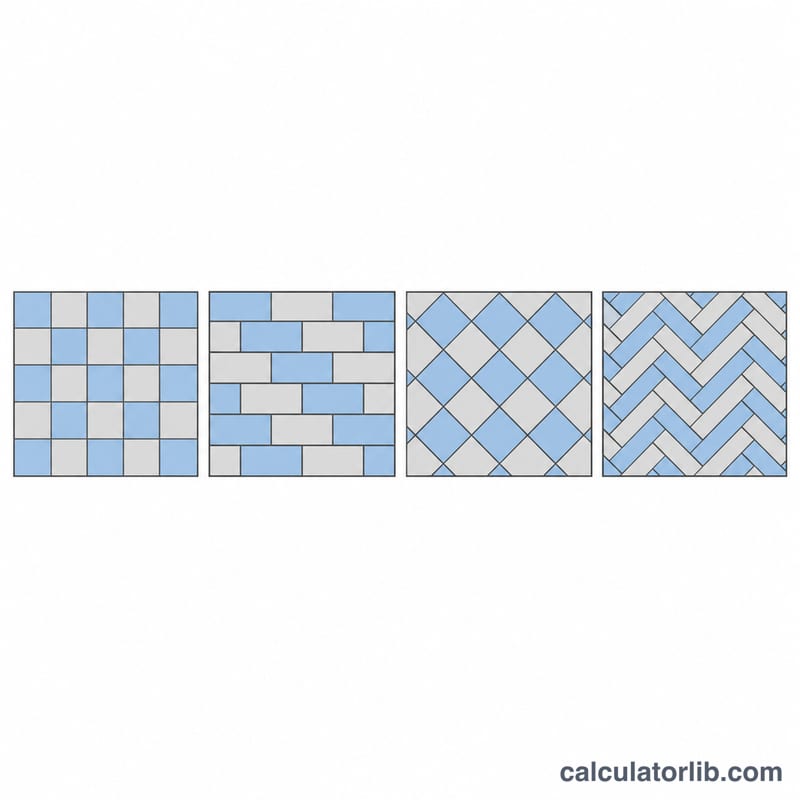
The layout you choose changes how many tiles you buy and how many must be cut. This calculator takes your room size, tile size, grout joint and pattern (straight, running bond, diagonal or herringbone) and returns the number of tiles, full pieces, cut pieces and boxes to order.
How to Use It
Enter the room length and width in feet, the tile length and width in inches, and the grout joint width. Pick a pattern, set an extra percentage for breakage (10% is common) and the number of tiles per box. The result updates with the total tiles to buy.
How the Numbers Are Calculated
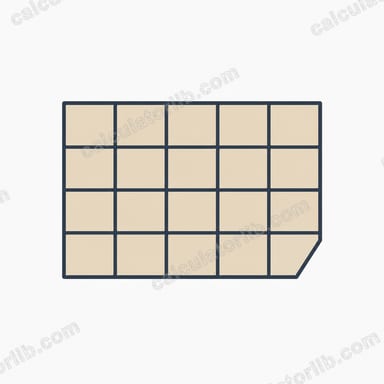
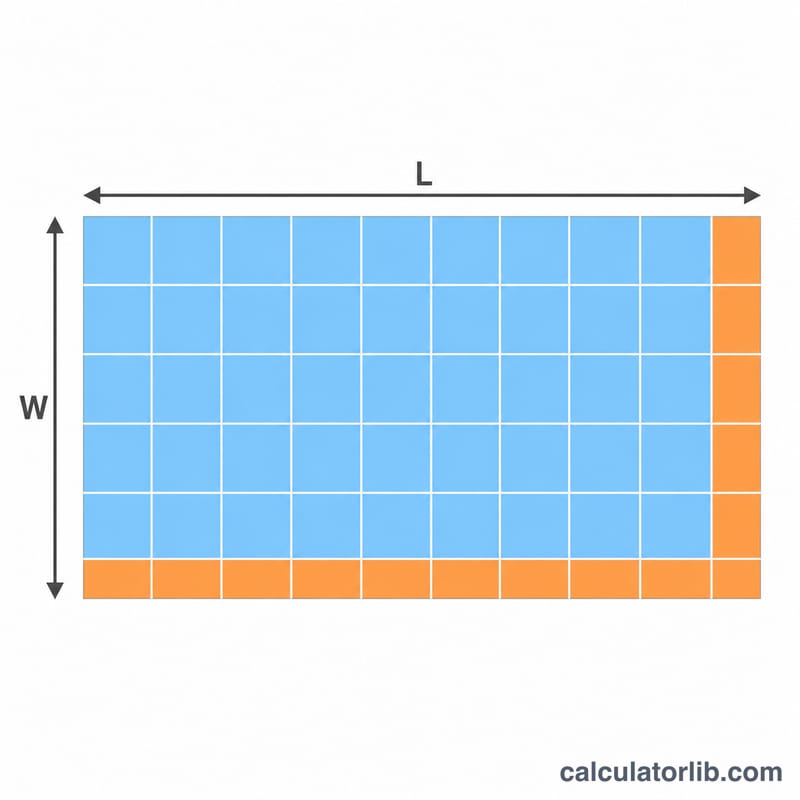
For straight and running bond layouts the room is divided into a grid. Each tile occupies its size plus one grout joint:
$$N_{grid} = \left\lceil \frac{L + g}{t_l + g} \right\rceil \times \left\lceil \frac{W + g}{t_w + g} \right\rceil$$Here \(L\) and \(W\) are room dimensions in inches, \(t_l\) and \(t_w\) are tile dimensions and \(g\) is the grout joint. Edge tiles that do not fit whole are counted as cut pieces. Running bond adds one extra piece for every two rows because each offset row starts with a half tile. Diagonal and herringbone layouts are estimated from floor area plus the pieces cut along the perimeter, so treat them as planning estimates.
Worked Example
A 10 ft by 8 ft room with 12 in square tiles, no grout and a straight pattern gives:
$$N = \frac{120}{12} \times \frac{96}{12} = 10 \times 8 = 80$$With 10% extra, \(80 \times 1.10 = 88\) tiles. At 10 tiles per box, order 9 boxes.
Typical Waste Percentages by Tile Pattern
The overage you enter covers cuts at the edges, breakage, and a few spare tiles. The figures below are commonly cited industry guidance, not fixed rules. Your installer or the tile manufacturer may recommend something different.
| Pattern | Typical waste allowance |
|---|---|
| Straight (grid) | about 5–10% |
| Running bond (brick) | about 10% |
| Diagonal | about 10–15% |
| Herringbone | about 15–20% |
Small rooms, large-format tiles, and complex layouts push the waste toward the upper end of each range. Rooms with many corners, niches, or obstacles do the same. Each cut piece often can't be reused, so a room with a lot of perimeter loses proportionally more material.
Pattern Comparison for the Same Room
Example: a 10 ft × 8 ft room, 12 in × 12 in tiles, no grout, 10 tiles per box. The base count comes from the calculator's formula:
$$B = \left\lceil \frac{120}{12} \right\rceil \cdot \left\lceil \frac{96}{12} \right\rceil = 10 \cdot 8 = 80 \text{ tiles}$$
Then \(N = \lceil B(1 + \text{Overage}/100) \rceil\) and \(\text{Boxes} = \lceil N / 10 \rceil\).
| Pattern | Suggested waste | Tiles to buy | Boxes (10 per box) |
|---|---|---|---|
| Straight | 10% | 80 × 1.10 = 88 | 9 |
| Running bond | 10% | 80 × 1.10 = 88 | 9 |
| Diagonal (estimate) | 15% | 80 × 1.15 = 92 | 10 |
| Herringbone (estimate) | 20% | 80 × 1.20 = 96 | 10 |
The diagonal and herringbone rows are estimates. The simple grid count of 80 tiles is a starting point, and the real count depends on how the pattern is laid out and trimmed against the walls. Rounding up to whole boxes means you will usually end up with a few extra tiles.
Practical Ordering Tips
- Round up to whole boxes. Tiles are sold by the box, so always order the next full box.
- Buy all tiles from the same dye lot. Color and shade can vary between production runs, and a mismatch is hard to hide once installed.
- Keep spare boxes for future repairs. Tiles may be discontinued or change shade, so a leftover box or two is useful for fixing cracks later.
- Add extra for large-format tiles or rooms with many obstacles. Fewer, bigger tiles mean each cut wastes more, and islands, niches, and angled walls add cuts.
- Dry-lay a row before cutting. Laying tiles out without adhesive shows how the edge cuts fall and whether you need to shift the layout to avoid thin slivers.
- Confirm the layout with the installer before ordering. They can advise on the starting point, the pattern, and the waste they expect.
This is general information, and your project's requirements may differ. Check the tile manufacturer's guidance as well.
FAQ
Why does a diagonal pattern need more tiles?
Every wall edge needs triangular cuts, and many offcuts cannot be reused, so waste is higher than for a straight layout. Consider raising the extra percentage to 15% or more.
Should I include grout?
Yes. Even a 1/8 in joint changes the tile pitch slightly, which matters in large rooms. Enter the joint in inches, for example 0.125.
Are the cut counts exact?
Straight layouts are exact for a grid starting in one corner. Other patterns are estimates; always keep spare tiles from the same batch.