
What this calculator does
This tool tells you how many rectangular tiles you need to cover a rectangular surface — a floor, wall, patio or backsplash. You enter the room dimensions in metres and the tile size in centimetres, and it works out the number of tiles by comparing the total surface area to the area of a single tile. A waste allowance is added on top to cover cuts, off-cuts and breakages.
How to use it
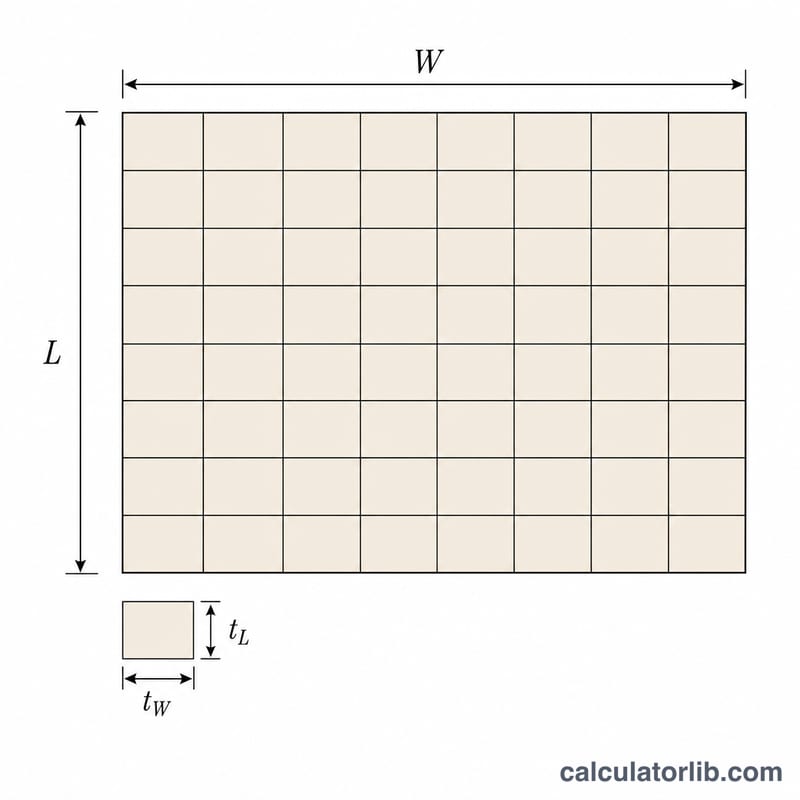
Enter the length and width of the area you want to tile (in metres). Then enter the length and width of one tile (in centimetres — most tiles are sold in cm, e.g. 30 × 30 or 60 × 30). Finally choose a waste allowance: 10% is a common rule of thumb for straightforward layouts, while diagonal patterns or rooms with many obstacles may need 15–20%.
The formula explained
The core calculation is simply the surface area divided by the tile area: $$\text{Tiles} = \left\lceil \frac{\text{Length (m)} \times \text{Width (m)}}{\dfrac{\text{Tile L (cm)}}{100} \times \dfrac{\text{Tile W (cm)}}{100}} \times \left(1 + \frac{\text{Waste (\%)}}{100}\right) \right\rceil$$. Tile dimensions are converted from centimetres to metres (divide by 100) so the units match. The result is rounded up (the ceiling function) because you can't buy a fraction of a tile. With waste, the raw tile count is multiplied by \(1 + \text{waste}/100\) and then rounded up.
Worked example
Suppose you tile a 4 m × 3 m floor with 30 cm × 30 cm tiles and a 10% waste allowance. The surface area is 12 m². Each tile is \(0.30 \times 0.30 = 0.09\ \text{m}^2\). Bare tiles $$= \frac{12}{0.09} = 133.3,$$ rounded up to 134. With 10% waste: $$133.3 \times 1.10 = 146.67,$$ rounded up to 147 tiles.
FAQ
Why round up? You cannot buy part of a tile, so any fractional requirement means buying one more.
Should I add waste? Yes — cuts around edges, corners and fixtures create off-cuts you can't always reuse, and tiles break. 10% is typical; use more for complex layouts.
Does this account for grout lines? No. Grout joints are usually small enough that the standard waste allowance covers the difference, but for very large joints add a little extra.