What this calculator does
The Tile Floor Calculator turns a room measurement into a shopping list: how many individual tiles you need, how many extra tiles to allow for cuts and breakage, and how many boxes to carry home. It works for any rectangular or non-rectangular room as long as you know the total floor area in square feet, and for any tile size quoted in inches — 12 × 12, 18 × 18, 24 × 12 plank tiles, or anything in between.
How to use it
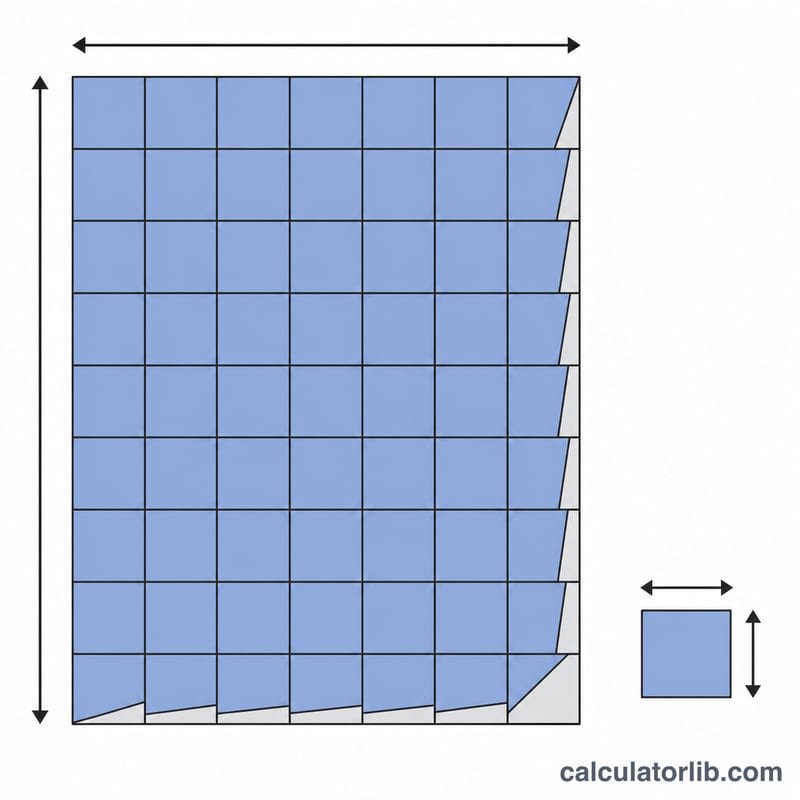
Enter the floor area you want to cover in square feet, then the tile width and length in inches. Add a waste allowance: 10% is typical for a simple straight lay, 15% for a diagonal layout or a room with many alcoves, and 20% for large-format or herringbone patterns. Finally, enter how many tiles come in one box (printed on the label) so the calculator can round up to whole boxes.
The formula explained
First convert the tile face to square feet, with \(w\) and \(l\) the tile width and length in inches:
$$a = \frac{w \times l}{144}$$Then divide the floor area \(A\) by the tile area, round up to a whole tile, apply the waste rate \(r\) in percent, and round up again:
$$N = \left\lceil \left\lceil \frac{A}{a} \right\rceil \times \left(1 + \frac{r}{100}\right) \right\rceil$$Boxes are \(B = \lceil N / p \rceil\) where \(p\) is the tiles per box. Grout joints are ignored — they are far smaller than the waste allowance already built in.
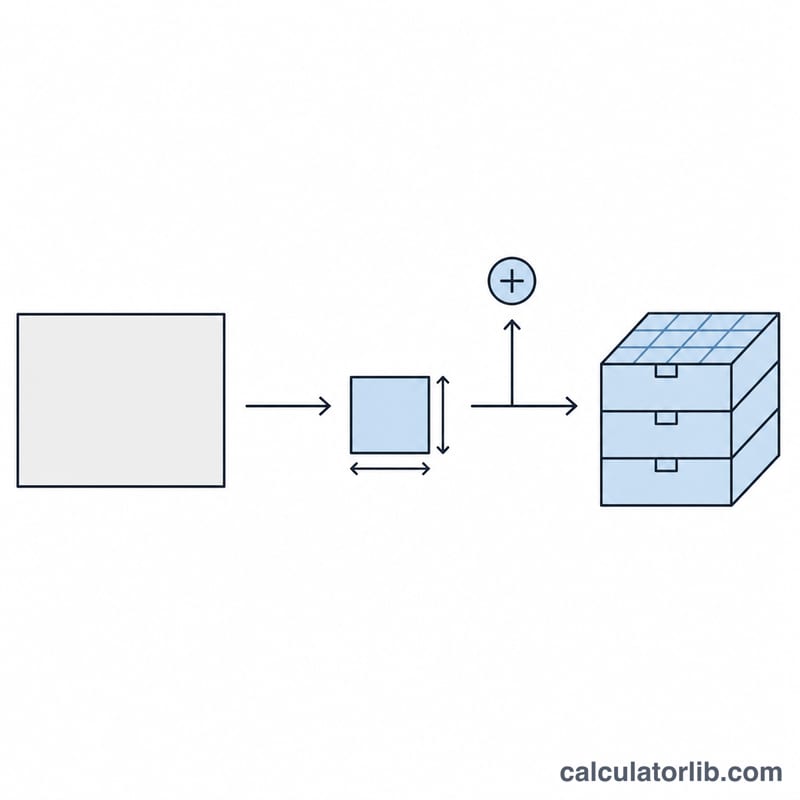
Tile counts are always rounded up to whole tiles, and boxes up to whole boxes. Buy from a single dye lot so colours match, and keep the leftovers for future repairs.
Worked example
A 150 sq ft bedroom tiled with 18 × 18 inch tiles, 15% waste, 6 tiles per box:
$$a = \frac{18 \times 18}{144} = 2.25\,\text{sq ft}$$$$N = \left\lceil 67 \times 1.15 \right\rceil = \left\lceil 77.05 \right\rceil = 78\ \text{tiles}$$That is 13 boxes, covering 175.5 sq ft.
Tile Size to Coverage Conversion Table
Every tile count starts from the coverage of a single tile. For a tile measured in inches, the face area in square feet is
$$A_t = \frac{w \times l}{144}$$where \(w\) and \(l\) are the tile width and length in inches and 144 is the number of square inches in one square foot. The last column is the bare minimum number of tiles for 100 sq ft of floor with no waste allowance, rounded up: \(\lceil 100 / A_t \rceil\).
| Nominal tile size (in) | Face area (sq in) | Tile area \(A_t\) (sq ft) | Tiles per 100 sq ft (0% waste) |
|---|---|---|---|
| 4 × 4 | 16 | 0.111 | 900 |
| 6 × 6 | 36 | 0.250 | 400 |
| 12 × 12 | 144 | 1.000 | 100 |
| 12 × 24 | 288 | 2.000 | 50 |
| 16 × 16 | 256 | 1.778 | 57 |
| 18 × 18 | 324 | 2.250 | 45 |
| 24 × 24 | 576 | 4.000 | 25 |
| 6 × 24 (plank) | 144 | 1.000 | 100 |
| 8 × 48 (plank) | 384 | 2.667 | 38 |
Notes on sizes and units. This calculator uses US customary units — tile dimensions in inches and floor area in square feet. Tile sizes are nominal: a tile sold as 12 × 12 in is typically pressed slightly under that (often around 117/8 in) so that the tile plus a grout joint lands close to the nominal module, so use the nominal size here rather than a tape measurement of one tile. Metric sizes map onto the same nominal scheme: 300 × 300 mm ≈ 12 × 12 in, 600 × 600 mm ≈ 24 × 24 in, 600 × 1200 mm ≈ 24 × 48 in.
If your room area is in square metres, convert before entering it: \(1\ \text{m}^2 = 10.764\ \text{sq ft}\), so a 12 m² bedroom is \(12 \times 10.764 = 129.2\) sq ft. Going the other way, divide square feet by 10.764.
Tiles and Boxes Across Common Room Scenarios
Two separate round-ups apply. First the tile count is rounded up, because you cannot buy a fraction of a tile:
$$N = \left\lceil \frac{\text{Area}}{A_t}\left(1 + \frac{\text{Waste}}{100}\right) \right\rceil$$Then the box count is rounded up, because tile is sold by the full box:
$$B = \left\lceil \frac{N}{\text{Tiles per box}} \right\rceil$$The gap between what you need and what you can buy is why the last column below is usually well above the room area. The 100 sq ft kitchen row works out as
$$N = \left\lceil \frac{100}{2.000}\left(1 + \frac{15}{100}\right) \right\rceil = \lceil 57.5 \rceil = 58 \quad\text{tiles},\qquad B = \left\lceil \frac{58}{6} \right\rceil = 10 \quad\text{boxes}$$| Job | Floor area (sq ft) | Tile size (in) | Tile area (sq ft) | Base tiles (area ÷ \(A_t\)) | Waste | Total tiles \(N\) | Tiles per box | Boxes to buy | Coverage purchased (sq ft) |
|---|---|---|---|---|---|---|---|---|---|
| Bathroom floor, straight lay | 40 | 12 × 12 | 1.000 | 40.0 | 10% | 44 | 12 | 4 | 48.0 |
| Kitchen, offset brick pattern | 100 | 12 × 24 | 2.000 | 50.0 | 15% | 58 | 6 | 10 | 120.0 |
| Bedroom, straight lay | 150 | 18 × 18 | 2.250 | 66.7 | 15% | 77 | 4 | 20 | 180.0 |
| Open living area, large format | 250 | 24 × 24 | 4.000 | 62.5 | 10% | 69 | 2 | 35 | 280.0 |
| Hallway, plank herringbone | 300 | 6 × 24 | 1.000 | 300.0 | 20% | 360 | 8 | 45 | 360.0 |
| Entry, wood-look plank | 80 | 8 × 48 | 2.667 | 30.0 | 15% | 35 | 4 | 9 | 96.0 |
Two patterns are worth noticing. Large-format tile boxes hold very few pieces, so the box round-up costs you the most: the 250 sq ft living area needs 69 tiles but 35 two-tile boxes deliver 70 tiles — and because each tile covers 4 sq ft, a single extra tile is 4 sq ft of the overage. Small mosaics and planks round up far more gently. Tiles-per-box values above are plausible examples only; the ones printed on your box govern.
Practical Ordering Tips
- Buy the whole job in one order, from one shade lot. Fired ceramic and porcelain vary in colour and size between production runs, and boxes are marked with a dye lot (shade) and calibre/gauge code. Mixing lots mid-floor can show as a visible band. Check that every box in the delivery carries the same codes before the tiler opens them.
- Keep a spare box, or roughly 5–10% beyond the installed amount. Attic stock is the only realistic way to repair a cracked tile years later, once the pattern has been discontinued. In the examples above the box round-up often supplies this for free — the 150 sq ft bedroom ends up with 180 sq ft purchased — so check what you already have left over before adding more.
- Verify tiles per box and coverage per box from the label, not from habit. Counts vary widely by manufacturer and format: small-format boxes may hold 10–15 pieces, while large-format boxes often hold only 2–3 tiles. Most labels also state coverage per box directly; divide that by the tile area to sanity-check the piece count you entered.
- Match the waste allowance to the layout, not just the room. Around 10% is a common working allowance for a simple straight lay in a square room. Use roughly 15–20% for diagonal, herringbone and plank layouts, for long narrow rooms, and for spaces with many cuts — doorways, alcoves, islands, pipe penetrations. Very large-format tile also deserves a higher allowance, since each mis-cut wastes several square feet.
- Confirm the return policy on unopened boxes before ordering the extra. Many retailers accept unopened, undamaged full boxes within a set window, sometimes with a restocking fee, while special-order and clearance tile is often non-returnable. Knowing this decides whether you round up generously or order tight and rely on a second trip — and keep the receipt and the lot code either way.
- Remember tile is only one line on the materials list. Thinset mortar, grout, spacers, edge trim or Schluter-type profiles, backer board or uncoupling membrane, sealer and leveling compound are all separate quantities that this calculator does not estimate. Their coverage depends on trowel notch size, joint width and substrate, so take those figures from each product's own datasheet.
- Re-measure the floor in sections. Split an irregular room into rectangles, compute each one's square footage, add them, and enter the total. Subtracting fixed obstructions such as a kitchen island base or a built-in tub is reasonable; do not subtract small features, since the offcuts around them rarely get reused.
FAQ
How much waste should I allow? 10% for straight layouts in square rooms, 15% for diagonal or irregular rooms, and up to 20% for large-format tiles and patterned installations where offcuts are rarely reusable.
Should I measure each room separately? Yes. Calculate each room or area on its own and add the results, because cut waste depends on the shape of each space.
Why round up to whole boxes? Retailers sell tile by the box, and buying a spare box from the same dye lot guarantees a colour match if you ever need a repair.