What this calculator does
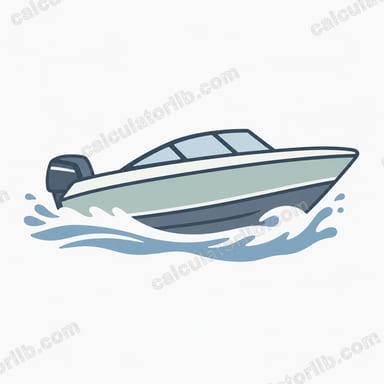
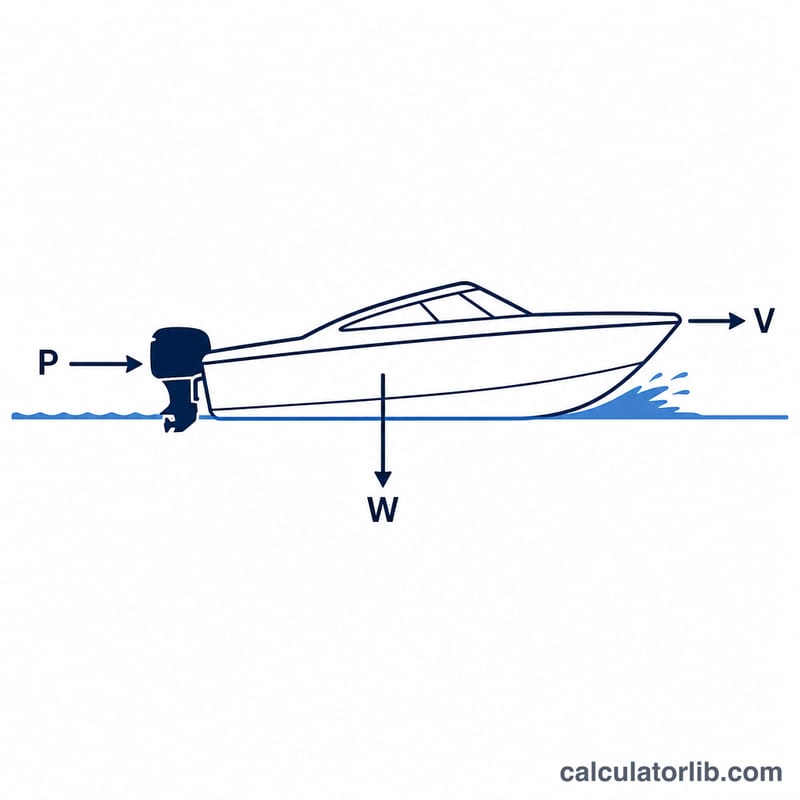
A planing hull lifts onto the surface of the water and rides on dynamic pressure rather than buoyancy, so its top speed is not capped by waterline length the way a displacement hull is. Instead it is governed mainly by how much power you have per pound of boat. This calculator applies the classic Crouch formula to turn engine horsepower, total loaded weight and a hull-type constant into an expected top speed in knots, mph and km/h.
The formula explained
Crouch expressed planing speed as
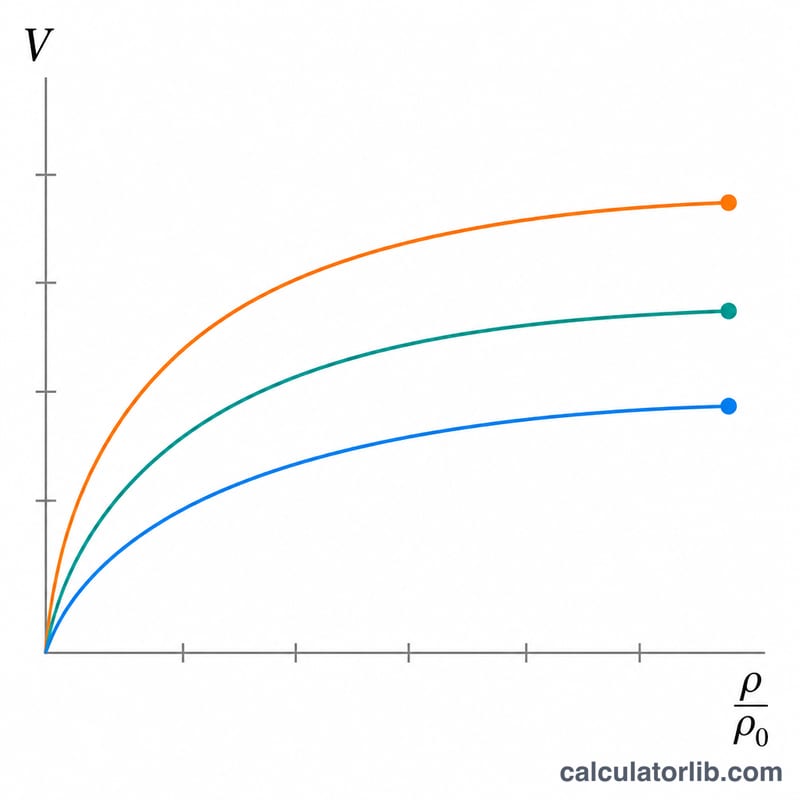
$$V = \frac{C}{\sqrt{W / P}}$$where \(V\) = top speed in knots, \(W\) = total loaded weight in pounds (boat, engine, fuel, gear and crew), \(P\) = shaft horsepower actually delivered, and \(C\) = a constant describing how efficiently the hull converts power into speed. Typical values are \(C = 150\) for average runabouts and cruisers, \(190\) for light high-speed runabouts, \(210\) for race boats and stepped hulls, and \(220\) for three-point hydroplanes. Because speed scales with \(\sqrt{P/W}\), four times the power only doubles the speed, while trimming weight is comparatively cheap performance.
How to use it
Enter the engine power at the prop shaft, the all-up weight of the boat as you actually run it, and the hull type that best matches your boat. Weight may be entered in pounds or kilograms; kilograms are converted at 1 kg = 2.20462 lb.
Worked example
A 5,000 lb family runabout with a 300 hp engine and \(C = 150\):
$$V = \frac{150}{\sqrt{5000 / 300}} = \frac{150}{4.0825} = 36.74\,\text{knots}$$$$36.74 \times 1.15078 = 42.28\,\text{mph}$$That is 16.7 lb per horsepower, or 120 hp per 2,000 lb.
Key Terms and Variables
- Planing hull
- A hull shaped to lift onto its own bow wave and skim across the surface, supported mainly by hydrodynamic lift rather than buoyancy. Once on plane, wetted surface drops sharply and speed is no longer capped by waterline length — which is exactly the regime the Crouch formula describes.
- Displacement hull
- A hull that pushes water aside at all speeds and remains supported by buoyancy. Its practical top speed is limited by its own wave system. The Crouch formula does not apply to displacement hulls.
- Semi-displacement hull
- An intermediate form that generates some dynamic lift and can exceed classical hull speed, but never fully planes. Crouch-style estimates are unreliable here; these hulls are usually assessed with speed–length ratio or resistance data instead.
- Hull speed
-
The rule-of-thumb speed at which a displacement hull's bow and stern waves match its waterline length, after which wave-making drag climbs steeply. In US customary units:
\(V_{\text{knots}} = 1.34 \times \sqrt{L_{wl}}\), with waterline length \(L_{wl}\) in feet. A 25 ft waterline gives \(1.34 \times 5 = 6.7\) knots. It is a guideline, not a physical wall. - Shaft horsepower (shp)
- Power actually delivered to the propeller shaft. This is the value the Crouch formula expects. Do not substitute engine crankshaft output.
- Crankshaft / brake horsepower (bhp)
- Power measured at the engine's crankshaft on a dynamometer, before the drivetrain. A gearcase, sterndrive or marine transmission typically absorbs on the order of 3–10% of it, so shaft horsepower is correspondingly lower. Using bhp in place of shp inflates the speed prediction. Note also that outboard motors are commonly rated at the propeller shaft, while many inboard engines are quoted at the crankshaft — check which figure your rating is.
- Loaded (all-up) displacement
- The boat's total weight in the condition you are predicting: dry hull, engine(s), rigging, batteries, fuel, water, crew, and gear. This is the \(W\) the formula needs.
- Dry weight
- The manufacturer's bare-boat figure, often excluding engine, fluids, battery and options. Using dry weight instead of loaded weight is the single most common reason a Crouch estimate comes out optimistic. Useful approximate fluid weights (per US gallon): gasoline ≈ 6.1 lb, diesel ≈ 7.1 lb, fresh water ≈ 8.34 lb. So 60 US gal of gasoline adds roughly 366 lb, and four adults with gear can easily add 800 lb or more.
- Crouch constant (C)
- An empirical coefficient absorbing everything the formula does not model — hull efficiency, running surface, appendage drag, propulsion type. Higher \(C\) means a more efficient hull for its power and weight. Commonly cited values: about 150 for average runabouts and cruisers, 190 for light high-speed craft, 210 for stepped or race hulls, with intermediate values such as 220 used for specialized designs. Because \(C\) is fitted to past boats rather than derived from physics, choosing it well matters more than any other input.
- Power-to-weight ratio (lb/hp)
- Loaded pounds divided by horsepower — the inverse of the ratio inside the square root. Lower is faster. Roughly 25 lb/hp suggests modest planing performance; below about 10 lb/hp puts a boat firmly in high-performance territory.
- Propeller slip
- The gap between the distance a propeller would advance per revolution if it moved through a solid (pitch × rpm) and the distance the boat actually travels. Expressed as a percentage, it reflects the fact that a propeller must accelerate water to create thrust. Some slip is unavoidable; excessive slip signals a mismatched prop, ventilation, or a badly loaded boat.
- Propeller pitch
- The theoretical forward distance per revolution, in inches, set by blade angle. More pitch raises potential top speed but loads the engine, lowering achievable rpm and hurting hole-shot; less pitch does the reverse. Since the Crouch formula assumes the boat can reach its power potential, an incorrectly pitched prop will make real speed fall short of the prediction.
- Trim
- The boat's fore-and-aft running attitude, adjusted with drive trim angle, trim tabs and weight placement. There is an optimum running angle for any given speed; too bow-down drags excess wetted surface, too bow-up risks porpoising and lost efficiency. Trim can easily change real top speed by several knots on an otherwise unchanged boat.
- Knot
- One nautical mile per hour. 1 knot = 1.15078 mph = 1.852 km/h exactly (the nautical mile is defined as 1,852 m). So 36.7 knots is about 42.2 mph or 68.0 km/h.
FAQ
Why does my boat run slower than this? The formula assumes shaft horsepower and a well-matched propeller. Propeller slip, the wrong pitch, a dirty bottom, a heavy load or a choppy sea can each cost several knots.
Which constant should I pick? Start at 150 for a normal recreational hull. Only use 190 or above if your boat is genuinely light, flat-running and set up for speed.
Does this work for displacement or semi-displacement hulls? No. Below planing speed, use the hull speed relation \(1.34\sqrt{L_{WL}}\) instead.