
What this calculator does
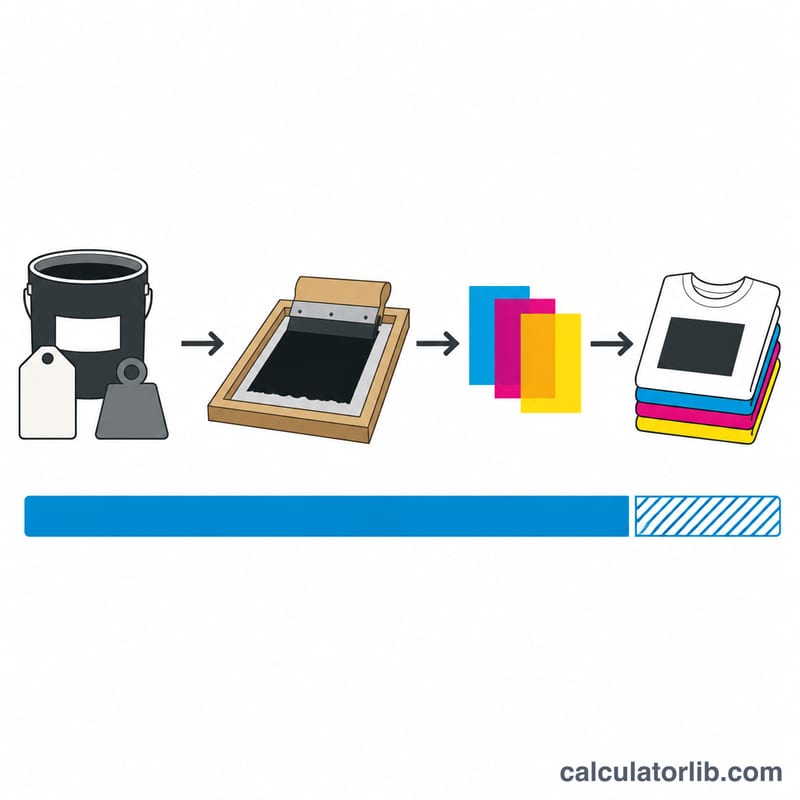
Plastisol and water-based inks are sold by the container, but jobs are quoted by the piece. This calculator converts a container price into a real ink cost per print and per job, so you can price a run with confidence instead of guessing. It works in any currency and uses grams for ink weight and square inches for image area, the units most ink technical sheets quote.
How to use it
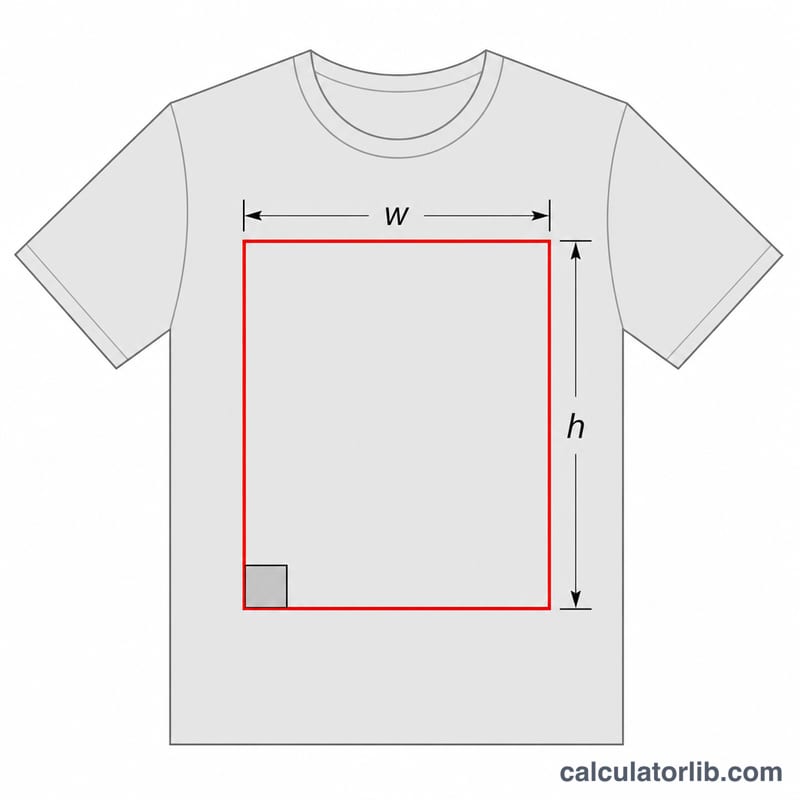
Enter the price and net weight of the container you actually buy, the printed image area for one garment, how many ink colours (print passes) the design needs, and the deposit rate from the ink data sheet. A typical single-stroke deposit on a 110–160 mesh is roughly 5–10 grams per 100 square inches; thick white on dark fabric can be much higher. Finally add a waste allowance for flooding the screen, test prints and ink left in the bucket, and the run quantity.
The formula
With \(A\) = image area in square inches, \(N\) = colour passes, \(R\) = deposit in grams per 100 sq in, \(w\) = waste percent, \(P\) = container price, \(W\) = container net weight in grams and \(Q\) = run quantity:
$$C_{\text{print}} = \frac{A \times N \times R}{100} \times \left(1 + \frac{w}{100}\right) \times \frac{P}{W}$$The job total is simply \(C_{\text{job}} = C_{\text{print}} \times Q\).
Worked example
A 1,000 g container costs 30. The design is one colour over a 100 sq in area at 7 g per 100 sq in, with a 10% waste allowance, for 250 shirts.
$$\frac{P}{W} = \frac{30}{1000} = 0.03 \text{ per gram}$$$$m = \frac{100 \times 1 \times 7}{100} \times 1.10 = 7.7\,\text{g}$$$$C_{\text{job}} = 7.7 \times 250 \times 0.03 = 57.75$$That is about 0.231 of ink per shirt, and 1,925 g of ink pulled from stock.
Ink Deposit Rates by Mesh Count and Ink Type
The deposit rate \(R\) (grams of ink laid down per 100 square inches of printed area, per pass) is the one input most printers have to estimate rather than read off a label. It depends on mesh count, thread diameter, stencil thickness, squeegee angle and pressure, off-contact, and the ink's own density — so treat the figures below as indicative starting points, not constants. Mesh counts are given in threads per inch (the convention used in the United States); metric mesh counts in threads per centimetre are roughly the US number divided by 2.54.
| Mesh (threads/in) | Ink type / application | Typical deposit (g per 100 sq in, per pass) | Notes on strokes and pressure |
|---|---|---|---|
| 110 | Standard plastisol, single stroke | 2.0 – 3.5 | One flood, one firm stroke. Common for bold spot colour on light garments; the upper end reflects heavy pressure or a soft squeegee. |
| 156 | Standard plastisol, single stroke | 1.5 – 2.5 | General-purpose spot colour; moderate pressure, 70–75 durometer blade. |
| 180 | Plastisol, single stroke | 1.2 – 2.0 | Finer detail and small text; light-to-moderate pressure keeps edges sharp. |
| 230 | Plastisol, halftones and overprints | 0.8 – 1.5 | Sharp blade, low pressure. Printing over a flashed underbase reduces deposit further because the surface is already sealed. |
| 305 | Plastisol / simulated process, fine halftone | 0.5 – 1.0 | Minimal pressure, high angle. Deposit is small enough that four fine-mesh colours can cost less than one 110-mesh hit. |
| 86 – 110 | Low-bleed / high-opacity white underbase on dark garments | 4.0 – 6.5 | Often two strokes, or print–flash–print. Whites are pigment-heavy (high titanium dioxide loading) and therefore dense, so grams climb faster than film thickness suggests. This is usually the single most expensive pass in a job. |
| 110 – 160 | Water-based and discharge inks | 1.5 – 3.0 (wet) | Wet deposit; water-based inks lose much of their mass to evaporation during curing, but you buy and weigh the wet ink, so cost should be figured wet. Discharge activator added at the press adds a few percent to mass. |
| 86 – 110 | Puff plastisol | 3.0 – 5.0 | Needs a heavy, even lay-down to raise properly; a thin deposit puffs unevenly. Budget nearer the top of the range. |
| 24 – 60 | Metallic, glitter and shimmer inks | 5.0 – 10.0 | Coarse mesh is required to pass the flake; one slow stroke. Per-gram ink price is also typically well above standard plastisol. |
| 32 – 60 (thick stencil) | High-density / gel, raised prints | 8.0 – 15.0+ | Capillary film stencils of 200–400 microns do most of the work; deposit scales with stencil thickness, not mesh alone. |
Calibrate, don't trust the table. As the FAQ describes, weigh the ink container (or the whole screen-and-ink setup) on a kitchen or bench scale before a run and again after a known number of prints, then divide:
$$R = \frac{ {\text{grams used}} \times 100}{\text{prints} \times \text{image area (sq in)} \times \text{passes}}$$
Fifty prints is usually enough to average out the start-up waste. One measured \(R\) for your own press, blade and mesh is worth more than any published range, and it is the number you should type into the deposit field.
Cost per Print Across Typical Jobs
Every row below uses the article's formula with one consistent ink price: a 1000 g container costing 30.00, i.e. \(c = 30.00 / 1000 = 0.03\) per gram. Grams per print and cost per print are:
$$g = \frac{\text{Area} \times \text{Colors} \times R}{100} \times \left(1 + \frac{\text{Waste}}{100}\right), \qquad \text{Cost per print} = g \times 0.03$$
Rows 1–4 and 6 use a mid-range plastisol deposit of \(R = 2.5\) g per 100 sq in per pass; row 5 uses \(R = 4.0\) to reflect a heavy white underbase averaged over its four passes. Currency is left unitless — the arithmetic is identical whichever currency you price ink in.
| Job | Image area (sq in) | Passes (colours) | Deposit R (g/100 sq in) | Waste % | Ink grams per print | Cost per print | Cost for 250 pieces |
|---|---|---|---|---|---|---|---|
| 1-colour left-chest | 30 | 1 | 2.5 | 15 | 0.863 | 0.0259 | 6.47 |
| 1-colour full front | 100 | 1 | 2.5 | 10 | 2.75 | 0.0825 | 20.63 |
| 2-colour full front | 100 | 2 | 2.5 | 15 | 5.75 | 0.1725 | 43.13 |
| 4-colour spot front | 120 | 4 | 2.5 | 20 | 14.4 | 0.4320 | 108.00 |
| White underbase + 3 colours, dark garment | 150 | 4 | 4.0 | 20 | 28.8 | 0.8640 | 216.00 |
| Oversized 1-colour front | 200 | 1 | 2.5 | 10 | 5.5 | 0.1650 | 41.25 |
Worked arithmetic for row 4, so the pattern is clear:
$$g = \frac{120 \times 4 \times 2.5}{100} \times \left(1 + \frac{20}{100}\right) = 12 \times 1.2 = 14.4\ \text{g}$$
$$\text{Cost per print} = 14.4 \times 0.03 = 0.432, \qquad \text{250 prints} = 0.432 \times 250 = 108.00$$
Two patterns are worth reading off the table. First, colours multiply: the same 100 sq in image costs roughly twice as much in ink at two colours as at one, because each pass lays its own film. Second, the dark-garment job is the outlier — at 0.864 per print it costs more in ink than the oversized single-colour front at more than twice the printed inches, purely because of the opaque white underbase and its higher deposit. If a dark-garment quote feels tight, the underbase is where to look: a finer underbase mesh, a print–flash–print instead of a double stroke, or a garment colour that needs less opacity all cut grams directly.
Putting the Number to Work
The calculator gives you grams and a cost figure. Turning that into a defensible quote takes a few more steps.
- Convert grams into whole containers. Ink is sold by the container, not the gram, so divide total job grams by the container's net weight and round up. The four-colour job above needs \(14.4 \times 250 = 3600\) g in total, or 900 g per colour; against 1000 g containers that is \(3600 / 1000 = 3.6\) → four containers to have on hand. Check the label for net weight rather than assuming: a US quart of plastisol typically weighs somewhere around 1.0–1.3 kg depending on pigment loading, and pigment-heavy whites sit at the top of that range.
- Set the waste allowance to match the job, not a house default. Use 15–25% for short runs, underbase whites and multi-colour work, where screen filling, registration pulls, flooding and scraping the screen out all consume ink that never reaches a garment. Use 5–10% for long single-colour runs, where the fixed start-up loss is spread across hundreds of prints. A 500-piece one-colour run and a 24-piece four-colour run genuinely do not waste ink at the same rate.
- Recalibrate the deposit rate on your own press. Weigh the bucket before the run and again after the first 50 prints, then back out \(R\) with the formula in the deposit-rate section and re-run the numbers. Do this once per mesh/blade/ink combination you use regularly and keep the results in a note; after a handful of measurements your estimates stop being estimates.
- Quote ink as one line among several. Ink is usually a small share of the cost of a printed garment. Add blank garments, screens and reclaim, emulsion and film, press set-up and registration labour, printing labour per piece, dryer time and energy, folding and packing, and your margin as separate lines. A quote built only on ink cost will lose money even when the ink figure is perfectly accurate.
- Treat leftovers as stock, not loss. Plastisol does not air-dry, so clean ink returned to a sealed container stays usable more or less indefinitely and is inventory value rather than waste. Water-based and discharge inks are different: once activated, discharge has a working life of hours to a day, so for those jobs mix close to what the calculator says you need. Ink scraped off a screen and contaminated with another colour is genuinely gone — that is part of what the waste percentage is paying for.
- Re-run the numbers when anything structural changes. A new ink brand, a switch from 156 to 230 mesh, a move to a thicker stencil or a change in garment colour all shift grams per print. The cheapest lever in the whole calculation is usually mesh count: moving a solid colour from 110 to 156 mesh can cut its ink deposit by roughly a third with no visible difference on most designs.
This section is general operational guidance for estimating material cost; it is not professional pricing, accounting or business advice, and it does not account for your local ink prices, tax treatment or contractual terms. Validate the figures against your own purchase invoices and measured runs before quoting work.
FAQ
Why is my real usage higher? Underbase white, heavy coverage halftones and coarse mesh all raise the deposit. Weigh a container before and after a short run and divide by the number of prints to calibrate your own \(R\).
Does this include anything but ink? No. Garments, screens, emulsion, tape, labour, dryer time and reclaim are separate cost lines; add them on top of this figure before quoting.
How do I handle multi-colour art where colours cover different areas? Run the calculator once per colour with that colour actual area and a single pass, then add the per-print results together.