What this calculator does
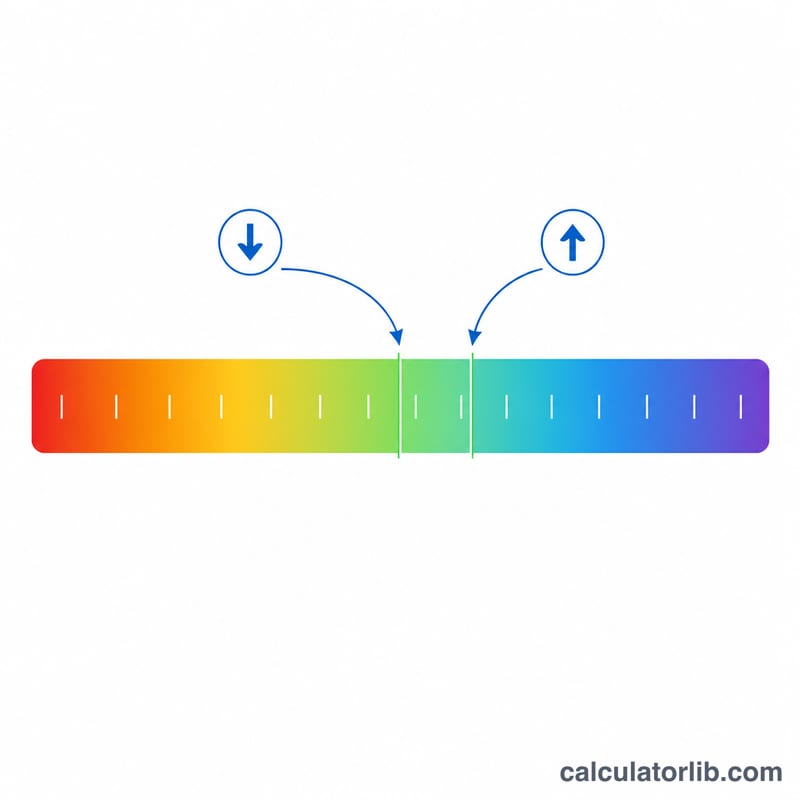
Pool water sits comfortably between pH 7.4 and 7.6. Below that the water is corrosive to plaster, grout, heaters and eyes; above it chlorine loses sanitising power and scale forms. This tool takes your pool volume, your measured pH, your target pH and your total alkalinity, then tells you how much acid or soda ash to add to close the gap. Pool chemistry is universal, so the tool works anywhere — only the units switch between US gallons and liters.
How to use it
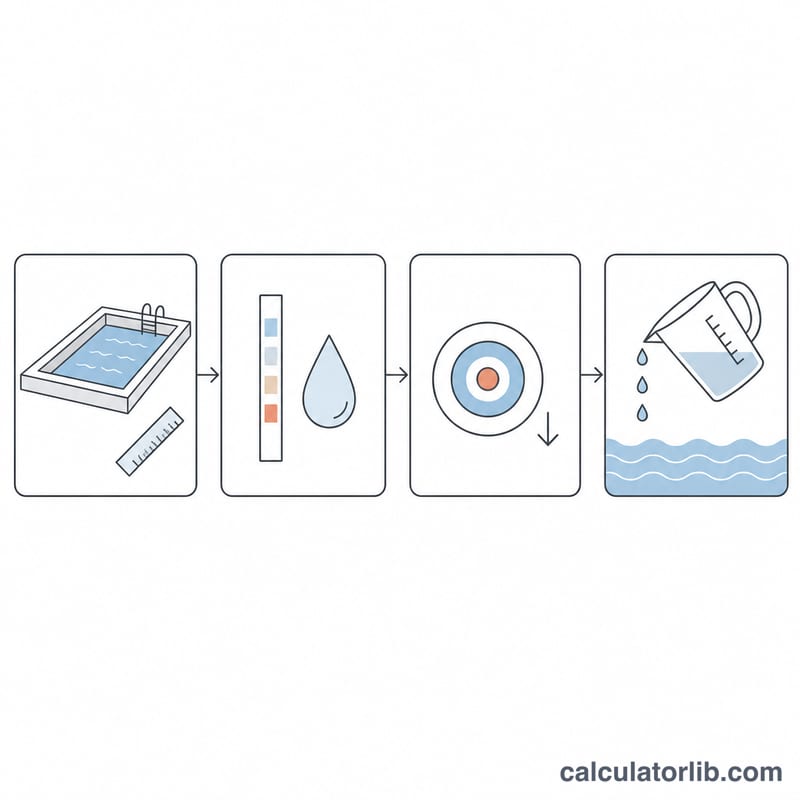
Enter the pool volume (use liters if that is how you know it), the pH from a fresh test, the pH you want, and your total alkalinity in ppm. If the pH is too high, pick whether you dose liquid muriatic acid at 31.45% or granular dry acid (sodium bisulfate). The result shows the primary dose in big type plus every alternative unit — cups, milliliters, pounds and grams.
The formula
To raise pH, soda ash is dosed per 10,000 gallons and per pH unit:
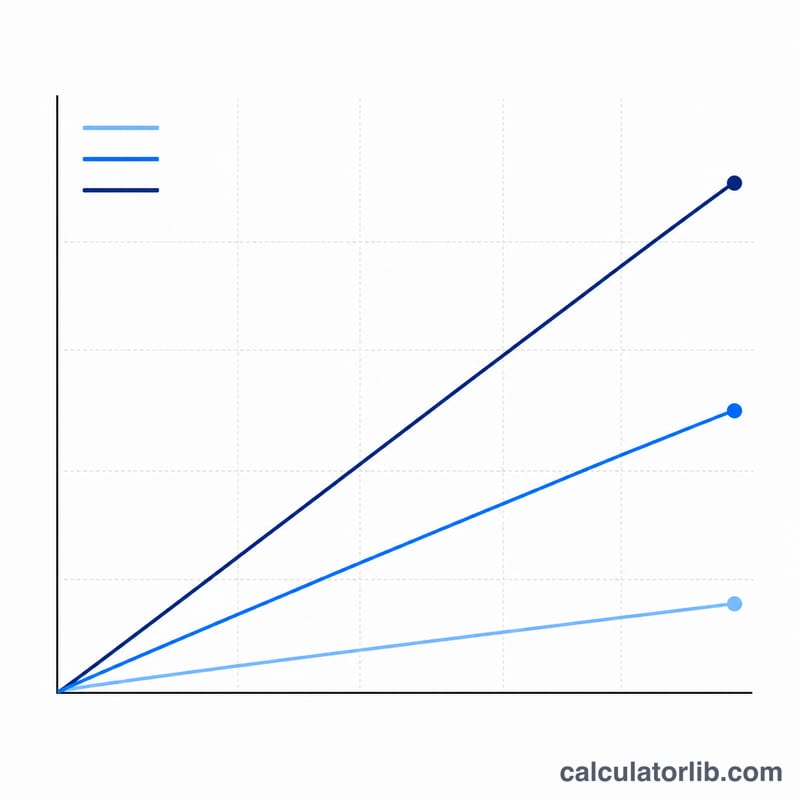
$$m_{\text{soda ash}} = 30 \times \frac{V}{10{,}000} \times \Delta\text{pH}\ \text{oz}$$To lower pH, acid demand also scales with total alkalinity, because carbonate alkalinity is what resists the change:
$$v_{\text{muriatic}} = 64 \times \frac{V}{10{,}000} \times \frac{TA}{100} \times \Delta\text{pH}\ \text{fl oz}$$Here \(V\) = volume in US gallons, \(TA\) = total alkalinity in ppm, and \(\Delta\text{pH}\) = the absolute pH change wanted. Dry acid is taken as \(1.375\) oz by weight per fluid ounce of 31.45% muriatic acid.
Worked example
A 10,000 gallon pool reads pH 7.2 and you want 7.6, so \(\Delta\text{pH} = 0.4\):
$$m = 30 \times \frac{10{,}000}{10{,}000} \times 0.4 = 12\ \text{oz} = 0.75\ \text{lb}$$So three quarters of a pound of soda ash, added in two halves several hours apart.
Ideal Pool Water Chemistry Ranges
The ranges below are the ones used in United States guidance — the CDC Model Aquatic Health Code (MAHC) for public pools and the ANSI/APSP/ICC-11 water-quality standard that most US residential pool literature follows. Other countries regulate pools differently: Germany's DIN 19643, for example, works with much lower free-chlorine residuals (roughly 0.3–0.6 mg/L) in continuously filtered public pools, and UK (PWTAG) guidance differs again. Check your local code before treating any figure here as a legal limit.
| Parameter | Ideal range | Acceptable range | Notes |
|---|---|---|---|
| pH | 7.4 – 7.6 | 7.2 – 7.8 | Target 7.5 if you want one number. Below 7.2 the water is corrosive to metals, grout and plaster; above 7.8 chlorine loses most of its bite and scale forms. |
| Total alkalinity (TA) | 80 – 120 ppm | 60 – 180 ppm | Aim for the lower end, 80–100 ppm, if you sanitize with trichlor or liquid chlorine (acidic / high-TA-drifting feeds); 100–120 ppm suits salt systems and cal-hypo. |
| Calcium hardness | 200 – 400 ppm (plaster, pebble, tile) 175 – 225 ppm (vinyl, fiberglass) |
150 – 1000 ppm | Low calcium in a plaster pool etches the surface; high calcium plus high pH gives cloudy water and scale. |
| Cyanuric acid (CYA) | 30 – 50 ppm (outdoor pools) | Up to 100 ppm | Stabilizer for outdoor pools only — indoor pools need little or none. CYA does not affect pH directly but changes how much free chlorine you need. |
| Free chlorine | 2 – 4 ppm | 1 – 4 ppm | Scale the target with CYA. A reading in range is meaningless if pH is out of range. |
Correct alkalinity before pH
Total alkalinity is the water's buffer: it resists pH change. If TA is far outside 80–120 ppm, fix it first. With TA too low, pH bounces after every rain, swim or dose and your acid addition will overshoot; with TA too high, pH creeps upward relentlessly and no amount of acid "holds" until the buffer itself comes down. This is also why the dose formula scales with TA — the same pH move needs proportionally more acid in more heavily buffered water:
$$\text{Muriatic acid (fl oz)} = 64 \cdot \frac{V}{10000} \cdot \frac{T}{100} \cdot \Delta$$
Why pH above 7.8 matters so much
Free chlorine exists as a mix of hypochlorous acid (HOCl, the strong killing form) and hypochlorite ion (OCl⁻, roughly 50–100× weaker as a disinfectant). The split depends on pH, with a dissociation constant near pH 7.5 at 25 °C (77 °F):
| pH | Approx. share of free chlorine as HOCl |
|---|---|
| 7.0 | ~78% |
| 7.2 | ~69% |
| 7.5 | ~52% |
| 7.8 | ~36% |
| 8.0 | ~26% |
So a pool at pH 8.0 with 3 ppm free chlorine has less active sanitizer than a pool at pH 7.4 with 1.5 ppm. Bringing pH back into the 7.4–7.6 band is usually cheaper and faster than adding more chlorine.
Acid and Base Strength Factors
This calculator's baseline acid is 31.45% hydrochloric acid — the 20° Baumé "full strength" muriatic acid sold for pools in the US. If your bottle or bag says something else, convert with the dose factors below. Volumes are US fluid ounces; dry-chemical amounts are ounces by weight.
Products that lower pH
| Product | Typical strength | Dose relative to 31.45% muriatic | Side effect on total alkalinity |
|---|---|---|---|
| Muriatic acid (20° Baumé) | 31.45% HCl | 1.0× (baseline) | Lowers TA about 10 ppm per 25 fl oz per 10,000 gal — unavoidable, acid always lowers both. |
| Muriatic acid (10° Baumé, "safety" or "low-fume" acid) | 14.5% HCl | ≈ 2.2× the volume | Same TA drop per unit of acid delivered; you simply pour about twice as much liquid. |
| Dry acid (sodium bisulfate) | ~93.2% NaHSO₄ | 1.375 oz by weight per 1 fl oz of 31.45% acid | Equivalent TA drop (~10 ppm per 35 oz per 10,000 gal) and adds sulfate, which accumulates permanently and can attack plaster and concrete in heavily dosed pools. |
| Sulfuric acid | 38% H₂SO₄ | ≈ 1.0× by volume (it is close to acid-equivalent to 31.45% muriatic) | Same TA drop; also adds sulfate. Common in acid feeders because it fumes far less than muriatic. |
Products that raise pH
| Product | Typical strength | Working rate | Side effect on total alkalinity |
|---|---|---|---|
| Soda ash (sodium carbonate) | ~100% Na₂CO₃ | Baseline ≈ 30 oz by weight per 10,000 gal per 1.0 pH unit (much less per step near pH 7.5 — work in small doses and retest) | Raises TA roughly 7 ppm per 10 oz per 10,000 gal, so about 20 ppm at the 30 oz rate. Strong pH mover, moderate TA mover. |
| Sodium bicarbonate (baking soda) | ~100% NaHCO₃ | About 1.5 lb per 10,000 gal raises TA ≈ 10 ppm | Primarily a TA product. Its own equilibrium pH is near 8.3, so above about pH 7.2 it barely moves pH at all — use it to rebuild alkalinity, not to fix a low pH reading. |
| Borax (sodium tetraborate decahydrate, e.g. 20 Mule Team) | ~99% Na₂B₄O₇·10H₂O | Roughly 3–4× the weight of soda ash for a comparable pH move; about 3.7 lb per 10,000 gal adds ≈ 5 ppm borate | Adds a borate buffer near pH 9 that slows the usual upward pH drift. Borates do register in a standard TA titration, so subtract their contribution before judging your TA number. |
A practical note on labels: "muriatic acid" with no Baumé or percentage on the jug is ambiguous in some markets, and diluted 14.5% product is increasingly common in US retail because of shipping and fume rules. Read the percentage before you dose — assuming full strength when you are holding half strength is the single most common reason a pH correction under-delivers.
Practical Dosing and Safety Notes
A worked dose
A 20,000 gallon plaster pool reads pH 8.0 with total alkalinity at 100 ppm, and you want 7.5:
$$64 \cdot \frac{20000}{10000} \cdot \frac{100}{100} \cdot (8.0 - 7.5) = 64 \cdot 2 \cdot 1 \cdot 0.5 = 64 \ \text{fl oz}$$
That is 64 fl oz of 31.45% muriatic acid — half a US gallon. In practice you would add 32 fl oz (one quart) now, circulate, retest, and decide about the rest. Expect this dose to also pull total alkalinity down by roughly 25 ppm, from 100 to about 75 ppm.
Handling acid
- Always add acid to water, never water to acid. Acid poured into a small amount of water can boil and spit back at you.
- Either dilute the measured acid in a plastic bucket of pool water (acid in, slowly, after the water) and pour that in, or walk the deep end and pour the acid slowly into the water in front of a return jet — with the pump running in both cases.
- Never mix acid with chlorine, shock, algaecide or anything else — acid plus hypochlorite releases chlorine gas. One chemical, one bucket, one dose.
- Wear eye protection and gloves, stand upwind, and keep the jug capped between pours. Store acid and chlorine apart and never in the same cabinet.
Handling soda ash
- Pre-dissolve soda ash in a bucket of pool water and pour the solution slowly across the surface near a return. Broadcasting dry soda ash causes cloudy water and can leave grey spots etched or scaled into plaster.
- Add it with the pump running, in the deep end, and expect temporary cloudiness that clears within a few hours of filtration.
Getting the dose right
- Dose no more than half the calculated amount at a time. Overshooting pH downward with acid is much more annoying to undo than adding the second half.
- Run circulation 4–6 hours before you retest. A sample taken 20 minutes after dosing tells you almost nothing.
- Retest with fresh reagents. Phenol red and DPD solutions degrade, and strips that have been damp or sitting in a hot shed read badly. Every number in the formula above — pH and alkalinity both — comes from your test kit, so a stale test skews the whole calculation. Replace reagents at least yearly.
- Take the sample elbow-deep, away from returns and skimmers, and not immediately after heavy swimmer load or a rainstorm.
- If total alkalinity is well outside 80–120 ppm, correct alkalinity first. At low TA your pH will not hold and will swing back within days; at high TA it will climb straight back up.
- Avoid dosing in direct midday sun and heat — the water is most stratified, outgassing is highest, and a reading taken then is the least representative. Early evening with the pump running is ideal.
- Keep swimmers out until the water has circulated and retested in range, and never let anyone swim near a spot where undiluted acid has just been poured.
This section is general information and not professional advice. Always follow the safety instructions and dosing rates printed on the product you actually bought, observe your local rules for public or commercial pools, and consult a pool professional for persistent chemistry problems, staining, or equipment damage.
FAQ
Why does alkalinity matter only for acid? Alkalinity is the buffer that fights a pH drop, so acid demand rises with it. Raising pH with soda ash also raises alkalinity, so the simpler per-gallon rule is used.
Should I add the whole dose at once? No. Add about half, run the pump 4 to 6 hours, retest, then repeat. Overshooting is far harder to fix than undershooting.
Can I use baking soda instead? Baking soda (sodium bicarbonate) mainly raises alkalinity and barely moves pH. Use soda ash when pH is the problem.