What this calculator does
The Duct CFM Calculator converts a duct size and an air velocity into volumetric airflow, measured in CFM (cubic feet per minute). It works for both rectangular sheet-metal ducts and round pipe, and also reports the cross-sectional area, the velocity expressed in feet per second, the equivalent round diameter, and the duct perimeter. These are the numbers HVAC technicians, balancers and DIY installers need when sizing a branch run, checking whether an existing duct can carry the air a room requires, or converting a rectangular trunk to flex or spiral pipe. The method is pure geometry, so it applies in any country; only the units are imperial.
The formula explained
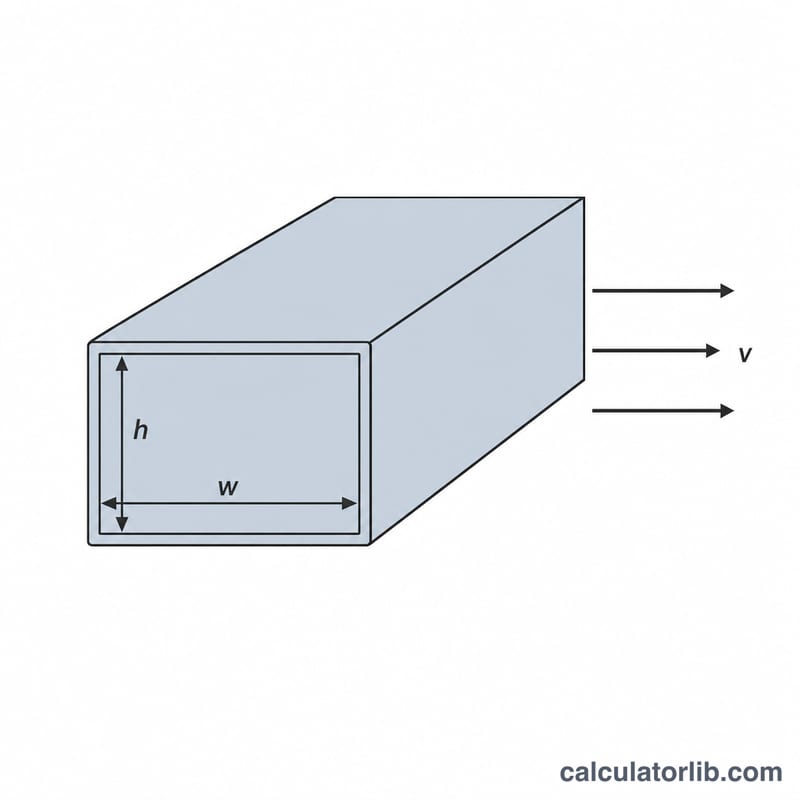
Airflow is simply area multiplied by speed:
$$\text{CFM} = A_{ft^2} \times V_{FPM}$$where \(A_{ft^2}\) = duct cross-sectional area in square feet and \(V_{FPM}\) = average air velocity in feet per minute. Because duct sizes are given in inches, the area must be divided by 144:
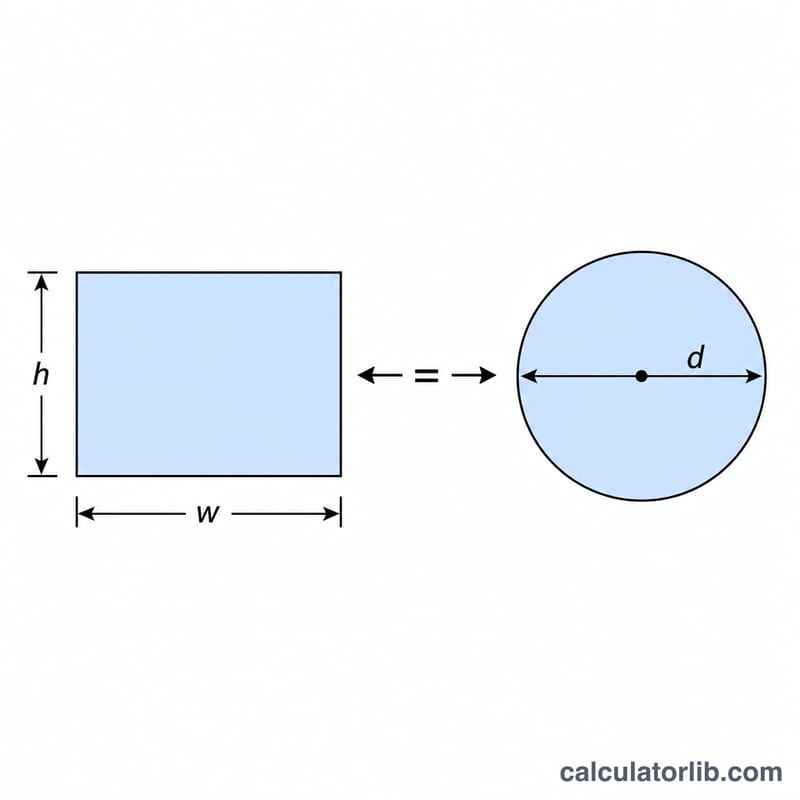
$$A_{ft^2} = \frac{W \times H}{144} \quad \text{(rectangular)}, \qquad A_{ft^2} = \frac{\pi d^{2}}{4 \times 144} \quad \text{(round)}$$The equivalent round diameter, useful when swapping a rectangular duct for pipe of the same free area, is \(d_{eq} = \sqrt{4A/\pi}\) with \(A\) in square inches.
Typical design velocities: 700–900 FPM for residential branch runs, 900–1200 FPM for trunk ducts, and 1200–1800 FPM for commercial main ducts. Higher velocities raise noise and static pressure loss.
Worked example
A 12 in × 8 in rectangular branch carries air at 900 FPM. First the area:
$$A = \frac{12 \times 8}{144} = \frac{96}{144} = 0.6667\,\text{ft}^2$$Then the airflow:
$$\text{CFM} = 0.6667 \times 900 = 600\,\text{CFM}$$That duct moves about 600 CFM, enough for roughly 500–600 sq ft of conditioned space at one CFM per square foot. Its equivalent round size is \(d_{eq} = \sqrt{4 \times 96 / \pi} = 11.05\,\text{in}\), so a 12 in round pipe would be the practical substitute.
Key Terms and Variables Defined
- CFM — cubic feet per minute
- Volumetric airflow rate: the volume of air crossing a section each minute. This is the tool's output and the quantity equipment, registers and ventilation requirements are rated in.
- FPM — feet per minute
- Air velocity, the average speed of the airstream through the duct. It is the input that, multiplied by free area in square feet, gives CFM.
- ft/s — feet per second
- The same velocity in a more intuitive unit: \(\text{ft/s} = \text{FPM} / 60\). So 900 FPM is 15 ft/s.
- Cross-sectional (free) area
- The clear open area the air actually flows through, in square feet. From inside dimensions in inches: \(A = \dfrac{W \times H}{144}\) for rectangular duct, \(A = \dfrac{\pi d^2}{576}\) for round.
- Equivalent round diameter (equal area)
- The round duct with the same free area as a given rectangular duct: \(d = \sqrt{4A/\pi}\). Useful for matching a rectangular trunk to round fittings by velocity, since equal area means equal velocity at equal CFM.
- Equal-friction equivalent diameter
- A different and larger-duct-penalising number: the round duct that has the same friction loss per unit length at the same airflow. The ASHRAE expression (dimensions in inches) is $$D_e = \frac{1.30\,(ab)^{0.625}}{(a+b)^{0.25}}$$ For a 12 × 8 duct this gives about 10.7 in, versus 11.06 in by equal area. The equal-friction value is the one used when sizing from a friction chart; do not substitute the equal-area value there.
- Duct perimeter
- \(2(W+H)\) for rectangular or \(\pi d\) for round, in inches — a sheet-metal quantity estimate, since material and sealing cost scale with perimeter × length, not with airflow.
- Aspect ratio
- The ratio of a rectangular duct's width to its height (W:H). Flat ducts carry more friction and more metal per CFM than square ones; keep the ratio under about 4:1 where space allows.
- Traverse
- A measurement method: velocity readings are taken on a defined grid of points across the duct and averaged, because velocity is highest at the centre and near zero at the wall. A single centreline reading overstates average velocity and therefore overstates CFM.
- Static, velocity and total pressure
- Static pressure is the pressure acting on the duct walls (the resistance the fan works against, usually in inches of water column). Velocity pressure is the pressure due to the air's motion. Total pressure is their sum; a pitot tube measures the difference between total and static, from which velocity is derived.
- Anemometer and pitot tube
- A vane, hot-wire or thermal anemometer reads velocity directly in FPM — typically at a grille face or in the duct. A pitot tube with a manometer derives velocity from velocity pressure and is the standard instrument for in-duct traverses.
- CFM per ton
- System airflow divided by nominal cooling capacity in tons (one ton = 12,000 BTU/h in US equipment ratings). Around 400 CFM/ton is the usual design target, with 350–450 CFM/ton the acceptable band.
Always enter inside (clear) dimensions. Nominal duct sizes refer to the sheet-metal or outside dimension in some product lines, and any internal liner or internal insulation eats into the opening — a 12 × 8 duct with 1 in of liner on all four sides has a free area of 10 × 6, which is 0.417 sq ft instead of 0.667 sq ft, a 37% loss. Enter the reduced inside dimensions, or the calculated CFM will be too high and the real velocity (and noise) will be higher than designed.
FAQ
What velocity should I assume? If you have no measurement, use 700–900 FPM for residential branches, 900–1200 FPM for residential trunks and 1200–1800 FPM for commercial mains. Lower velocity means quieter, lower-pressure duct but a larger, costlier duct.
How do I measure velocity in the field? Take a traverse of readings with an anemometer or a pitot tube across the duct face and average them; a single centreline reading overstates the average by roughly 10–20 percent.
Does this account for friction or fittings? No. This is the continuity relationship only. Static pressure loss depends on duct length, roughness and fitting equivalent lengths, which are handled by a friction-loss chart or a duct-sizing tool such as a ductulator.