What this calculator does
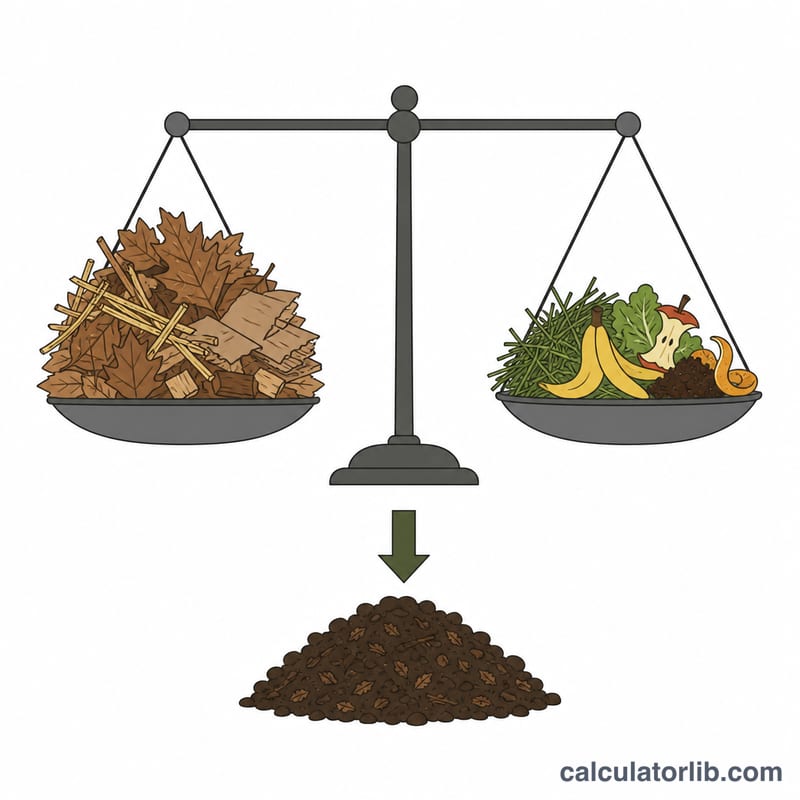
Compost microbes eat carbon for energy and nitrogen to build cells. They work fastest when the pile supplies roughly 30 parts carbon to 1 part nitrogen. Too much nitrogen and the heap turns into a sour, ammonia-smelling sludge; too much carbon and it just sits there cold for a year. This tool takes the amount of nitrogen-rich greens you actually have and tells you how much carbon-rich browns to pile on top of it.
How to use it
Weigh or estimate your greens, then pick a carbon-to-nitrogen ratio for each stream from the suggestion lists: vegetable scraps are about 15:1, fresh grass 20:1, dry leaves 60:1, straw 80:1, cardboard 170:1, sawdust 400:1. Leave the target at 30 unless you are deliberately building a slower, woodier heap. The greens ratio must be below the target and the browns ratio above it, otherwise no blend of the two can reach it.
The formula explained
Each material contributes mass divided by its own ratio to the nitrogen pool, so the blended ratio is total mass over total nitrogen. Solving that for the browns mass gives:
$$M_b = M_g \times \frac{R_b\,(R_t - R_g)}{R_g\,(R_b - R_t)}$$where \(M_g\) = mass of greens, \(R_g\) = C:N of the greens, \(R_b\) = C:N of the browns and \(R_t\) = target C:N. The carbon fraction of the dry matter cancels out, which is why only the ratios are needed.
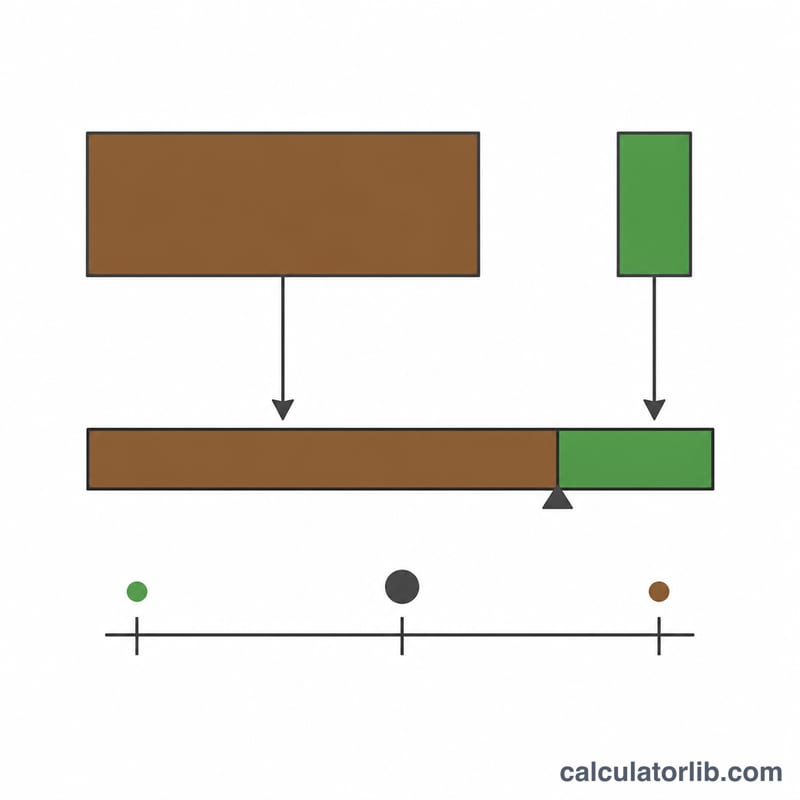
Weights are as-received material weight. Browns are bulky and light, so this amount of straw or leaves will look like a much larger volume than the greens — expect roughly 2 to 3 buckets of browns per bucket of greens. Keep the pile as damp as a wrung-out sponge and turn it when it cools.
Worked example
You have 10 kg of kitchen scraps at 15:1 and a bale of straw at 80:1, aiming for 30:1:
$$M_b = 10 \times \frac{80\,(30 - 15)}{15\,(80 - 30)} = 10 \times \frac{1200}{750} = 16\,\text{kg}$$So 16 kg of straw, a 1.6 : 1 weight ratio, giving a 26 kg pile that is about 61.5% browns by weight.
C:N Ratios of Common Compost Materials
The calculator needs three ratios: the carbon-to-nitrogen ratio of your greens, the ratio of your browns, and the target for the finished mix (conventionally 30:1). The tables below give typical published values. All figures are dry-matter ratios — the carbon and nitrogen content of the material itself, with water excluded — because water contains neither carbon nor nitrogen and only affects moisture, not the C:N balance.
Greens — nitrogen-rich (below 30:1)
| Material | Typical C:N | Notes |
|---|---|---|
| Poultry manure (fresh) | ~10:1 | Very strong nitrogen source; use sparingly |
| Alfalfa / legume hay | 12–15:1 | Legumes fix nitrogen, so ratios are far lower than grass hay |
| Vegetable and fruit scraps | ~15:1 | Very wet; the dry matter is only a small share of the weight |
| Cow manure (fresh) | ~18:1 | Bedding mixed in raises the ratio considerably |
| Seaweed | ~19:1 | Rinse salt off if it was collected from a beach |
| Coffee grounds | ~20:1 | A green despite the brown colour |
| Weeds (green, before seeding) | ~20:1 | Dried-out weeds behave more like browns |
| Grass clippings (fresh) | 15–25:1 | Lower when cut from fertilised lawns, higher when mature and seeding |
| Horse manure (fresh) | ~25:1 | Close to the green/brown boundary; bedding pushes it over 30:1 |
Browns — carbon-rich (above 30:1)
| Material | Typical C:N | Notes |
|---|---|---|
| Nut shells | ~35:1 | Borderline — barely above a 30:1 target; also very slow to break down |
| Hay (dry grass hay) | ~40:1 | Borderline — only just a brown; grass hay differs sharply from legume hay above |
| Corn (maize) stalks | ~60:1 | Shred before adding; whole stalks resist decay for a long time |
| Fallen / dry leaves | 40–80:1 | Oak, beech and birch sit at the high end; maple and ash lower |
| Pine needles | ~80:1 | Waxy and slow; mix into a larger pile rather than composting alone |
| Straw | 75–100:1 | The classic bulking brown; holds air structure well |
| Shredded paper (newsprint, office) | ~170:1 | Shred and wet thoroughly or it mats into impermeable sheets |
| Cardboard (plain corrugated) | ~170–500:1 | Published values vary widely; ~350:1 is a common mid-range figure |
| Sawdust (untreated wood) | 400–500:1 | Extremely high carbon — small amounts go a long way |
| Wood chips | 400–600:1 | Decomposes over years, not months; best as a bulking agent |
Why published figures disagree
C:N ratios are measured on real samples, and real samples vary with species, growing conditions, maturity, soil fertility and how long the material has sat outdoors. Widely used reference sets — the Cornell Waste Management Institute composting tables, USDA/NRCS composting guidance, and the Rodale Institute's organic-gardening literature — frequently differ for the same material (grass clippings appear anywhere from 12:1 to 25:1 across sources). Treat the numbers above as representative mid-ranges, not measurements of your own material. Because the mix formula divides by differences between the ratios, a modest error in an input ratio shifts the result but rarely changes the practical answer by more than a bucket or two.
The greens < target < browns rule
The formula only has a physically meaningful solution when your greens ratio is below the target and your browns ratio is above it:
$$\text{Greens C:N} < \text{Target C:N} < \text{Browns C:N}$$If both inputs sit on the same side of the target, no blend of the two can reach it. This is where the borderline materials matter. Grass hay at ~40:1 and nut shells at ~35:1 are technically browns, but against a 30:1 target they supply so little surplus carbon that the required mass of them becomes very large. Likewise, horse manure at ~25:1 is a green only until bedding is counted — straw-heavy stable waste is often already near or above 30:1 and needs greens added, not browns. When a material sits within about 10 points of your target, check which side of the line it actually falls on before entering it.
Practical Mixing Tips
The calculator returns a mass of browns, because C:N ratios are defined by mass. Almost nobody weighs leaves. The steps below turn that number into something you can measure with a bucket and then correct by eye as the pile works.
1. Convert the browns mass into buckets
Divide the required mass by the material's rough bulk density to get a volume:
$$\text{Volume (m}^3) = \frac{\text{Mass (kg)}}{\text{Bulk density (kg/m}^3)}$$| Material | Rough loose bulk density |
|---|---|
| Dry leaves (loose) | 50–100 kg/m³ |
| Straw (loose, unbaled) | 50–80 kg/m³ |
| Sawdust | 200–250 kg/m³ |
| Kitchen scraps | 400–600 kg/m³ |
Worked example. Suppose you have 10 kg of fresh grass clippings at 20:1, dry leaves at 60:1, and a 30:1 target:
$$\text{Browns} = 10 \times \frac{60\,(30 - 20)}{20\,(60 - 30)} = 10 \times \frac{600}{600} = \text{10 kg}$$So the mix needs 10 kg of leaves. At a loose density of about 75 kg/m³ that is 10 ÷ 75 ≈ 0.13 m³, or roughly 130 litres — about thirteen 10-litre buckets of leaves for one bucket-and-a-bit of clippings. Note how different the volumes are even at equal mass: light fluffy browns always occupy far more space than the greens they balance, which is why a correctly balanced heap looks overwhelmingly brown.
2. Layer thin, or mix thoroughly
- Build in thin alternating layers — roughly 5–10 cm of greens to 15–20 cm of browns — or, better still, turn the two together with a fork as you load so the ratio holds at every point in the pile.
- Avoid dumping either material as a single thick block. A 20 cm slab of grass clippings goes anaerobic and sour no matter how much carbon sits elsewhere in the heap; a thick mat of wet paper or leaves blocks air and water movement. The calculated ratio describes the whole heap, but decomposition happens locally.
- Shred or crush coarse browns (cardboard, corn stalks, big leaves) before adding. Surface area, not just the ratio, sets the speed.
3. Keep a reserve of dry browns beside the heap
Stockpile a bag or bin of dry leaves, straw or shredded cardboard next to the pile and cover each new batch of kitchen scraps with a handful or two. This caps odour, blocks flies, absorbs the liquid that wet scraps release, and keeps the running ratio near target between full builds. A covered reserve also stays dry, which is what makes it useful for soaking up excess moisture later.
4. Round browns up, not down
When in doubt, add the extra bucket of carbon. The two errors are not symmetrical: surplus carbon mainly slows the pile down, because microbes must recycle scarce nitrogen through several generations before the extra carbon is consumed. Surplus nitrogen has nowhere to go and escapes as ammonia — so you get a smell, you lose the nitrogen you were trying to capture, and the pile can turn slimy and anaerobic. A pile at 40:1 finishes late; a pile at 15:1 finishes smelly and poorer.
5. Give the heap enough mass to self-heat
Aim for a minimum of about 1 m³ (roughly a 1 m cube). Below that volume the pile loses heat through its surface faster than the microbes generate it, so it never reaches thermophilic temperatures regardless of how well the C:N ratio is balanced. Moisture should feel like a wrung-out sponge — around 50–60% by mass — and the structure should stay open enough for air to reach the centre, which is where coarse straw or wood chips earn their place beyond their carbon contribution.
6. Field corrections once the pile is running
| What the pile is doing | Likely cause | Correction |
|---|---|---|
| Sharp ammonia smell | Too much nitrogen; surplus N volatilising | Fork in dry browns and turn |
| Soggy, slumped, sour or rotten smell | Too wet and airless, usually with excess greens | Add dry absorbent browns, turn to re-aerate, cover against rain |
| Cold, dry and visually unchanged after a week | Too much carbon, too little water, or both | Add greens and water together, then turn |
| Warm centre, cold edges | Normal; heat is lost at the surface | Turn outer material inward; insulate the outside with a brown layer |
| Cools after 1–3 weeks having heated well | Normal end of the active hot phase | Turn once; if it does not reheat, let it cure |
Re-run the calculation whenever your feedstock changes — switching from fresh grass clippings to kitchen scraps, or from leaves to sawdust, moves the required mass a long way. And note that the calculator balances carbon and nitrogen only; it does not account for moisture content, particle size, pH or contaminants, all of which affect whether a correctly balanced pile actually composts well.
FAQ
Is this by weight or by volume? By weight. Browns are far less dense than greens, so 16 kg of straw occupies several times the volume of 10 kg of scraps — expect around two to three buckets of browns per bucket of greens.
Do I have to be exact? No. Anything from 25:1 to 35:1 composts well, and published ratios for the same material vary, so treat the answer as a starting recipe and adjust by smell and heat.
What about moisture? Moisture is tracked separately from C:N. Aim for 50-60% moisture — material that feels like a wrung-out sponge — and turn the heap when it cools below about 40 degrees Celsius.