What the Nitrox Mix Calculator does
Enriched air nitrox (EANx) replaces some of the nitrogen in your breathing gas with extra oxygen. That reduces nitrogen loading and extends no-decompression limits, but the added oxygen introduces a toxicity ceiling. This calculator returns the two numbers every nitrox dive plan needs: the maximum operating depth (MOD) and the equivalent air depth (EAD).
The formulas explained
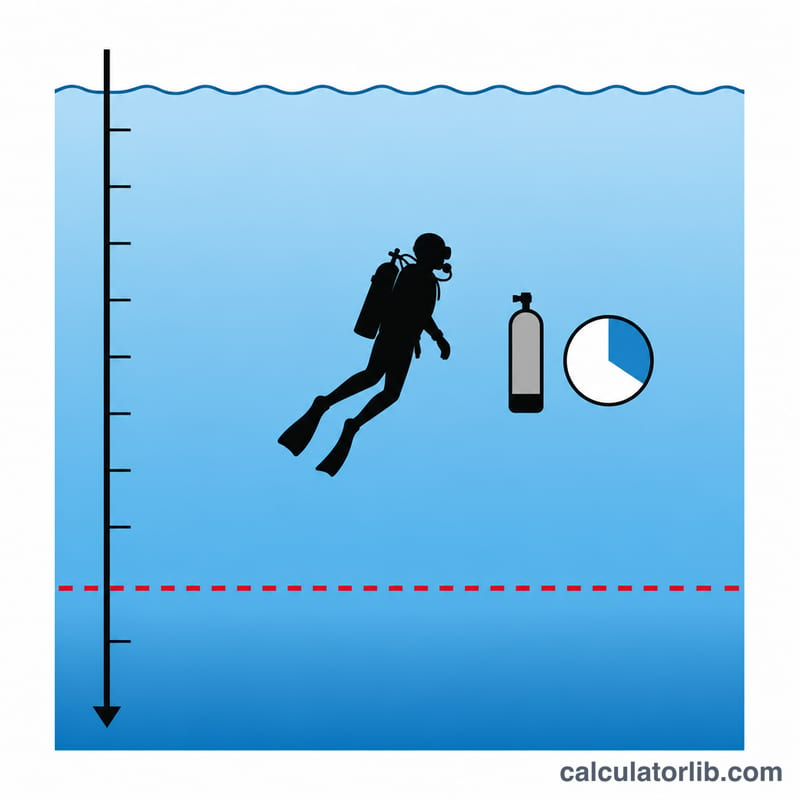
The MOD is the depth where the oxygen partial pressure hits your selected limit \(PO_2\) (commonly 1.4 ATA for the working portion of a dive):
$$\text{MOD} = 10 \times \left( \frac{PO_2}{FO_2} - 1 \right)$$where \(PO_2\) is the maximum oxygen partial pressure in ATA and \(FO_2\) is the oxygen fraction (0.32 for EAN32). The EAD compares your mix to plain air by matching nitrogen partial pressure at planned depth \(d\):
$$\text{EAD} = (d + 10) \times \frac{1 - FO_2}{0.79} - 10$$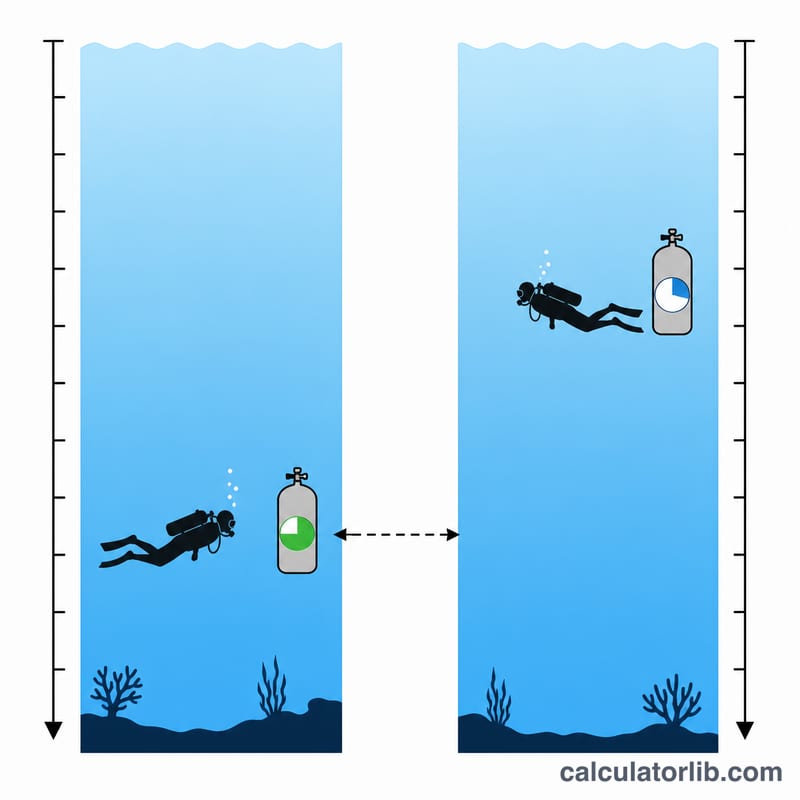
How to use it
Enter the oxygen percentage of your blend, your chosen PO2 ceiling, and the depth you plan to dive. The tool reports the deepest safe depth for that mix and the air-equivalent depth you should use when reading air dive tables.
Worked example
For EAN32 with a 1.4 ATA limit, planning to 30 m:
$$\text{MOD} = 10 \times \left( \frac{1.4}{0.32} - 1 \right) = 33.75\,\text{m}$$$$\text{EAD} = (30 + 10) \times \frac{0.68}{0.79} - 10 = 24.43\,\text{m}$$So this dive is within the MOD, and you would plan nitrogen exposure as if diving to about 24 m on air.
FAQ
Why is 0.79 used? Ordinary air is roughly 79% nitrogen, so it is the reference nitrogen fraction for the EAD comparison.
Which PO2 should I pick? Most agencies use 1.4 ATA for the active dive and 1.6 ATA as an absolute contingency maximum. Lower limits give a shallower, more conservative MOD.
Does this replace training? No. These figures support planning, but always follow certified nitrox training and analyse your own cylinder.