What is the Round Bale Weight Calculator?
A round hay bale is essentially a solid cylinder of packed forage. This calculator estimates its weight from three simple measurements: the bale diameter, the bale width (the length of the roll), and the density of the packed hay. Knowing the weight helps you price hay, plan feeding rations, check equipment load limits, and manage transport safely.
The formula
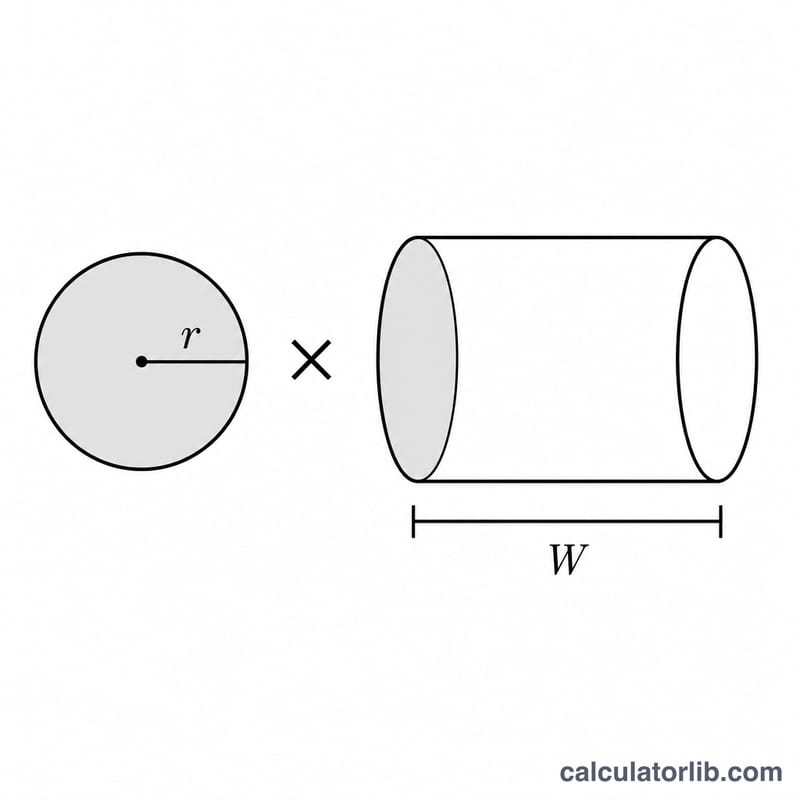
The bale is treated as a cylinder, so its volume is the circular cross-section area multiplied by the width. Multiplying volume by density gives the weight:
$$W = \rho \times \frac{\pi}{4} \times d^2 \times w$$where \(W\) = weight in pounds, \(\rho\) = hay density in \(\text{lb/ft}^3\), \(d\) = bale diameter in feet, and \(w\) = bale width in feet. The term \(\frac{\pi}{4} d^2\) is the circular end area, equivalent to \(\pi r^2\) with \(r = d/2\).
How to use it
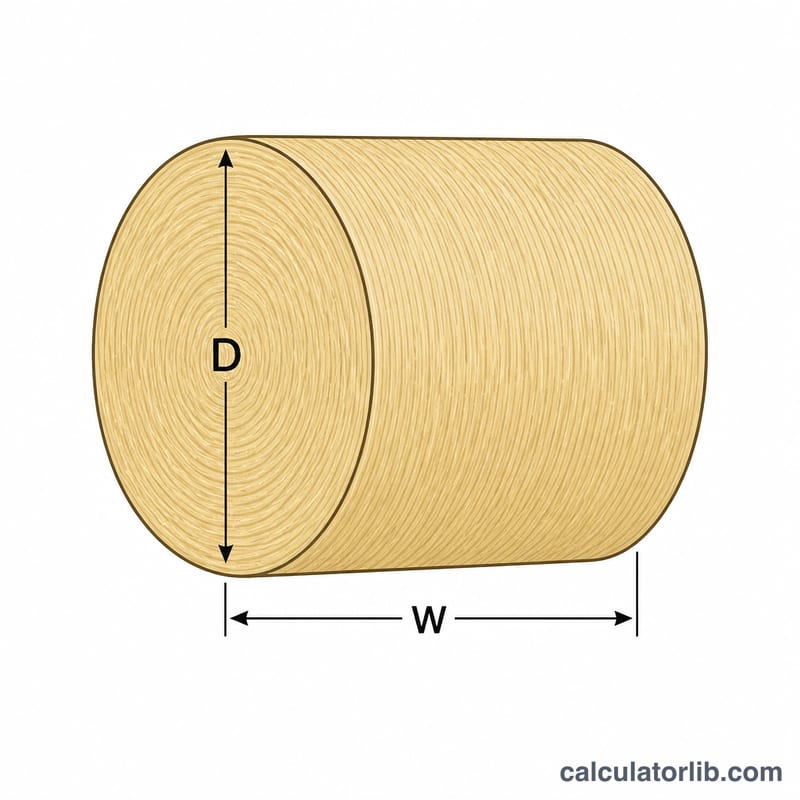
Measure the bale diameter across the flat circular face and the width along the axis of the roll, both in feet. Enter a density value for your hay: typical dry grass hay runs about 8 to 12 \(\text{lb/ft}^3\), while tightly rolled or moist bales are denser. Submit the form to see the estimated weight and the computed cylinder volume.
Worked example
Suppose a bale is \(5\,\text{ft}\) in diameter, \(4\,\text{ft}\) wide, packed at \(10\,\text{lb/ft}^3\). First find the volume:
$$V = \frac{\pi}{4} \times 5^2 \times 4 = 25\pi \approx 78.54\,\text{ft}^3$$Then multiply by density:
$$W = 78.54 \times 10 \approx 785\,\text{lb}$$FAQ
Why model the bale as a cylinder? A rolled round bale is very close to a right circular cylinder, so the cylinder volume gives a reliable estimate.
What density should I use? Density varies with hay type, moisture, and how tightly it was baled. If unsure, weigh one bale on a scale and back-solve \(\rho = W / V\) to calibrate.
Does moisture change the weight? Yes. Wetter hay is heavier and denser, so use a higher density value for high-moisture bales.