What is round bar bend allowance?
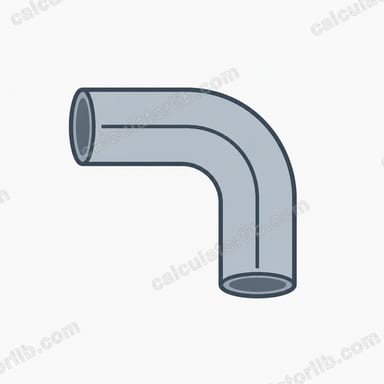
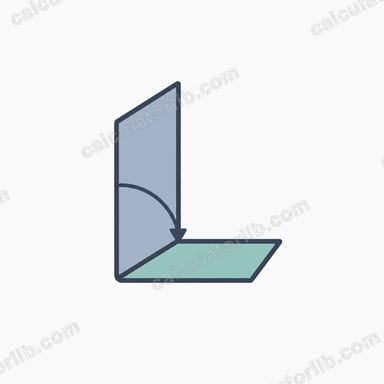
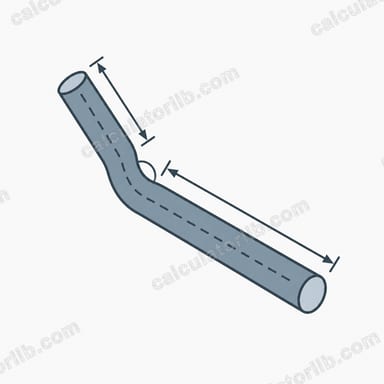
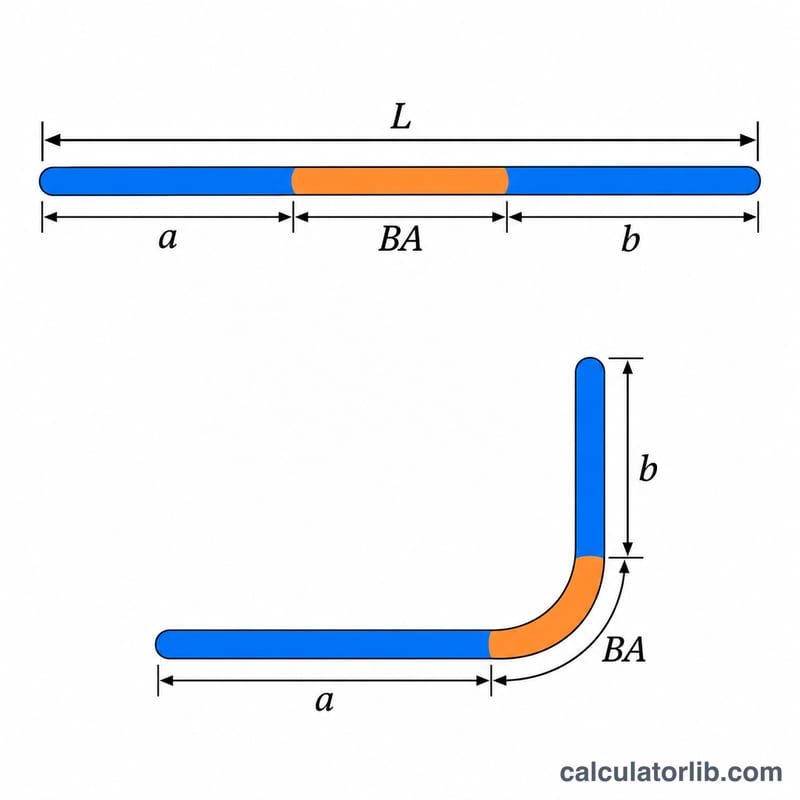
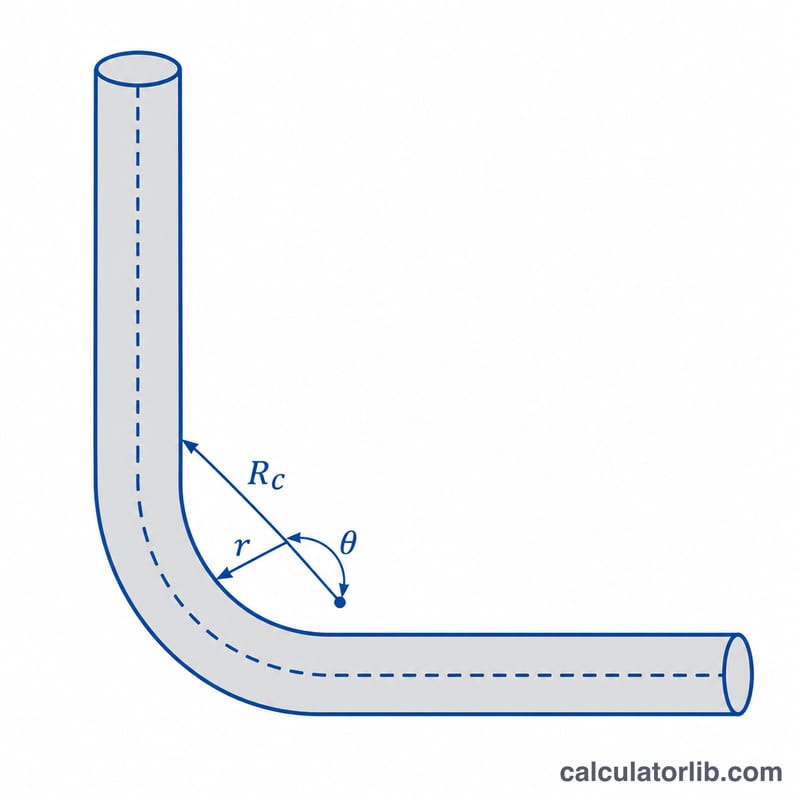
When a round bar is bent, the outside of the bend stretches and the inside compresses. Somewhere between them lies a neutral axis that keeps its original length. The bend allowance is the arc length of that neutral axis through the bend, and it is the amount of straight stock that is consumed by the curved section. Adding it to the straight legs gives the cut length before bending.
How to use this calculator
Enter the bar diameter, the angle the bar turns through (a right-angle corner is 90°), and the inside bend radius measured to the inner surface of the bar. Keep all lengths in one unit, such as millimetres or inches. The neutral axis factor K defaults to 0.5, which places the neutral axis on the bar centerline, a common assumption for solid round bar with a generous radius. Enter the two straight leg lengths, measured from the bar ends to where the bend starts, to get the total cut length.
The formula explained
The neutral axis radius is the inside radius plus K times the diameter. The arc length is that radius times the bend angle in radians.
$$BA = \frac{\pi \, \theta}{180} \times (R + K \times d)$$Here \(\theta\) is the bend angle in degrees, \(R\) the inside radius, \(d\) the bar diameter and \(K\) the neutral axis factor. The cut length is then
$$L = L_1 + L_2 + BA$$For very tight bends the neutral axis shifts toward the inside, so a K below 0.5 may match your tooling better. Confirm with a test bend.
Worked example
A 10 mm bar is bent 90° around an inside radius of 15 mm, with two 100 mm legs. The neutral axis radius is
$$R_n = 15 + 0.5 \times 10 = 20\,\text{mm}$$The bend allowance is
$$BA = \frac{\pi \times 90}{180} \times 20 = 31.416\,\text{mm}$$So the cut length is
$$L = 100 + 100 + 31.416 = 231.416\,\text{mm}$$Typical K-Factor Values and Minimum Bend Radius for Round Bar
In this calculator, the K-factor locates the neutral axis (the fibre that neither stretches nor compresses) as a fraction of the bar diameter \(d\), measured from the inside of the bend. The neutral radius is \(R_c = R + K\cdot d\), where \(R\) is the inside radius. For round bar, K is close to 0.5 (the bar centre) when the bend is gentle. It moves toward the inside as the bend gets tighter.
Suggested starting K by R/d ratio
| Inside radius / diameter (R/d) | Suggested K | Comment |
|---|---|---|
| 2 or more | about 0.50 | Gentle bend; the neutral axis stays near the bar centre |
| 1 to 2 | about 0.45 | Slight shift toward the inside |
| 0.5 to 1 | about 0.40 | Moderate shift |
| Below 0.5 (tight) | about 0.33 to 0.35 | Strong shift; the most variation between materials and tooling |
These are starting estimates only. Material, temper, tooling and the bending method all change the true value. Verify with a trial bend: bend a test piece, measure the actual overall length, and adjust K until the calculated cut length matches.
Indicative minimum inside radius by material
| Material | Typical minimum inside radius (cold bend) |
|---|---|
| Mild / low-carbon steel | about 1 to 2 × d |
| Stainless steel (austenitic) | larger, often about 2 to 3 × d, because of work hardening and springback |
| Aluminum, soft temper (e.g. annealed) | about 1 to 2 × d |
| Aluminum, heat-treated or hard temper | noticeably larger, often several × d; high risk of cracking if bent too tightly |
These values are indicative only. The real limit depends on the alloy and temper, bar quality, tooling, bend speed, temperature, and the governing specification or supplier data. Always follow the material supplier's or applicable code's requirement. For example, US reinforcing-bar practice (ACI 318) sets minimum bend diameters for standard hooks in terms of bar diameter, and other countries' codes differ.
Quick check
For \(d = 10\) mm, a 90° bend, inside radius 20 mm (R/d = 2) and K = 0.5: \(R_c = 20 + 0.5\cdot 10 = 25\) mm. Then \(BA = \frac{\pi\cdot 90}{180}\cdot 25 \approx 39.27\) mm. With two 100 mm legs, \(L = 100 + 100 + 39.27 =\) 239.27 mm.
FAQ
Is the bend angle the included angle?
No. It is the angle the bar turns through. A bar bent into a right-angle corner has a bend angle of 90°, and a straight bar has 0°.
Does springback affect the result?
Springback changes the final angle you achieve, not the arc length, so you may overbend slightly, but the allowance still uses the target angle.
Can I use it for tube or flat bar?
The same arc formula works, but the best K factor differs by section and material, so adjust K and verify with a trial piece.