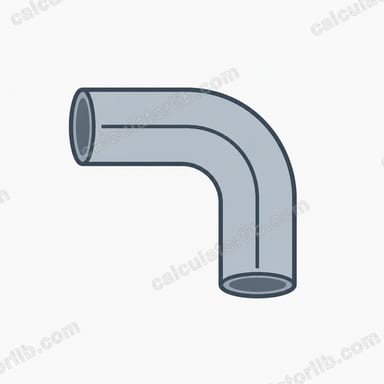
What is tube bend allowance?
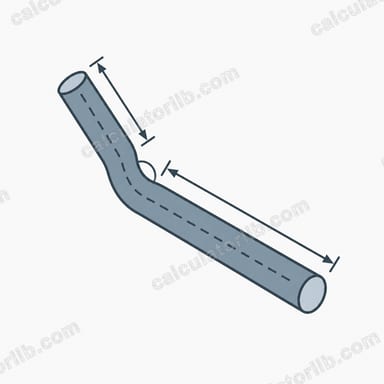
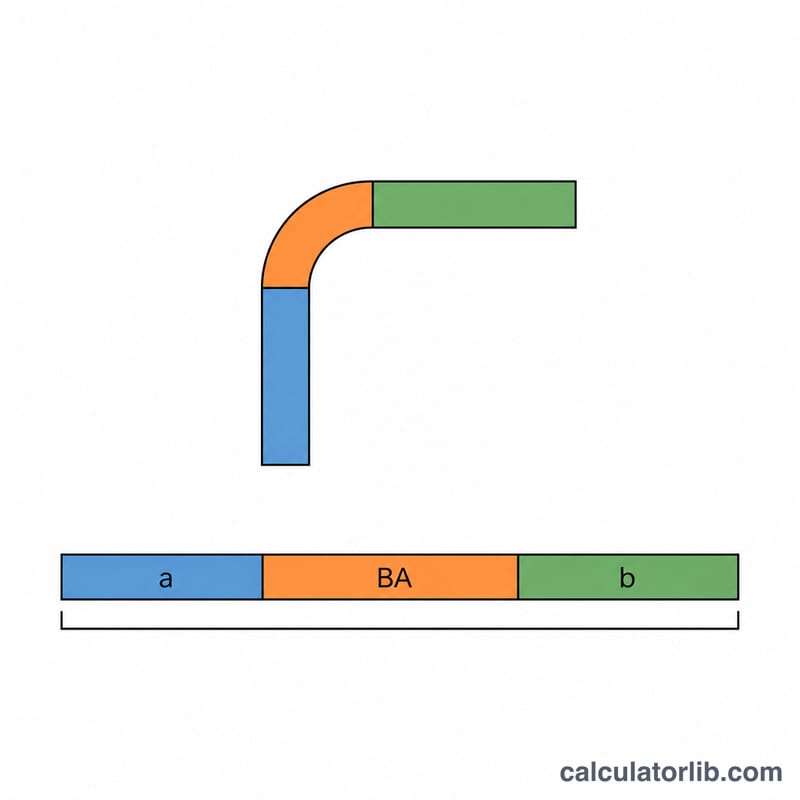
When a tube is bent, the material along its centerline keeps its length while the outer wall stretches and the inner wall compresses. The bend allowance is the length of the centerline arc through the bend. Adding it to the straight sections gives the length of tube you need to cut before bending.
How to use this calculator
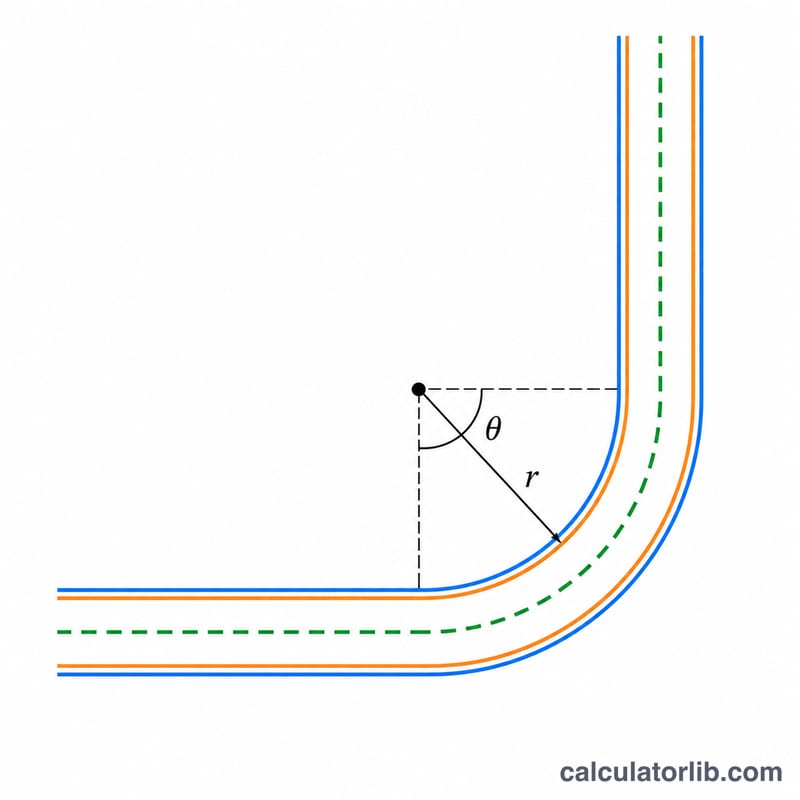
Enter the tube outside diameter, the bend angle in degrees, and the centerline radius (CLR) of your bender die. Then enter the two straight leg lengths measured to the tangent points where the bend begins and ends. Use one unit consistently. The calculator returns the bend allowance, the cut length, and the outer and inner wall arc lengths.
The formula explained
The centerline arc is a fraction of a circle:
$$\text{BA} = \frac{\theta \times \pi}{180} \times R$$Here \(\theta\) is the bend angle in degrees and \(R\) is the centerline radius. The cut length is:
$$L_{\text{cut}} = L_1 + L_2 + \text{BA}$$The outer arc uses radius \(R + \text{OD}/2\) and the inner arc uses \(R - \text{OD}/2\).
Worked example
A 1.5 in OD tube is bent 90° on a 4.5 in CLR die with straight legs of 10 in and 8 in.
$$\text{BA} = \frac{90 \times \pi}{180} \times 4.5 = 7.069\,\text{in}$$$$L_{\text{cut}} = 10 + 8 + 7.069 = 25.069\,\text{in}$$The outer wall arc is 8.247 in and the inner wall arc is 5.890 in.
How CLR and Bend Angle Change Bend Allowance
The table fixes the tube at OD = 1.5 in with straight legs of 10 in and 8 in (18 in of straight length in total). It then varies the bend angle and the centerline radius (CLR). Each value uses \(BA = \dfrac{\theta\pi}{180} \times R\), where \(R\) is the CLR for the bend allowance, \(R = \text{CLR} + \text{OD}/2\) for the outer arc, and \(R = \text{CLR} - \text{OD}/2\) for the inner arc. The cut length is \(18 + BA\). All lengths are in inches. The CLR/OD ratio is 2.0 for a 3 in CLR, 3.0 for 4.5 in and 4.0 for 6 in.
| Angle | CLR (in) | Bend allowance (in) | Cut length (in) | Outer arc (in) | Inner arc (in) |
|---|---|---|---|---|---|
| 45° | 3.0 | 2.356 | 20.356 | 2.945 | 1.767 |
| 90° | 3.0 | 4.712 | 22.712 | 5.890 | 3.534 |
| 135° | 3.0 | 7.069 | 25.069 | 8.836 | 5.301 |
| 45° | 4.5 | 3.534 | 21.534 | 4.123 | 2.945 |
| 90° | 4.5 | 7.069 | 25.069 | 8.247 | 5.890 |
| 135° | 4.5 | 10.603 | 28.603 | 12.370 | 8.836 |
| 45° | 6.0 | 4.712 | 22.712 | 5.301 | 4.123 |
| 90° | 6.0 | 9.425 | 27.425 | 10.603 | 8.247 |
| 135° | 6.0 | 14.137 | 32.137 | 15.904 | 12.370 |
Worked check for 90° at 4.5 in CLR: \(\theta = 90\pi/180 = 1.5708\) rad, so \(BA = 1.5708 \times 4.5 = 7.069\) in and \(L_{cut} = 10 + 8 + 7.069 = 25.069\) in. The outer arc is \(1.5708 \times (4.5 + 0.75) = 8.247\) in and the inner arc is \(1.5708 \times (4.5 - 0.75) = 5.890\) in.
Two things stand out. Bend allowance is directly proportional to both the angle and the CLR, so doubling either one doubles the bend allowance. The difference between the outer and inner arcs is \(\theta \times \text{OD}\), so it depends only on the angle and the OD, not on the CLR. Here the difference is 1.178 in at 45°, 2.356 in at 90° and 3.534 in at 135°.
Typical CLR-to-OD Ratios and Minimum Bend Radii
The CLR/OD ratio (often written as "D", so 2D means CLR = 2 × OD) is the quickest way to judge how severe a bend is. The ranges below are general shop rules of thumb, not a formal standard.
| CLR/OD ratio | Bend severity | Typical comment |
|---|---|---|
| About 1D | Very tight | Usually needs a mandrel and ductile, thin-to-moderate wall tube. Expect more wall thinning and ovality, and a higher risk of wrinkling or cracking. |
| 1.5D – 2D | Tight, common with mandrel bending | Achievable with good tooling, a mandrel and suitable material. |
| 2D – 3D | Standard rotary-draw bending | A common working range. Quality is generally good and tooling is widely available. |
| 3D and above | Easy, gradual | Low distortion, often possible without a mandrel on thicker-wall tube. Takes more space and gives a larger bend allowance. |
- The practical minimum radius depends on the material (its ductility and temper), the wall thickness, whether a mandrel and wiper die are used, and the tooling quality. Thin-wall tube (large OD/wall ratio) needs a larger CLR or a mandrel.
- Tubing standards and bender manufacturers publish their own minimum radii for specific tube sizes and materials. Use those figures rather than a general ratio when they are available.
- In the example table, the 3 in, 4.5 in and 6 in CLR values on a 1.5 in OD tube correspond to 2D, 3D and 4D.
Tube Bending Terms and Variables
- Outside diameter (OD)
- The outer diameter of the tube, in length units such as mm or in. Use the same unit for every length in the calculator.
- Bend angle (θ)
- The angle in degrees through which the tube direction changes. A straight tube is 0° and a right-angle elbow is 90°. The formula converts it to radians with \(\theta = \text{angle} \times \pi / 180\).
- Centerline radius (CLR)
- The radius of the bend measured to the tube's centerline, in length units. It is the radius used for the bend allowance.
- Tangent points
- The two points where the tube centerline stops being straight and starts to curve, and where it returns to straight after the bend.
- Straight legs (Leg 1, Leg 2)
- The straight lengths of tube on either side of the bend, measured up to the tangent points, in length units.
- Bend allowance (BA)
- The centerline arc length of the bend, \(BA = \theta \times \text{CLR}\) with θ in radians. It is the amount of tube material consumed by the bend.
- Cut length
- The length of straight tube to cut before bending: \(L_{cut} = \text{Leg 1} + \text{Leg 2} + BA\). Add extra length for clamping or trimming if your process requires it.
- Outer arc
- The arc length along the outside of the bend, \(\theta \times (\text{CLR} + \text{OD}/2)\). This surface stretches and thins.
- Inner arc
- The arc length along the inside of the bend, \(\theta \times (\text{CLR} - \text{OD}/2)\). This surface compresses. The calculator limits the radius to a minimum of 0 if the CLR is smaller than half the OD.
- Springback
- The small elastic recovery of the tube after the bending force is released, which opens the bend angle slightly. Operators usually overbend by a material- and tooling-dependent amount, found by test bends. This calculator does not model it.
This tool uses the geometric centerline method. It assumes the centerline length does not change during bending, which is a common approximation. Real tube may differ slightly because of material stretch, so a test bend is advisable for tight tolerances.
FAQ
Does tube diameter change the bend allowance?
Not for a centerline calculation. Diameter only affects the outer and inner arc lengths, and the minimum practical radius.
Why is my bent tube slightly different from the calculation?
Springback, wall stretch, and die tolerances shift real results. Test-bend a sample and adjust the angle or length if you need tight tolerances.
What CLR should I choose?
Many shops use a CLR of at least 2 to 3 times the tube OD. Tighter bends risk wrinkling or flattening.