What is the pulse width to frequency calculator?
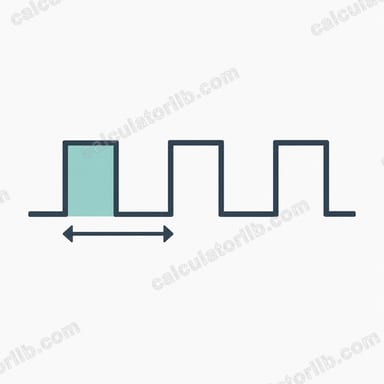
This calculator converts the duration of a pulse in a repeating electronic signal into the signal frequency. Pulse width alone does not fix the frequency: you also need to know what fraction of each cycle the signal is high, called the duty cycle. For a symmetrical square wave the duty cycle is 50%, so one cycle lasts exactly twice the pulse width.
How to use it
Enter the pulse width, choose its unit (seconds, milliseconds, microseconds or nanoseconds) and enter the duty cycle in percent. The calculator returns the frequency in Hz, kHz and MHz, plus the period, the pulse width and the off time in microseconds. If you only need the simple reciprocal 1/t, set the duty cycle to 100%.
The formula explained
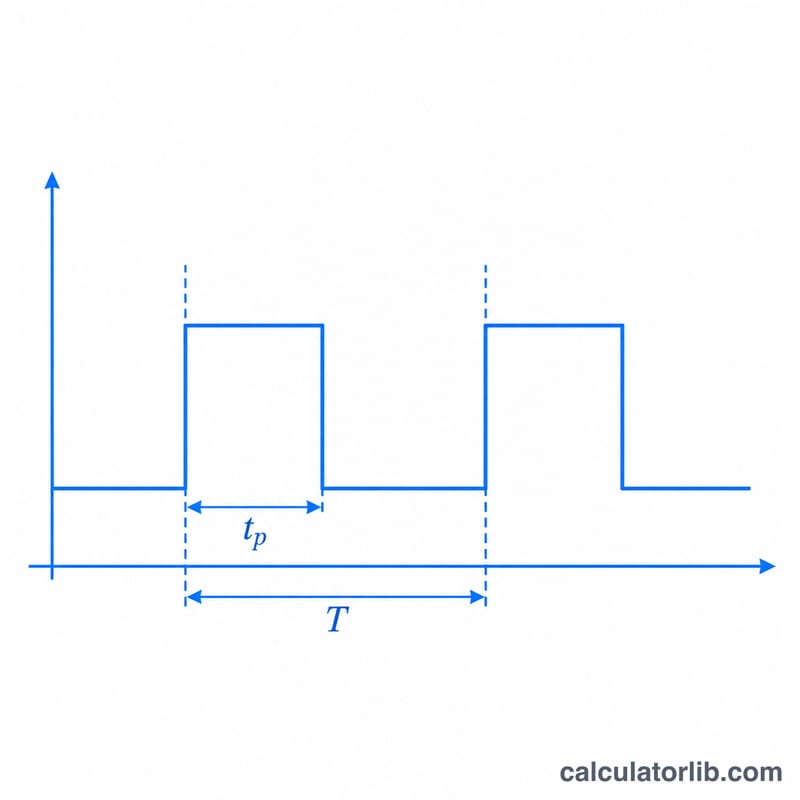
The period \(T\) is the pulse width \(t_p\) divided by the duty fraction \(D\), and the frequency is the reciprocal of the period:
$$f = \frac{1}{T} = \frac{D}{t_p}$$Here \(f\) is in hertz, \(t_p\) in seconds and \(D\) is a fraction between 0 and 1 (for example 50% is 0.5).
Worked example
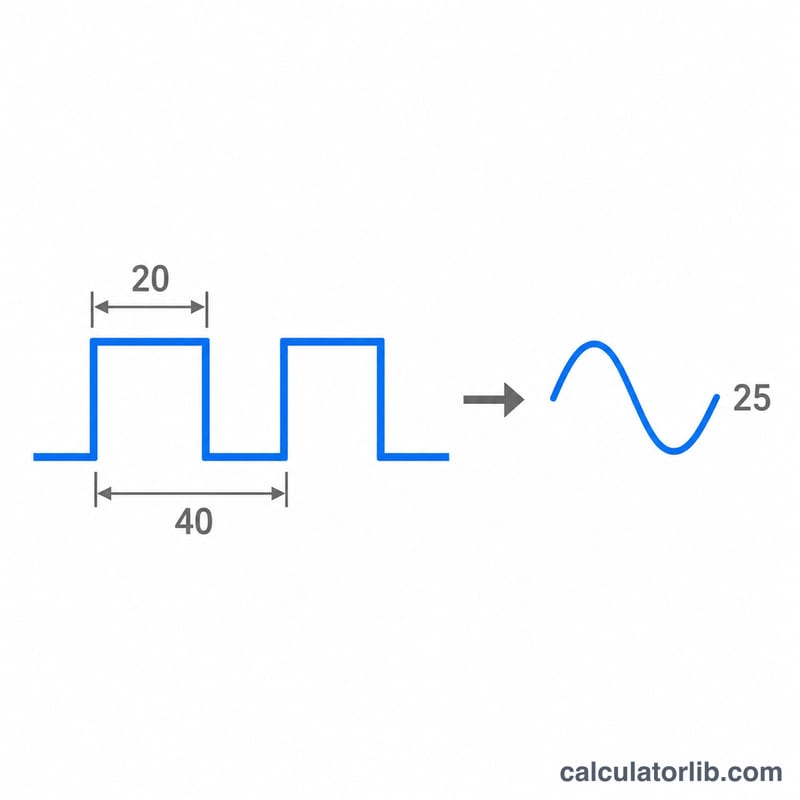
A 20 µs pulse in a 50% duty cycle signal gives:
$$T = \frac{20\,\mu\text{s}}{0.5} = 40\,\mu\text{s}$$$$f = \frac{1}{40 \times 10^{-6}\,\text{s}} = 25{,}000\,\text{Hz} = 25\,\text{kHz}$$The off time is 40 − 20 = 20 µs.
Key Terms: Pulse Width, Period, Duty Cycle
- Pulse width (\(t_p\))
- The time a periodic signal stays in its active ("high") state during one cycle, measured in seconds (s), milliseconds (ms), microseconds (µs) or nanoseconds (ns). It is also called the on time or high time. Pulse width is usually measured between the 50% amplitude points of the rising and falling edges.
- Period (\(T\))
- The time for one complete cycle (on time plus off time), in seconds. It is found from the pulse width and duty cycle as \(T = t_p / D\).
- Frequency (\(f\))
- The number of complete cycles per second, in hertz (Hz), where 1 Hz = 1 cycle per second (1/s). It is the reciprocal of the period: \(f = 1/T\). Common multiples are 1 kHz = 1,000 Hz and 1 MHz = 1,000,000 Hz.
- Duty cycle (\(D\))
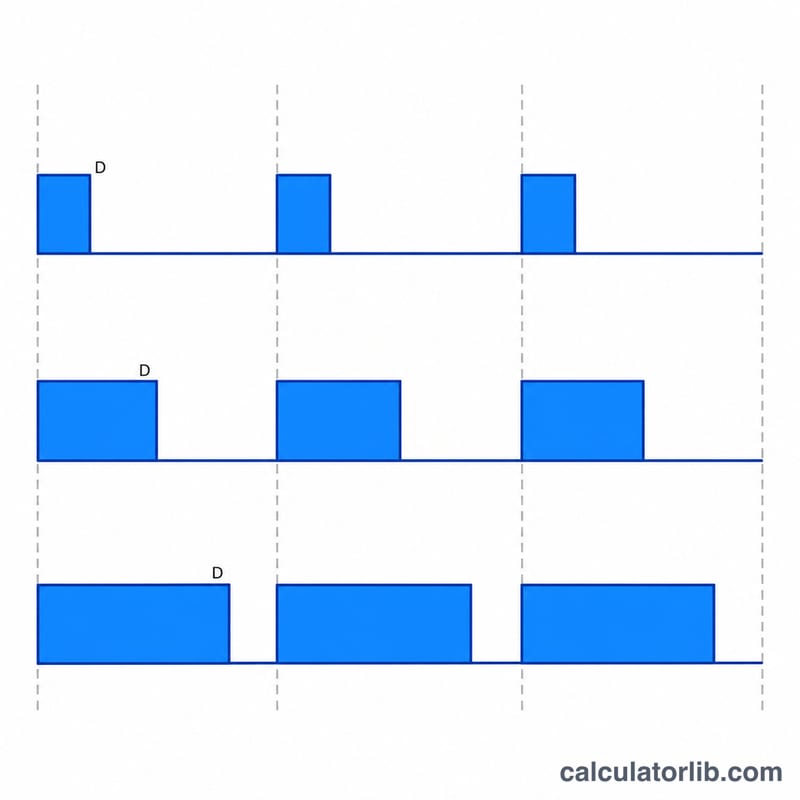
- The fraction of each period during which the signal is high: \(D = t_p / T\). It can be written as a fraction (0 to 1) or as a percentage (0% to 100%). In this calculator the duty cycle is entered as a percentage and divided by 100. A 50% duty cycle gives a symmetric square wave.
- Off time (\(T - t_p\))
- The part of the period during which the signal is low. It equals \(T(1 - D)\). For a 20 µs pulse at 50% duty, the period is 40 µs and the off time is 20 µs.
- Pulse repetition frequency (PRF)
- The number of pulses per second in a pulse train, used especially in radar, lasers and ultrasound. PRF is the same quantity as the signal frequency \(f = 1/T\), and the pulse repetition interval (PRI) is the same as the period.
- PWM (pulse-width modulation)
- A technique in which the frequency stays fixed while the pulse width, and therefore the duty cycle, is varied to control the average power or voltage delivered, for example in motor drives, LED dimming and switching power supplies. For a fixed PWM frequency, changing \(t_p\) changes \(D\) but not \(T\).
Example: \(t_p = 20\,\mu\text{s}\) and \(D = 0.5\) give \(T = 20/0.5 = 40\,\mu\text{s}\), so \(f = 1/(40\times10^{-6}\,\text{s}) = 25{,}000\) Hz = 25 kHz.
FAQ
Can I get frequency from pulse width alone?
Only if you assume a duty cycle. A 50% square wave is the usual default; with a different duty cycle the same pulse width gives a different frequency.
What is the maximum frequency for a given pulse width?
The highest frequency occurs at 100% duty, \(f = 1/t_p\), which is a constant high level. In practice you need some low time between pulses.
How do I convert microseconds to seconds?
Multiply by \(10^{-6}\). For example 20 µs equals 0.00002 s.