What is this lottery lucky number generator?
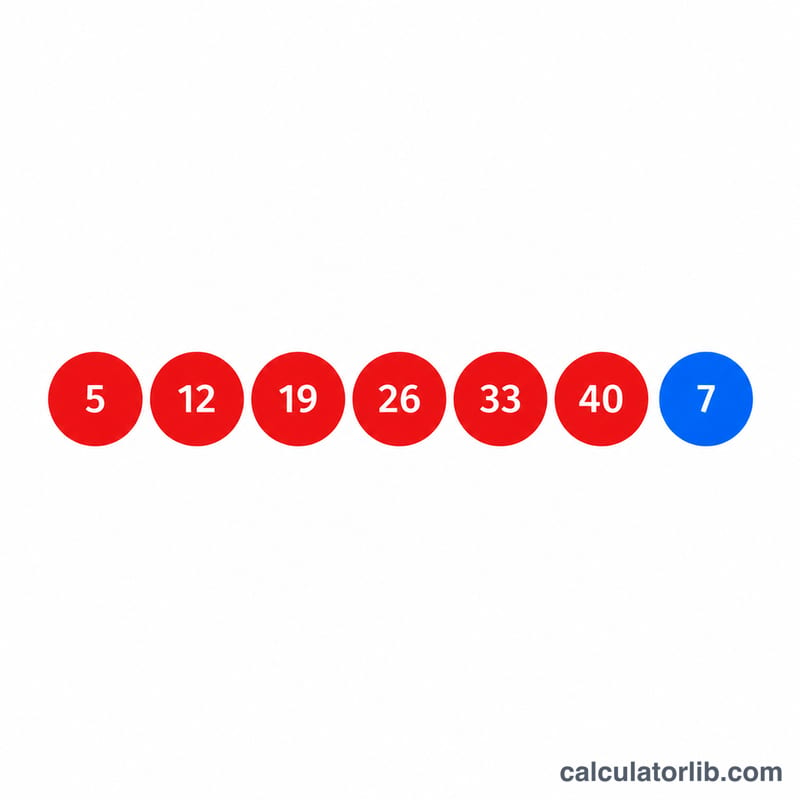
This tool builds a set of Double Color Ball (the Chinese welfare and sports lottery format) picks from a birth date: six red balls numbered 1 to 33 and one blue ball numbered 1 to 16. The same birth date always gives the same numbers, so you can use a birthday, an anniversary or a family member date as a personal lucky set. It is a fun, repeatable picker and not a prediction: every draw is random and no method improves your odds.
How to use it
Enter the birth year, month and day and submit. The red balls are shown in ascending order, as they appear on a ticket, followed by the blue ball. Change the date to get a different set.
The formula explained
Let \(Y\), \(M\) and \(D\) be the year, month and day. First a seed is formed and reduced to a starting offset:
$$s = (Y + M \times D) \bmod 33$$Next a step size \(t = ((D + M) \bmod 32) + 1\) is chosen (increased by 1 if it is 11 or 22, so the sequence never repeats within six picks). The red balls are:
$$r_k = ((s + k\,t) \bmod 33) + 1,\quad k = 0,\dots,5$$Because 33 = 3 \(\times\) 11 and \(t\) is not a multiple of 11, all six values are distinct. The blue ball is:
$$b = ((Y + M \times D) \bmod 16) + 1$$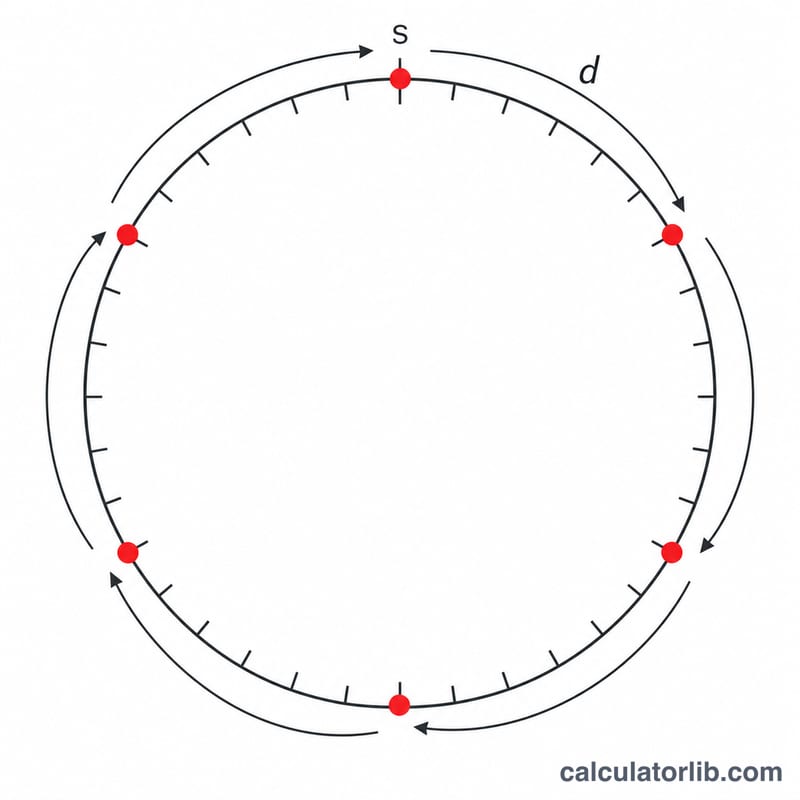
Worked example
Birth date 15 May 1990: \(Y + M \times D = 1990 + 75 = 2065\).
$$s = 2065 \bmod 33 = 19,\quad t = (20 \bmod 32) + 1 = 21$$The offsets 19, 40, 61, 82, 103, 124 reduce mod 33 to 19, 7, 28, 16, 4, 25; adding 1 and sorting gives red balls 5, 8, 17, 20, 26, 29. The blue ball is \(2065 \bmod 16 + 1 = 2\).
Example Picks for Different Birth Dates
The table applies the article's formula exactly: \(B = \text{year} + \text{month} \times \text{day}\), seed \(s = B \bmod 33\), step \(t = ((\text{day}+\text{month}) \bmod 32) + 1\) (add 1 more if \(t\) is 11 or 22), red balls \(R_k = ((s + k\,t) \bmod 33) + 1\) for \(k = 0,\dots,5\), and blue ball \((B \bmod 16) + 1\). This is the Double Color Ball format (6 reds from 1-33, 1 blue from 1-16). The numbers are for fun and do not improve your odds.
| Birth date | B | Seed s | Step t | Red balls (sorted) | Blue ball |
|---|---|---|---|---|---|
| 1 Jan 1985 | 1985 + 1×1 = 1986 | 1986 mod 33 = 6 | (2 mod 32) + 1 = 3 | 07, 10, 13, 16, 19, 22 | (1986 mod 16) + 1 = 3 |
| 15 May 1990 | 1990 + 5×15 = 2065 | 2065 mod 33 = 19 | (20 mod 32) + 1 = 21 | 05, 08, 17, 20, 26, 29 | (2065 mod 16) + 1 = 2 |
| 31 Dec 2000 | 2000 + 12×31 = 2372 | 2372 mod 33 = 29 | (43 mod 32) + 1 = 12 | 09, 12, 21, 24, 30, 33 | (2372 mod 16) + 1 = 5 |
| 7 Mar 1995 (adjustment case) | 1995 + 3×7 = 2016 | 2016 mod 33 = 3 | (10 mod 32) + 1 = 11 → 12 | 04, 07, 16, 19, 28, 31 | (2016 mod 16) + 1 = 1 |
How a row is built (15 May 1990): with \(s = 19\) and \(t = 21\), the raw values \(s + kt\) are 19, 40, 61, 82, 103, 124. Modulo 33 these give 19, 7, 28, 16, 4, 25. Adding 1 gives 20, 8, 29, 17, 5, 26, which sort to 05, 08, 17, 20, 26, 29.
Why the 11/22 adjustment exists: in the last row, \(t\) would be 11 without it. Then \(3 + 3\times 11 = 36 \equiv 3 \pmod{33}\), so the fourth ball would repeat the first. Moving \(t\) to 12 keeps all six red balls distinct.
Double Color Ball Terms and Variables
- Double Color Ball: a lottery format with 6 red balls drawn from 1-33 and 1 blue ball drawn from 1-16. It is best known from the China Welfare Lottery.
- Red ball: one of the six main numbers, each between 1 and 33 and all different from each other.
- Blue ball: the single extra number between 1 and 16. It is calculated separately from the red balls as \((B \bmod 16) + 1\).
- B: the birth-date number \(B = \text{year} + \text{month} \times \text{day}\), which feeds both the seed and the blue ball.
- Seed s: the starting value \(s = B \bmod 33\), between 0 and 32. It fixes the first red ball as \(s + 1\) before sorting.
- Step size t: the gap between successive red balls, \(t = ((\text{day}+\text{month}) \bmod 32) + 1\), so it starts between 1 and 32. If \(t\) is 11 or 22 it is increased by 1, because multiples of 11 would make the sequence repeat within six picks (33 = 3 × 11). The formula above writes this step as \(d\).
- Modulus (mod): the remainder after division. For example, \(2065 \bmod 33 = 19\) because \(2065 = 62\times 33 + 19\). Using mod 33 wraps values back into the 1-33 range, and mod 16 does the same for 1-16.
- Deterministic: the same birth date always produces the same numbers, so a pick can be repeated. Nothing is random, and the result has no predictive power.
- Ascending order: the six red balls are sorted from smallest to largest for display, as on a lottery ticket. The sort does not change which numbers are chosen.
FAQ
Does a birth date improve my chances of winning?
No. Each combination is equally likely in a fair draw; this is purely for entertainment.
Why are the numbers always the same for one date?
The method is deterministic, which makes it a repeatable personal set rather than a random one.
Can I use it for other lotteries?
The ranges are 1-33 and 1-16 for Double Color Ball. Other games use different ranges and would need a different modulus.