
What This Calculator Does
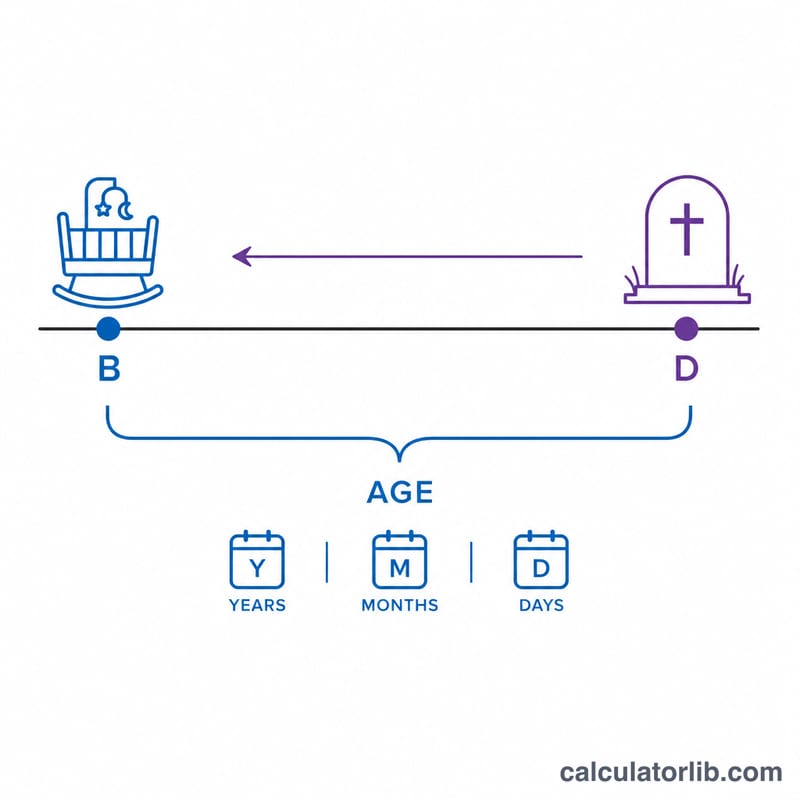
The Birth From Death Date Calculator estimates a person's date of birth when you know the date they died and how old they were at death. This is a common need in genealogy, historical research, and reading gravestones or obituaries, which frequently list a death date and an age but not a birth date.
How to Use It
Enter the death date (year, month and day). Then enter the age at death — at minimum the number of full years, and optionally additional months and days if you have a more precise age. The calculator subtracts that age from the death date and returns the estimated date of birth.
The Formula Explained
The math is simple calendar arithmetic: $$\text{Birth Date} = \text{Death Date} - \text{Age}$$. Subtracting whole years moves the date back the same month and day in an earlier year, while subtracting months and days walks the calendar backward, automatically accounting for differing month lengths and leap years.
Worked Example
Suppose a headstone shows a death date of 15 June 2020 and an age at death of 80 years. Subtracting 80 years gives a birth date of 15 June 1940. If the age were 80 years and 6 months, subtracting an extra six months gives 15 December 1939.
$$\text{15 June 2020} - 80\,\text{years} = \text{15 June 1940}$$$$\text{15 June 2020} - (80\,\text{years} + 6\,\text{months}) = \text{15 December 1939}$$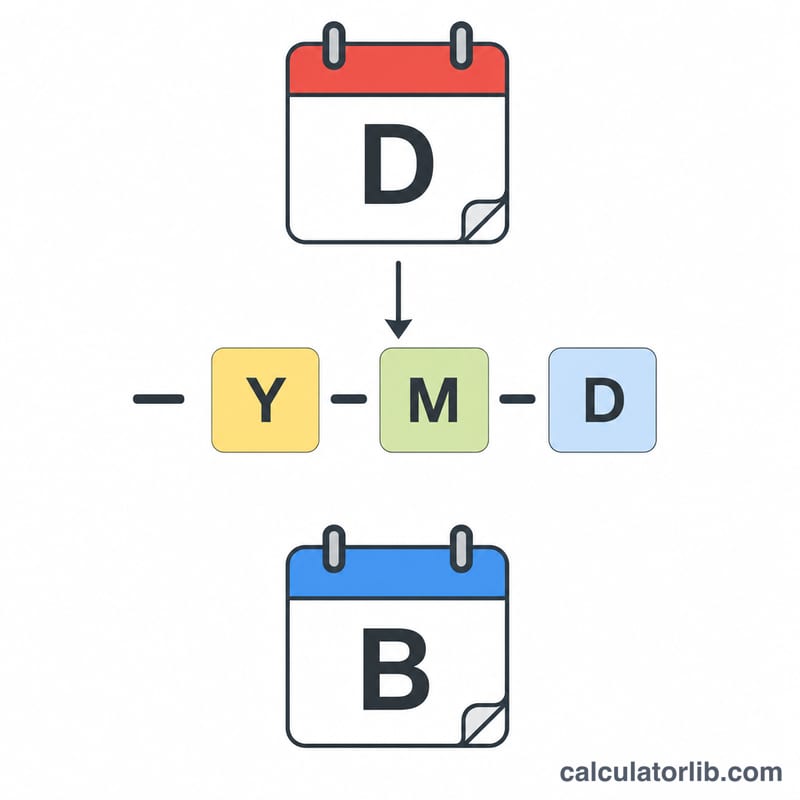
Interpreting Your Estimated Birth Date
How precise your result is depends on how much detail you entered for the age at death.
Whole-years-only gives a range, not a single day
If you know only the age in whole years (for example, "died aged 80"), the calculator can return only an estimated birth year, not an exact date. The true birthday falls somewhere inside a 12-month window. A person recorded as 80 at death on 15 June 2020 was born between 16 June 1939 and 15 June 1940 — depending on whether their birthday had already occurred that year.
Why death before vs. after the birthday matters
Age in whole years tells you only how many birthdays a person had reached, not the date of the last one. Consider two people who both died on 15 June 2020 at age 80:
- If their birthday was before 15 June, they had already turned 80 in early 2020, so they were born in 1940.
- If their birthday was after 15 June, they turned 80 in late 2019 (and would have turned 81 later in 2020), so they were born in 1939.
This is why a single whole-year age can map to two possible birth years. Entering the months and days of age, when known, removes this ambiguity and pins down the exact day.
Old records may use approximate ages
Ages on death certificates, gravestones, census returns and obituaries are frequently rounded, estimated, or simply wrong — especially for people who did not know their own birth date. Treat a calculated birth date from such sources as a starting point and confirm it against a birth or baptism record where possible. When you have two firm dates instead of an age, a date difference calculator can verify the exact span between them.
FAQ
Is the result exact? If you only know whole years, the result is an estimate — the true birthday could be up to a year earlier depending on whether the person had already had their birthday that year. Adding months and days improves accuracy.
Does it handle leap years? Yes. The calculation uses standard calendar rules, so leap days and varying month lengths are handled correctly.
Can I leave months and days blank? Yes. Leave them as 0 to subtract whole years only.