What is the beer keg weight calculator?
This calculator estimates the total weight, in pounds, of a beer keg that is full or only partly full. Pick a keg size, enter how full it is, and you get the total weight along with the beer weight, kilograms, and how many pints or 12 oz servings remain. It is useful for planning deliveries, deciding whether a keg needs two people, and tracking bar or event inventory.
How to use it
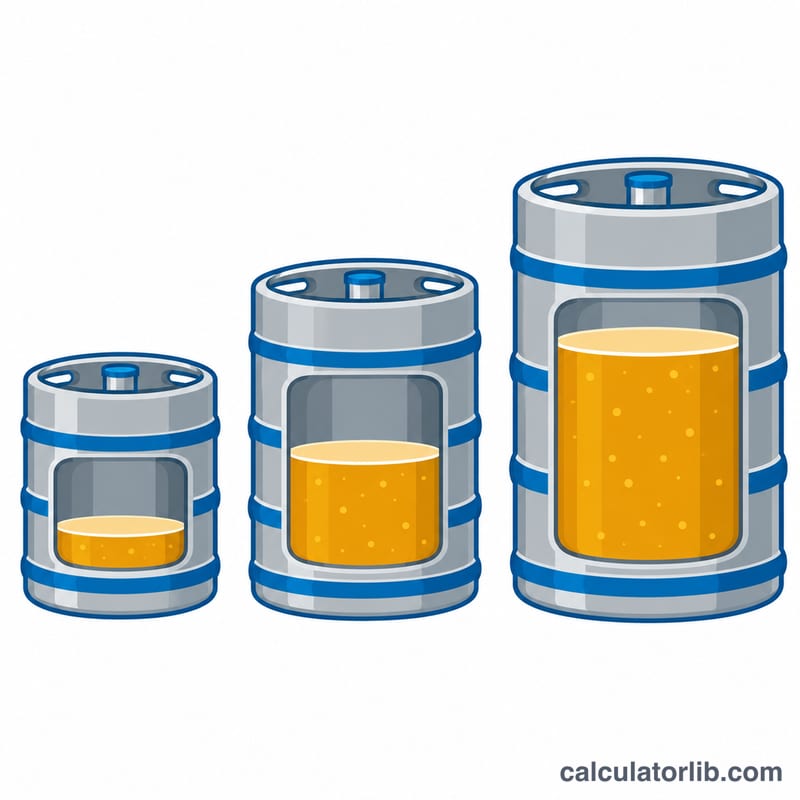
Choose the keg size (half barrel, quarter barrel, sixth barrel, 50 L, 30 L or a 5-gallon homebrew keg). Enter the fill level as a percentage, where 100 is a full keg and 0 is empty. Leave the specific gravity at 1.010 for typical beer, or raise it for strong, sweet beers such as imperial stouts.
The formula explained
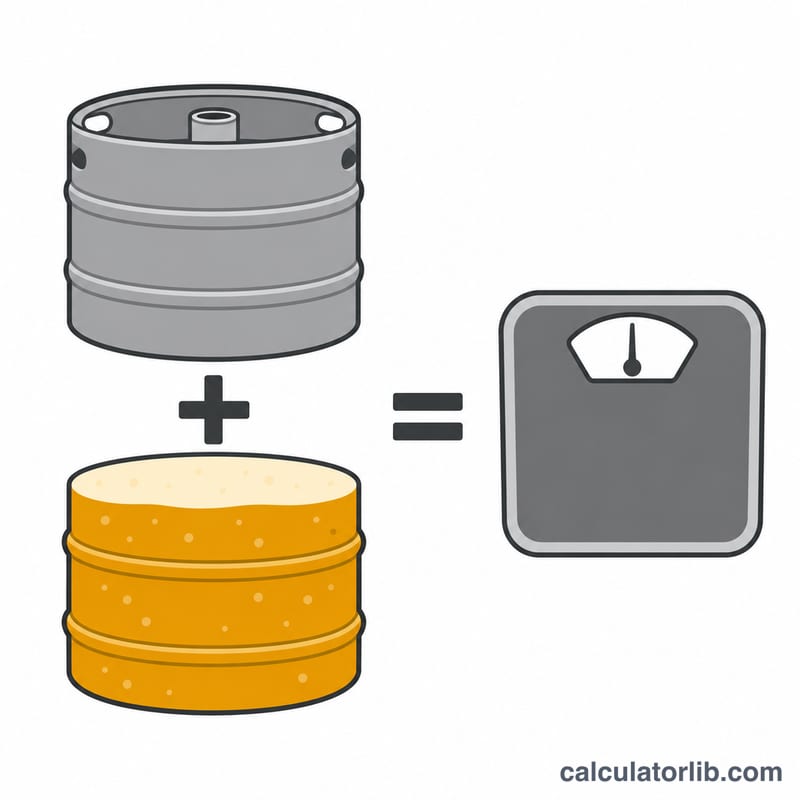
Beer is mostly water, so its weight per gallon is close to water at 8.345 lb per US gallon, scaled by specific gravity.
$$W = W_{\text{empty}} + V \times f \times 8.345 \times SG$$Here \(W_{\text{empty}}\) = empty keg weight in lb, \(V\) = keg capacity in US gallons, \(f\) = fill fraction, and \(SG\) = specific gravity of the beer. Empty weights are typical values for stainless steel kegs and vary by manufacturer by a few pounds.
Worked example
A full half barrel holds 15.5 gal and weighs about 30 lb empty. With SG = 1.010:
$$W_{\text{beer}} = 15.5 \times 8.345 \times 1.010 = 130.64\,\text{lb}$$$$W = 30 + 130.64 = 160.64\,\text{lb}$$That matches the commonly quoted figure of about 160 lb for a full half barrel.
Keg Sizes, Capacities and Empty Weights
The table lists common keg formats (US barrel sizes plus European and homebrew kegs). Full weights assume beer at specific gravity 1.010, i.e. 8.345 × 1.010 ≈ 8.428 lb per US gallon. Empty weights are typical values and vary by manufacturer, wall thickness and fittings, so treat them as approximations.
| Keg type | Capacity (US gal) | Capacity (L) | Approx. empty weight (lb) | Approx. full weight (lb) | 12 oz servings (approx.) |
|---|---|---|---|---|---|
| Half barrel | 15.5 | 58.7 | 30 | 160.6 | 165 |
| Quarter barrel | 7.75 | 29.3 | 24 | 89.3 | 83 |
| Sixth barrel | 5.17 | 19.6 | 16 | 59.6 | 55 |
| 50 L (Euro) | 13.2 | 50 | 29 | 140.3 | 141 |
| 30 L (Euro) | 7.9 | 30 | 18 | 84.6 | 84 |
| 5-gallon homebrew keg | 5 | 18.9 | 9 | 51.1 | 53 |
Servings are the capacity in ounces (gallons × 128) divided by 12, rounded, and ignore foam and trub losses, so real-world yield is usually a little lower.
Practical Handling and Shipping Tips
- Add a margin. Couplers, pallets, straps, ice and packaging add weight that the keg figure does not include. Adding a small margin (for example 5–10%) to the calculated weight is a sensible planning buffer.
- Plan for lifting. A full half barrel weighs about 160 lb, so it usually needs two people or a hand truck. Even a full sixth barrel (about 60 lb) is a awkward, heavy lift; use proper technique and keep the path clear.
- Check limits. Confirm weight limits and packaging rules with your carrier or freight company, as well as for any vehicle, lift gate or elevator involved, before shipping or moving kegs.
- Weigh when it matters. Beer gravity, foam, and keg-to-keg differences mean the result is an estimate; a scale gives the exact figure for critical loads.
FAQ
How much does a full keg of beer weigh?
A full half barrel weighs roughly 160 lb, a quarter barrel about 87 lb, and a sixth barrel about 58 lb.
Does the keg weight include CO2 or the coupler?
No. Gas pressure adds a negligible amount, and couplers, taps and hoses are not included.
Why does my keg weigh a little different?
Manufacturers differ in empty weight, and the actual beer density and fill volume vary slightly, so treat the result as an estimate within a few pounds.