What this calculator does
Cooler sizes are sold in quarts, but you plan a party in cans and bottles. This calculator converts the quart capacity into volume, reserves room for ice, applies a packing efficiency for the gaps between containers, and tells you how many drinks fit.
How to use it
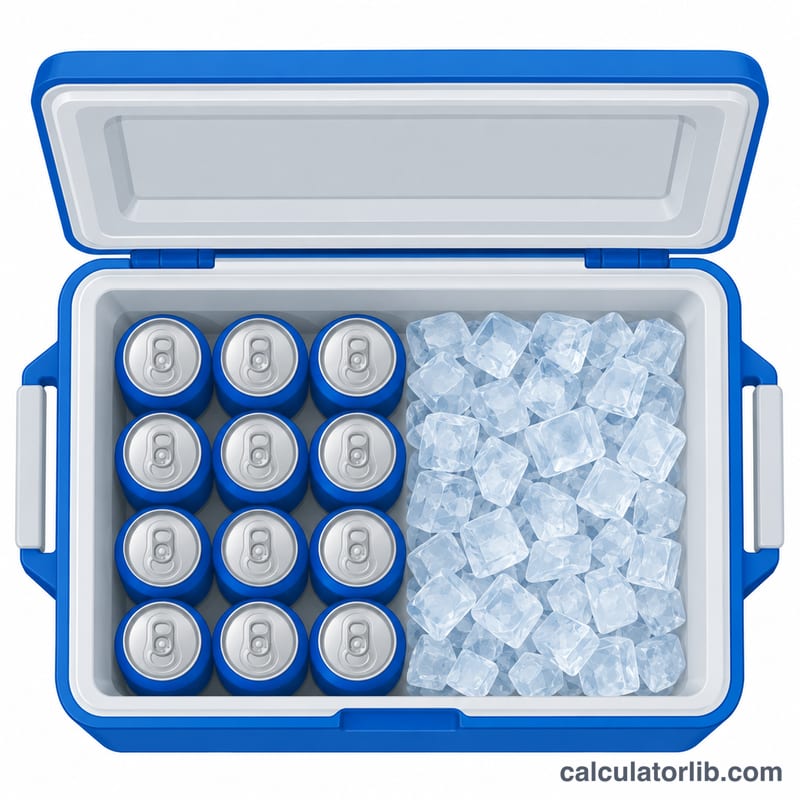
Enter the cooler capacity in quarts, choose the container type, and set the share of space you want to reserve for ice (50% is a common rule of thumb). Packing efficiency describes how well round containers stack; 75-85% is realistic for cans, lower for odd-shaped bottles.
The formula explained
One US quart is 946.353 mL. The number of drinks is the usable volume divided by the physical volume of one container, rounded down:
$$N = \left\lfloor \frac{Q \times 946.353 \times (1 - i) \times p}{v} \right\rfloor$$
Here \(Q\) = quarts, \(i\) = ice fraction, \(p\) = packing efficiency and \(v\) = container volume in mL. Physical volumes are larger than the liquid inside: a 12 oz can is about 420 mL, a 16 oz can 560 mL, a 500 mL bottle 600 mL, a 20 oz bottle 750 mL, a 1 L bottle 1250 mL and a 2 L bottle 2500 mL.
Worked example
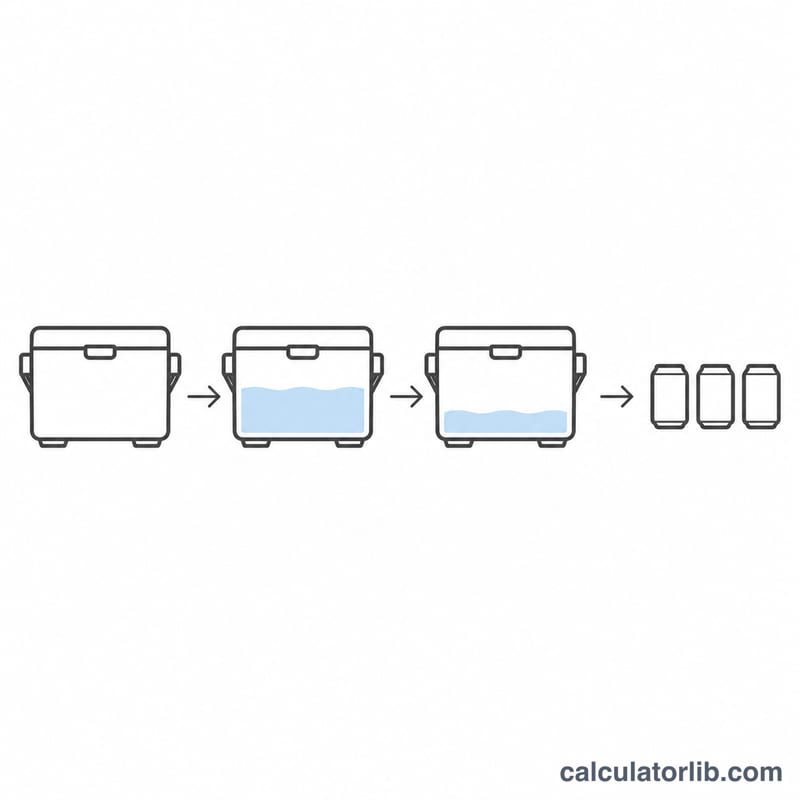
A 16 qt cooler holding 12 oz cans, with 50% ice and 80% packing:
$$N = \left\lfloor \frac{16 \times 946.353 \times 0.5 \times 0.8}{420} \right\rfloor = \left\lfloor \frac{6056.66}{420} \right\rfloor = \lfloor 14.42 \rfloor = 14$$
Without ice, the same cooler would hold about 28 cans.
Drink Counts Across Common Cooler Sizes and Ice Levels
These counts use the calculator's formula with US liquid quarts (1 qt = 946.353 mL), 80% packing efficiency, and a physical volume of 420 mL for a 12 oz can. Each count is rounded down:
$$N = \left\lfloor \frac{Q \times 946.353 \times (1 - i) \times p}{420} \right\rfloor$$
Here \(Q\) is the cooler size in quarts, \(i\) is the ice fraction, and \(p = 0.80\). With no ice, each quart holds about 1.80 cans (946.353 × 0.8 ÷ 420 ≈ 1.8026).
| Cooler size | 12 oz cans, 0% ice | 12 oz cans, 25% ice | 12 oz cans, 50% ice | 500 mL bottles (600 mL each), 25% ice |
|---|---|---|---|---|
| 16 qt | 28 | 21 | 14 | 15 |
| 24 qt | 43 | 32 | 21 | 22 |
| 48 qt | 86 | 64 | 43 | 45 |
| 70 qt | 126 | 94 | 63 | 66 |
Worked example (16 qt, 25% ice, 12 oz cans):
$$N = \left\lfloor \frac{16 \times 946.353 \times 0.75 \times 0.80}{420} \right\rfloor = \left\lfloor \frac{9084.99}{420} \right\rfloor = \lfloor 21.63 \rfloor = 21$$
For the bottle column, the 500 mL bottle uses 600 mL of space because of its shape and cap. For example, a 48 qt cooler at 25% ice gives \(\lfloor 48 \times 946.353 \times 0.75 \times 0.80 / 600 \rfloor = \lfloor 45.43 \rfloor = 45\) bottles.
These are estimates from volume alone. Real cooler interiors are usually smaller than the rated quart size because of insulated walls and sloped shapes, so treat the numbers as a planning guide.
Practical Packing Tips
- Round down and keep a buffer. The result is a maximum, not a target. Plan for a few fewer drinks than the count so the lid closes easily and ice has room.
- Pre-chill everything. Cold drinks and a cooler that has been cooled beforehand (for example, by keeping it indoors or putting some ice in it for a while) mean the ice lasts longer.
- Use block ice or ice packs for longer trips. Large blocks usually melt more slowly than cubes. Packs take up less space and don't create meltwater.
- Pack cans upright in tight layers. Even rows with few gaps get closer to the packing efficiency you entered. Fill gaps with ice or small packs.
- Put bottles in a separate layer. Tall or odd-shaped bottles waste space when mixed with cans. Place them in their own layer, usually at the bottom or along one side.
- Choose the next size up when the count is borderline. If your target is close to the calculated number, a larger cooler gives more room for ice and handling.
This is general planning guidance. Actual capacity varies by cooler design, so test-pack before an important trip.
FAQ
How many cans fit in a 16 qt cooler?
Roughly 14 cans with half the space given to ice, or about 28 with no ice.
Why not just divide by the liquid volume?
Containers have walls, shoulders and necks, so their physical footprint is bigger than the liquid they hold.
How much ice should I use?
A 1:1 ratio of ice to drinks by volume keeps drinks cold for many hours; use less for short trips, more in hot weather.