What is the Solution Mass Calculator?
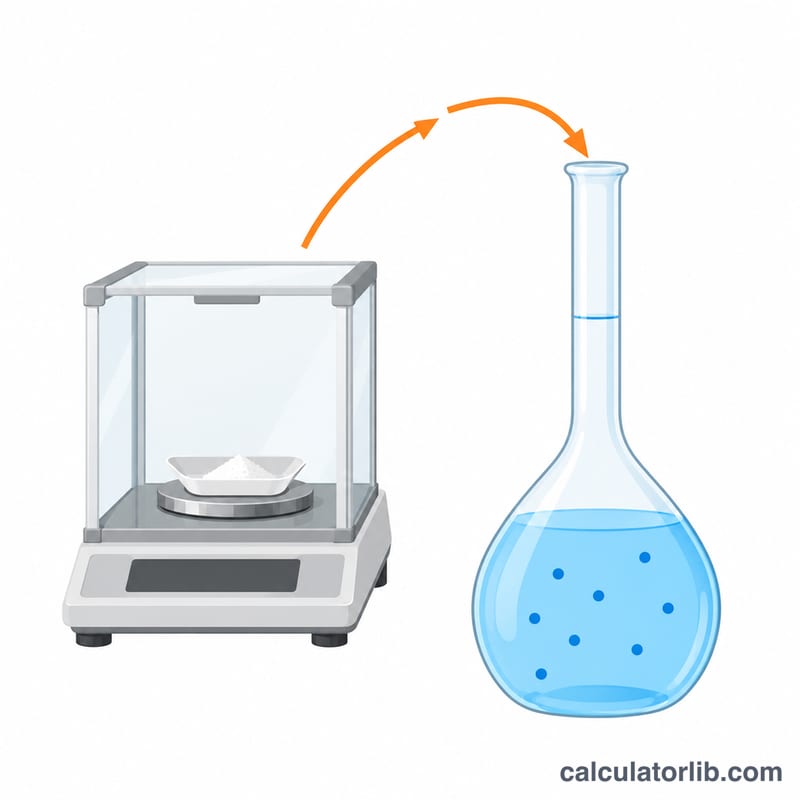
This calculator tells you how many grams of a solid substance you must weigh out to prepare a solution of a chosen molar concentration and volume. It is useful for chemistry students, lab technicians and anyone preparing buffers, stock solutions or standards.
How to use it
Enter the target concentration and pick its unit (mol/L, mmol/L or µmol/L). Enter the final volume of solution and choose liters, milliliters or microliters. Finally type the molar mass of the compound in g/mol, which you can find by adding the atomic masses in its formula. The result shows the mass in grams and milligrams, and the number of moles.
The formula explained
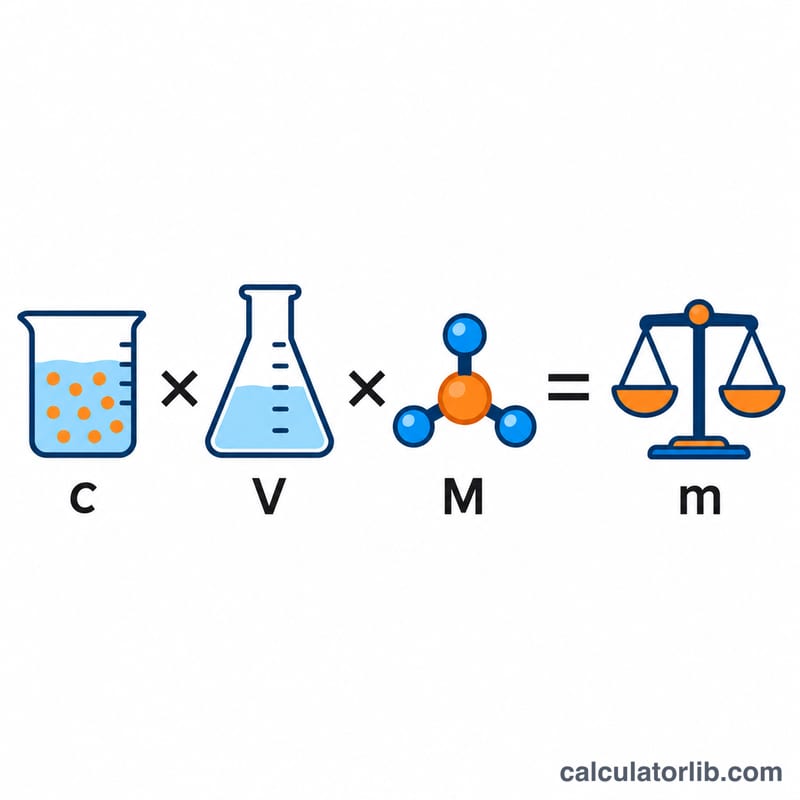
Concentration in mol/L multiplied by volume in liters gives the moles of solute. Multiplying moles by molar mass converts moles to grams.
$$m = c \times V \times M$$Here \(m\) = mass in grams, \(c\) = concentration in mol/L, \(V\) = volume in liters and \(M\) = molar mass in g/mol. The calculator converts mM, µM, mL and µL to base units automatically.
Worked example
How much sodium chloride (\(M = 58.44\) g/mol) is needed for 500 mL of a 0.1 mol/L solution? First convert the volume: 500 mL = 0.5 L.
$$m = 0.1 \times 0.5 \times 58.44 = 2.922\,\text{g}$$Weigh 2.922 g of NaCl, dissolve it, and add water up to a final volume of 500 mL.
Molar Masses of Common Lab Reagents
Enter the molar mass (g/mol) from this table, or from the reagent label, into the calculator. Values are rounded to two decimals. For hydrated salts, always use the molar mass of the hydrate as written on the bottle, because the water of crystallization is part of the weighed mass.
| Compound | Formula | Molar mass (g/mol) |
|---|---|---|
| Sodium chloride | NaCl | 58.44 |
| Potassium chloride | KCl | 74.55 |
| Sodium hydroxide | NaOH | 40.00 |
| Hydrogen chloride (as gas) | HCl | 36.46 |
| Tris base | C4H11NO3 | 121.14 |
| Glucose (anhydrous) | C6H12O6 | 180.16 |
| Calcium chloride (anhydrous) | CaCl2 | 110.98 |
| Calcium chloride dihydrate | CaCl2·2H2O | 147.01 |
| Sodium carbonate | Na2CO3 | 105.99 |
| Sodium bicarbonate | NaHCO3 | 84.01 |
| Potassium dihydrogen phosphate | KH2PO4 | 136.09 |
| Magnesium sulfate heptahydrate | MgSO4·7H2O | 246.47 |
| Copper(II) sulfate pentahydrate | CuSO4·5H2O | 249.69 |
Note: HCl is usually supplied as a concentrated aqueous solution (about 37% w/w), so the gas molar mass alone does not give the volume of stock to pipette; that needs the stock's density and percentage.
Mass Required for Common Solution Preparations
The table uses NaCl (58.44 g/mol) and the relation \(m = c \times V \times M\), with concentration in mol/L and volume in L.
| Target concentration | Volume | Calculation | Mass of NaCl |
|---|---|---|---|
| 1 M | 1 L | \(1 \times 1 \times 58.44\) | 58.44 g |
| 0.1 M | 500 mL | \(0.1 \times 0.5 \times 58.44\) | 2.922 g |
| 10 mM | 100 mL | \(0.01 \times 0.1 \times 58.44\) | 0.05844 g (58.44 mg) |
| 1 mM | 50 mL | \(0.001 \times 0.05 \times 58.44\) | 2.922 mg |
| 100 µM | 10 mL | \(10^{-4} \times 0.01 \times 58.44\) | 0.05844 mg (58.44 µg) |
| 0.15 M | 1 L | \(0.15 \times 1 \times 58.44\) | 8.766 g |
Worked example: for 0.1 M NaCl in 500 mL, \(V = 500 \times 10^{-3} = 0.5\ \text{L}\), so \(m = 0.1 \times 0.5 \times 58.44 = \) 2.922 g. Weigh the solid, dissolve it in less than the final volume of solvent, then top up to the final volume in a volumetric flask.
Unit Conversions for Concentration and Volume
| Quantity | Conversion |
|---|---|
| Concentration | 1 M = 1 mol/L = 1000 mM = 1,000,000 µM |
| Concentration | 1 mM = 0.001 mol/L |
| Concentration | 1 µM = 10-6 mol/L |
| Volume | 1 L = 1000 mL = 1,000,000 µL |
| Volume | 1 mL = 0.001 L |
| Volume | 1 µL = 10-6 L |
| Mass | 1 g = 1000 mg = 1,000,000 µg |
The calculator converts concentration to mol/L and volume to L before multiplying, so the result is in grams. Convert to mg by multiplying by 1000, or to µg by multiplying by 1,000,000.
FAQ
Should I dissolve the solid in exactly the final volume of water?
No. Dissolve the solid in less solvent, then top up to the final volume in a volumetric flask, because dissolving changes the total volume.
What about hydrates?
Use the molar mass of the hydrate including the water of crystallization, otherwise the real concentration will be too low.
Does purity matter?
Yes. For a reagent with purity below 100%, divide the calculated mass by the purity fraction.