What this calculator does
This tool measures the cost-performance (CP) value of your Wuthering Waves gacha spending. You enter how much real money you spent on top-ups, how much Lunite those purchases gave you (including first-purchase or bonus amounts), and how much free Astrite and how many Radiant Tides you have saved. It then shows what each paid pull really costs and how much of your total pull budget comes from purchases versus free currency.
How to use it
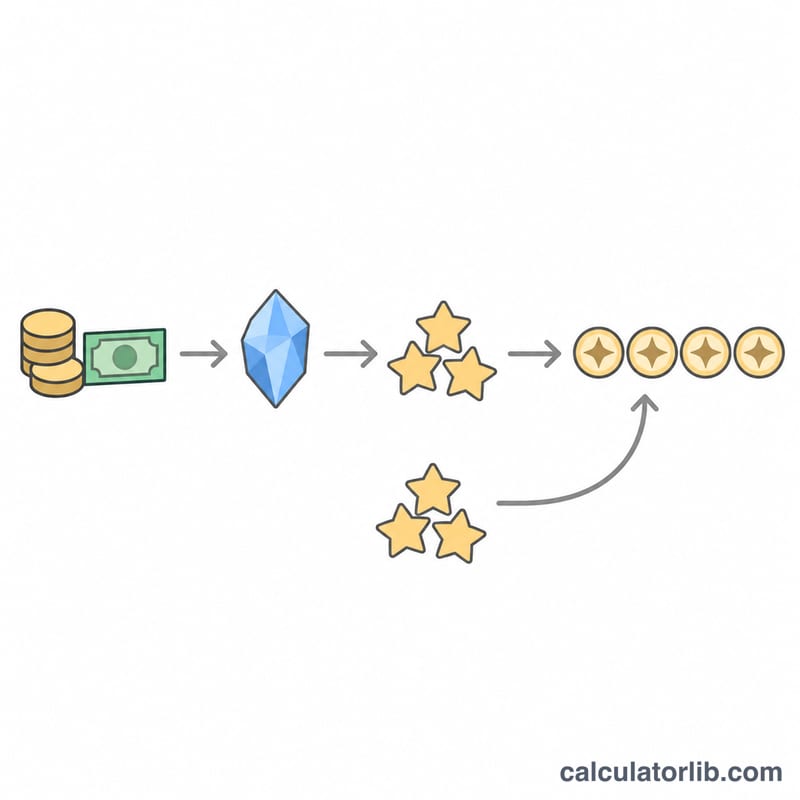
Enter your total spend and the total Lunite received. Add free Astrite from events, exploration and Union Level rewards, plus any Radiant Tides already in your inventory. Finally, set the pulls you expect to need per target 5-star: 80 if you win the 50/50 at hard pity, up to 160 in the worst case. Amounts are in your own currency, so you can relabel it freely.
The formula explained
Lunite converts to Astrite 1:1, and one Radiant Tide costs 160 Astrite. With \(M\) = money spent, \(L\) = Lunite purchased, \(A\) = free Astrite and \(T\) = Tides owned:
$$C_{\text{pull}} = \frac{M}{L / 160}$$$$P = \frac{L}{160} + \frac{A}{160} + T$$The cost per target 5-star is \(C_{\text{pull}} \times N\), where \(N\) is the pulls needed per target.
Worked example
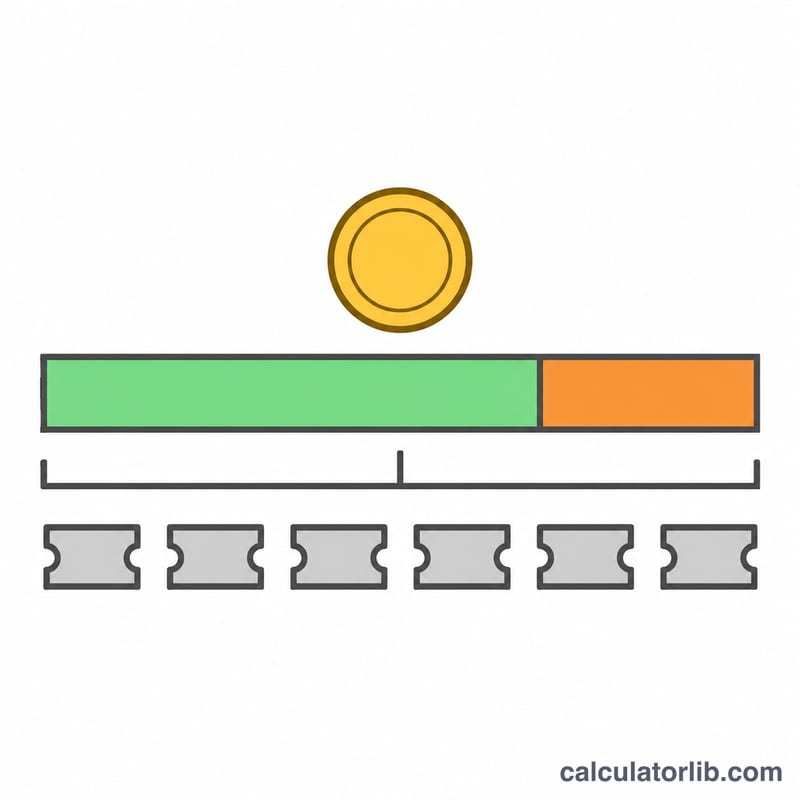
Suppose you spend 50 for 3,200 Lunite, have 1,600 free Astrite and 10 Tides, and plan for 80 pulls per target.
$$\frac{3200}{160} = 20 \text{ paid pulls},\quad \frac{1600}{160} + 10 = 20 \text{ free pulls}$$$$C_{\text{pull}} = \frac{50}{20} = 2.50,\quad C_{\text{target}} = 2.50 \times 80 = 200$$Total pulls are 40, so the effective cost across all pulls is 50 / 40 = 1.25 each, and half of your pulls were free.
Key Fixed Values Used in the Calculation
The calculator relies on a few fixed conversion values from Wuthering Waves. These are the game's standard values at the time of writing and can change with game updates, so check the in-game shop and banner info if they matter to you.
| Value | Figure | Role in the calculation |
|---|---|---|
| Lunite to Astrite | 1 : 1 | Purchased Lunite converts to Astrite at an equal rate, so Lunite can be divided by 160 directly to get paid pulls. |
| Cost of 1 Radiant Tide | 160 Astrite | The divisor in \(P_{paid} = \frac{L}{160}\) and in the free Astrite term \(\frac{A}{160}\). |
| 5-star hard pity (featured character banner) | 80 pulls | Pulls per target if your first 5-star is the featured character. |
| 50/50 guarantee, worst case | 160 pulls | Pulls per target if you lose the 50/50 and need a second pity cycle to get the featured 5-star. |
The 80 and 160 figures are worst-case ceilings, not averages. Your real pull count per featured 5-star can be lower because you can reach a 5-star before pity.
Scenario Comparison: Spending vs Free Pulls
All figures below are illustrative only. The money amounts and Lunite quantities are made-up examples in generic currency units, not real store prices. They use the formulas: cost per paid pull = \(M \div (L/160)\); total pulls = \(L/160 + A/160 + T\); effective cost per pull = \(M \div\) total pulls; cost per target = cost per paid pull × pulls per target (80 or 160). Free pulls = free Astrite ÷ 160 + Radiant Tides owned.
| Scenario | Money spent | Lunite | Free pulls (Astrite ÷ 160 + Tides) | Paid pulls | Cost per paid pull | Effective cost per pull | Cost per target (80) | Cost per target (160) |
|---|---|---|---|---|---|---|---|---|
| A: no free pulls | $10 | 600 | 0 | 3.75 | $2.67 | $2.67 | $213.33 | $426.67 |
| B: modest free stock | $20 | 1,280 | 800 ÷ 160 + 3 = 8 | 8 | $2.50 | 1.25 | $200.00 | $400.00 |
| C: larger top-up | $50 | 3,300 | 1,600 ÷ 160 + 5 = 15 | 20.625 | $2.42 | $1.40 | $193.94 | $387.88 |
| D: small top-up, big free stock | $8 | 500 | 4,800 ÷ 160 + 20 = 50 | 3.125 | $2.56 | $0.15 | $204.80 | $409.60 |
Example substitution (Scenario B): paid pulls \(= 1280 \div 160 = 8\); free pulls \(= 800 \div 160 + 3 = 8\); total \(= 16\); effective cost per pull \(= 20 \div 16 = 1.25\); cost per paid pull \(= 20 \div 8 = 2.50\), so a target costs \(2.50 \times 80 = 200\) or \(2.50 \times 160 = 400\).
How to read this:
- Free Astrite and owned Tides lower the effective cost per pull, but they do not change the cost per paid pull.
- Cost per target uses only paid pulls, as in the formula, so it shows what the money alone would have to cover. It does not subtract the value of your free pulls.
- Doubling pulls per target from 80 to 160 exactly doubles cost per target.
FAQ
Is a higher Lunite per currency value better?
Yes. More Lunite per unit of money means more pulls for the same spend, so bigger or bonus packs usually score higher.
Does this include pity?
Pity is handled through the pulls-per-target input rather than simulated, so use 80 for an optimistic plan and 160 for a safe one.
Why separate paid and free pulls?
It shows how much of your roster depends on spending and the true average cost of a pull once free currency is included.