
What Is a Cross Exchange Rate?
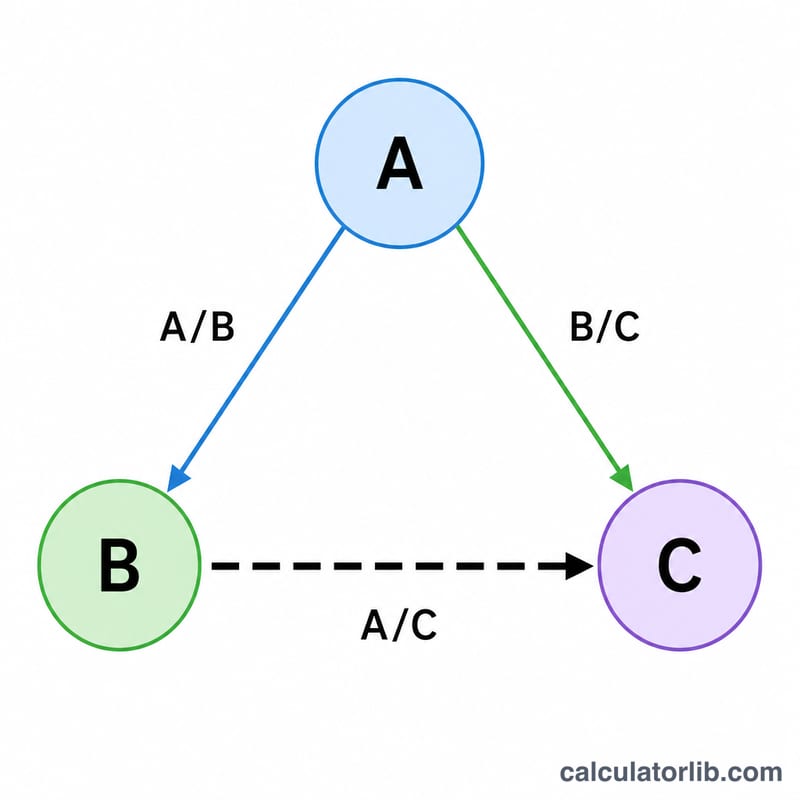
A cross exchange rate is the price of one currency in terms of another, derived indirectly through a common third currency rather than quoted directly. For example, if you know EUR/USD and USD/JPY, you can calculate EUR/JPY without ever quoting that pair directly. This is universal arithmetic — it works for any three currencies, commodities, or units that share a common reference.
How to Use This Calculator
Enter the first rate as A/B — how many units of currency B you get for one unit of A. Then choose how your second rate is quoted: if you know B/C (how many C per one B), select multiply; if you instead know C/B (how many B per one C), select divide. Enter that second rate and the calculator returns A/C, the number of units of C per one unit of A.
The Formula Explained
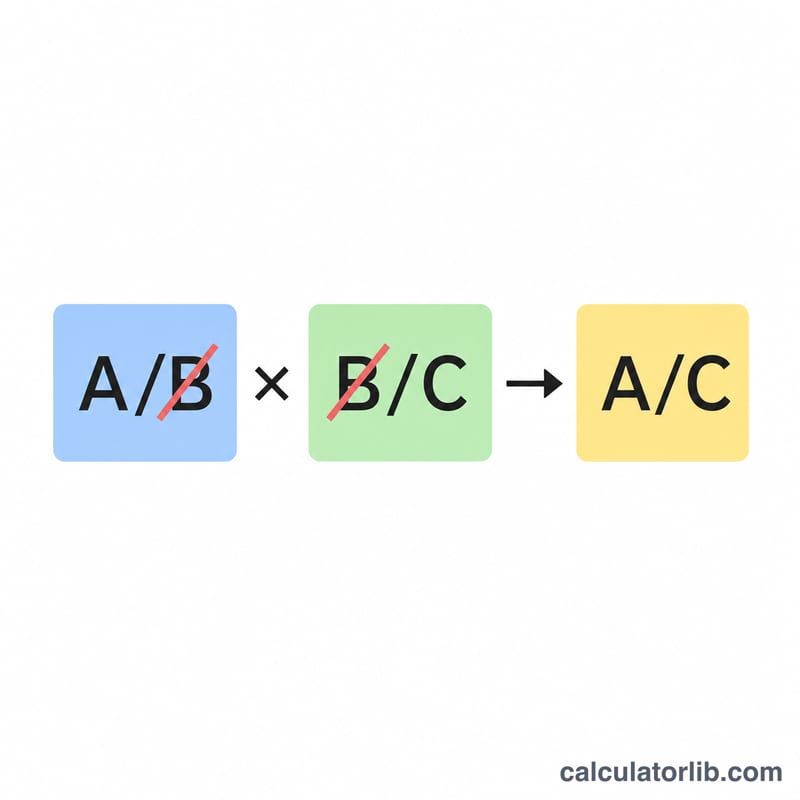
The B terms cancel algebraically: $$\text{A/C} = \text{Rate A/B} \times \text{Rate B/C}$$ When your second quote is inverted (C/B), you divide instead: $$\text{A/C} = \dfrac{\text{Rate A/B}}{\text{Rate C/B}}$$ Choosing the right operation prevents the most common mistake in cross-rate math — using a rate the wrong way up.
Worked Example
Suppose EUR/USD = 1.10 (A/B, with A=EUR, B=USD) and USD/JPY = 150 (B/C). Then $$\text{EUR/JPY} = 1.10 \times 150 = \mathbf{165}$$ yen per euro. If instead you held JPY/USD = 0.006667 (C/B), you would divide: \(1.10 \div 0.006667 \approx 165\).
FAQ
Does this include bid/ask spreads? No. It uses mid rates; real trades add a spread, so brokers may quote slightly different cross rates.
Which currency is "A"? A is the base of your final pair (A/C). Keep it consistent as the base of your A/B input.
Can I use it for non-currency conversions? Yes — any chained ratio with a shared middle unit works the same way.