What is a rising sign?
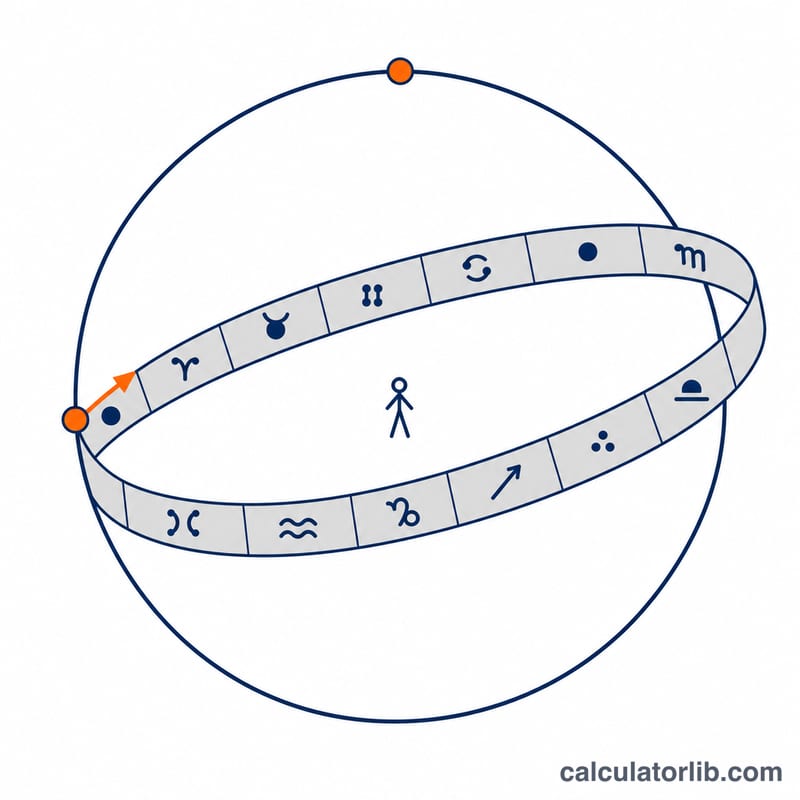
Your rising sign, or ascendant, is the zodiac sign that was crossing the eastern horizon at the exact moment and place of your birth. Because the horizon turns through all twelve signs roughly every 24 hours, the ascendant changes about every two hours, so an accurate birth time and location matter far more than for a Sun sign. This calculator uses the tropical zodiac and the standard astronomical definition of the ascendant.
How to use this calculator
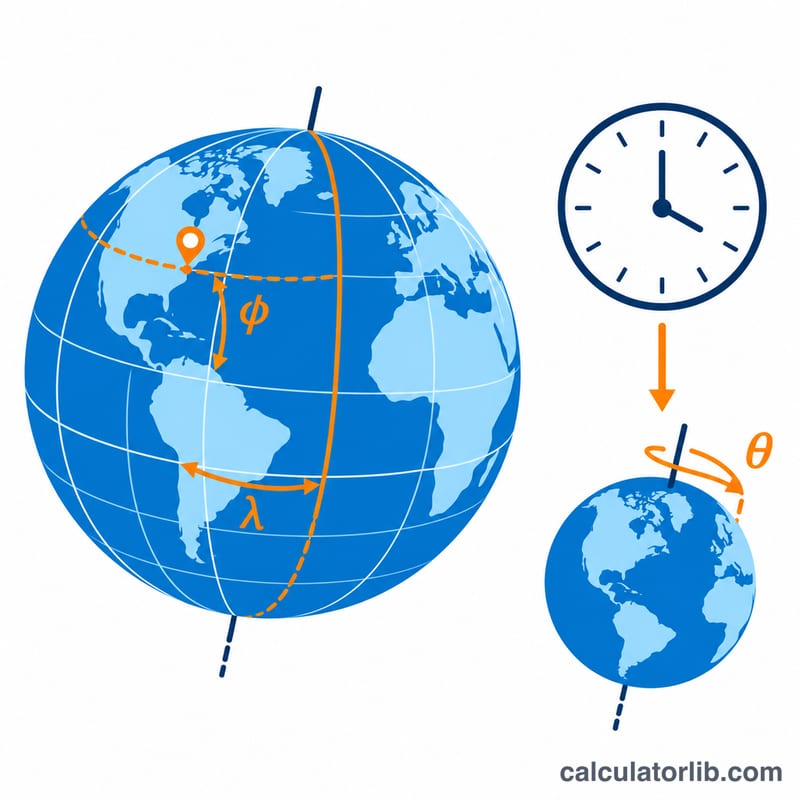
Enter your birth year, month and day, the local clock time (24-hour), the UTC offset that applied at that place and time (include daylight saving, e.g. -4 for New York in summer), plus latitude (north positive) and longitude (east positive). The result shows the sign, the exact degree within the sign, the full ecliptic longitude, and the Midheaven (MC).
The formula explained
First the date and time are converted to Universal Time and a Julian Date. From the days \(d\) since J2000.0 we get Greenwich sidereal time, and adding east longitude \(\lambda\) gives local sidereal time \(\theta\). Then the ascendant is:
$$\text{ASC} = \operatorname{atan2}\left(\cos\theta,\; -(\sin\theta\cos\varepsilon + \tan\varphi\sin\varepsilon)\right)$$Here \(\varepsilon \approx 23.44^\circ\) is the obliquity of the ecliptic and \(\varphi\) is the latitude. The angle is normalised to 0-360 degrees and divided by 30 to find the sign (0 = Aries, 30 = Taurus, and so on).
Worked example
Take 1 January 2000 at 12:00 UT on the equator at longitude 0. Here \(d = 0\), so \(\theta = 280.4606^\circ\). With \(\varphi = 0\):
$$\text{ASC} = \operatorname{atan2}(0.18156,\; 0.98338 \times 0.91748) = \operatorname{atan2}(0.18156,\; 0.90223) \approx 11.38^\circ$$That is about 11.4 degrees of Aries.
Zodiac Sign Ecliptic Longitude Ranges
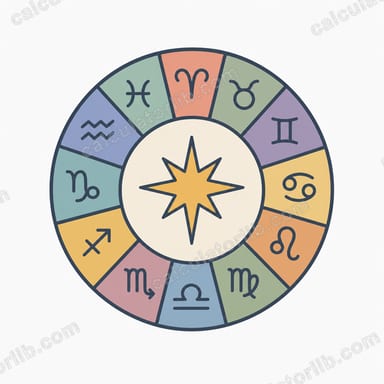
The tropical zodiac divides the ecliptic into twelve equal 30° segments, starting at the March equinox point (0° Aries). The calculator outputs the Ascendant as an ecliptic longitude from 0° to 360°. Match it to a sign using the table below.
| # | Sign | Start (°) | End (°) |
|---|---|---|---|
| 1 | Aries | 0 | 30 |
| 2 | Taurus | 30 | 60 |
| 3 | Gemini | 60 | 90 |
| 4 | Cancer | 90 | 120 |
| 5 | Leo | 120 | 150 |
| 6 | Virgo | 150 | 180 |
| 7 | Libra | 180 | 210 |
| 8 | Scorpio | 210 | 240 |
| 9 | Sagittarius | 240 | 270 |
| 10 | Capricorn | 270 | 300 |
| 11 | Aquarius | 300 | 330 |
| 12 | Pisces | 330 | 360 |
Each range starts at its start value and runs up to, but does not include, its end value. To read a result, divide the longitude by 30 and take the whole part. That gives the number of completed signs. The remainder is the degree within the sign. For example, an Ascendant of 95° lies in Cancer (90°–120°) at 5° Cancer, since \(95 - 90 = 5\).
Constants Used in the Calculation
| Constant | Value | Role |
|---|---|---|
| J2000.0 epoch | JD 2451545.0 (1 January 2000, 12:00 TT) | Reference moment from which the elapsed days \(D = JD - 2451545\) are counted |
| Obliquity of the ecliptic at J2000.0 | ≈ 23.44° (23.4393°; the formula uses 23.439291°) | Tilt between the equator and the ecliptic; it drifts by about −0.013° per Julian century |
| GMST at J2000.0 | 280.46061837° | Greenwich Mean Sidereal Time at the epoch |
| Sidereal rotation rate | ≈ 360.98564736629° per day | Earth turns slightly more than 360° per solar day relative to the equinox direction |
| Longitude to time | 15° per hour | 360° ÷ 24 h; local sidereal time = GMST + longitude |
| Sign width | 30° per sign | 360° ÷ 12 signs |
| Days per Julian century | 36525 | Used for \(T = D / 36525\) |
Together these give the local sidereal angle \(\theta = (\mathrm{GMST} + \text{longitude}) \bmod 360\). The Ascendant is then obtained from \(\theta\), the obliquity \(\varepsilon\) and the latitude \(\varphi\).
Key Terms: Ascendant, Midheaven, Obliquity and Sidereal Time
- Ascendant (ASC) / rising sign
- The point of the ecliptic that is rising on the eastern horizon at the given time and place. The zodiac sign containing that point is the rising sign.
- Descendant
- The point of the ecliptic setting on the western horizon. It is exactly opposite the Ascendant, 180° away.
- Midheaven (MC)
- The point of the ecliptic crossing the local meridian, the great circle running from north to south through the zenith. It is the ecliptic's highest point in the sky. It is computed from the same local sidereal angle \(\theta\) and the obliquity.
- Ecliptic
- The apparent yearly path of the Sun across the sky, which is the plane of Earth's orbit projected onto the celestial sphere. Zodiac longitudes are measured along it.
- Tropical vs sidereal zodiac
- The tropical zodiac fixes 0° Aries at the March equinox, so it follows the seasons. The sidereal zodiac is anchored to the fixed stars. Because of precession, the two differ by an offset (the ayanamsa) of roughly 24° today. This calculator uses the tropical zodiac.
- Obliquity of the ecliptic (ε)
- The angle between Earth's equator and the ecliptic, about 23.44° and slowly decreasing.
- Julian Date (JD)
- A continuous count of days from a fixed origin, which avoids calendar irregularities. Each JD day begins at noon, so midnight falls at a .5 value.
- Greenwich / local sidereal time
- Greenwich Mean Sidereal Time (GMST) is the hour angle of the mean March equinox at Greenwich 0° longitude. Local sidereal time is GMST plus the observer's east longitude. It tells which ecliptic degrees are on the meridian.
- UTC offset
- The difference between local clock time and UTC in hours, for example −5 for US Eastern Standard Time or +1 for Central European Time. The calculator uses \(UT = \text{local time} - \text{offset}\). If daylight saving time was in effect at birth, use the offset that applied then (for example −4 for US Eastern Daylight Time), not the standard one.
- Latitude and longitude conventions
- Latitude is positive north of the equator and negative south. Longitude is positive east of Greenwich and negative west. For example, New York is about +40.7° latitude and −74.0° longitude. Entering west longitude as a positive number puts the chart on the wrong side of the globe and gives a wrong Ascendant. Near the poles the Ascendant becomes unstable, so this tool limits latitude to ±89°.
FAQ
Why is birth time so important?
The ascendant moves about one degree every four minutes, so a 30-minute error can shift it by 7 degrees and a two-hour error can change the sign.
Does this use the sidereal zodiac?
No. It uses the tropical zodiac used by most Western astrologers. Vedic astrology subtracts an ayanamsa of roughly 24 degrees.
What about extreme latitudes?
Above about 66 degrees north or south the ascendant can behave unusually, and house systems may fail. Latitude is limited to 89 degrees to avoid mathematical singularities.