What is a quilt backing calculator?
The backing is the fabric layer on the underside of a quilt. Because standard quilting cotton is only about 42 to 44 inches wide, most quilts need two or more panels sewn together. This calculator tells you how many panels you need and how many yards to buy, so you do not come up short at the cutting table.
How to use it
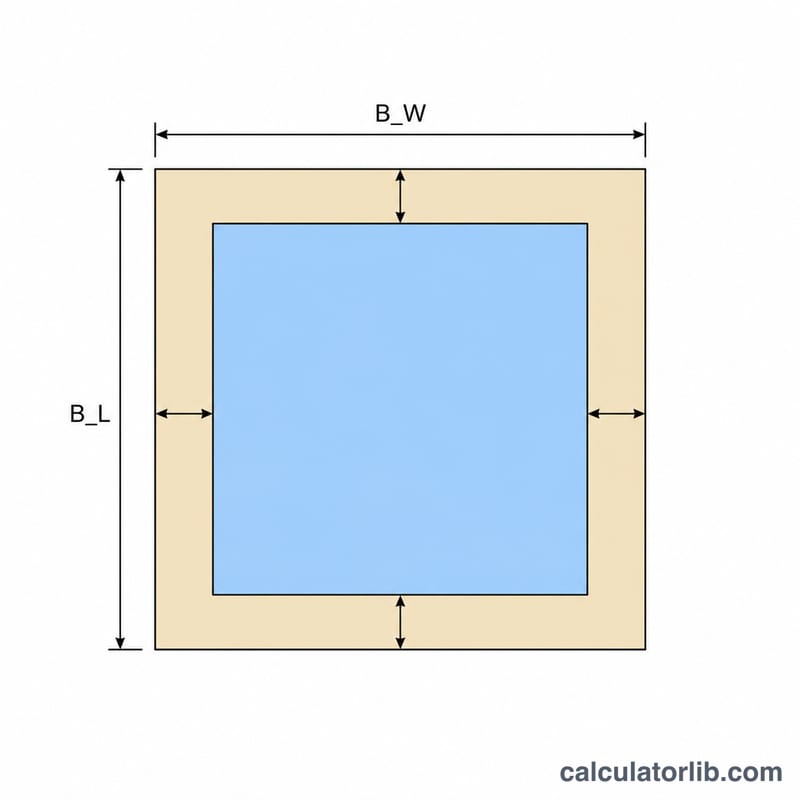
Enter the finished quilt top width and length in inches. Add extra backing per side (4 inches is common, giving 8 inches total) so there is room for longarm quilting or shrinkage. Enter the usable fabric width after removing selvages, and a seam allowance (0.5 inch is typical). Choose a seam direction or leave it on automatic and the tool will pick the layout that uses the least fabric.
The formula explained
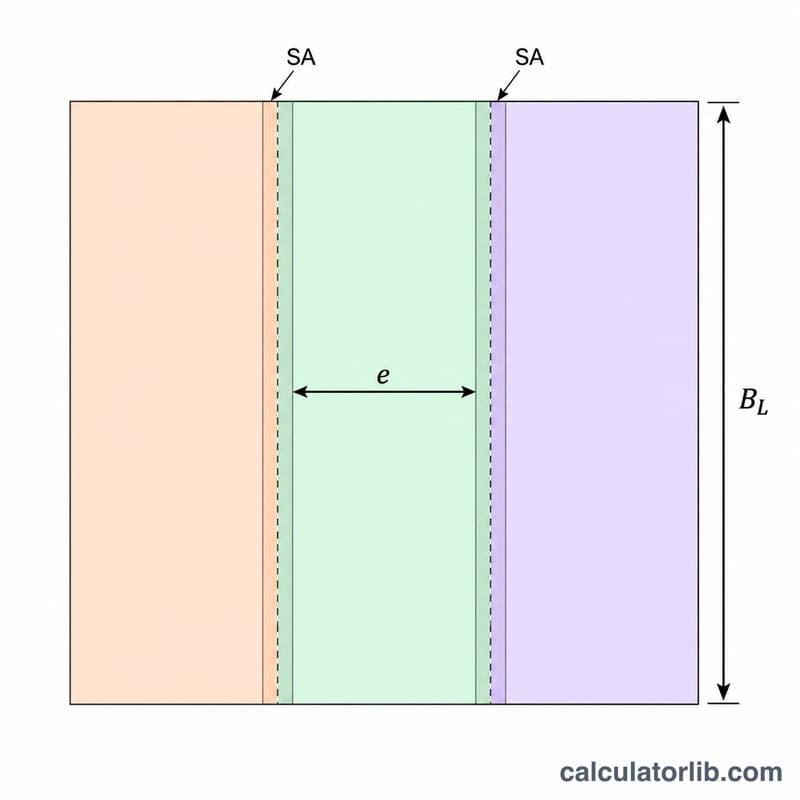
First the backing size is the quilt size plus margin on every side: \(W_{\text{back}} = W + 2m\) and \(L_{\text{back}} = L + 2m\). Each seam costs a seam allowance on both panels, so the number of panels is
$$n = \left\lceil \frac{W_{\text{back}} - 2s}{F - 2s} \right\rceil$$where \(F\) is usable fabric width and \(s\) is the seam allowance. Each panel is cut to the backing length, so
$$\text{Yards} = \frac{n \times L_{\text{back}}}{36}$$The same calculation is repeated with width and length swapped for crosswise panels.
Worked example
A 60 by 80 inch quilt with 4 inches extra per side, 42 inch fabric and a 0.5 inch seam allowance has a backing of 68 by 88 inches.
$$n = \left\lceil \frac{68 - 1}{42 - 1} \right\rceil = \lceil 1.63 \rceil = 2$$$$\text{Yards} = \frac{2 \times 88}{36} = 4.89$$Running panels across the width would need 3 panels and 5.67 yards, so the lengthwise layout wins. Buying 5 yards covers it.
Standard Quilt Sizes and Backing Yardage
The table below lists common finished quilt sizes (in inches; sizes vary by maker and region) and the backing needed with 4 in of extra fabric on every side. Assumptions: 0.5 in seam allowance on each panel edge, panels sewn with lengthwise seams (the seams run parallel to the quilt length), and a fabric width of 42 in or 108 in measured after trimming selvages.
Formulas used: backing width \(B_W = W + 2m\), backing length \(B_L = L + 2m\), usable panel width \(e = F - 2s\), panels \(P = \lceil (B_W - 2s)/e \rceil\), and yards \(= P \cdot B_L / 36\).
| Quilt size | Backing size (in) | Panels (42 in) | Yards (42 in) | Panels (108 in) | Yards (108 in) |
|---|---|---|---|---|---|
| Crib 45 × 60 | 53 × 68 | 2 | 3.78 | 1 | 1.89 |
| Throw 60 × 72 | 68 × 80 | 2 | 4.44 | 1 | 2.22 |
| Twin 70 × 90 | 78 × 98 | 2 | 5.44 | 1 | 2.72 |
| Full 85 × 90 | 93 × 98 | 3 | 8.17 | 1 | 2.72 |
| Queen 90 × 108 | 98 × 116 | 3 | 9.67 | 1 | 3.22 |
| King 108 × 108 | 116 × 116 | 3 | 9.67 | 2 | 6.44 |
Worked example (queen, 42 in fabric): \(B_W = 90 + 2\cdot 4 = 98\), \(B_L = 108 + 2\cdot 4 = 116\), \(e = 42 - 2\cdot 0.5 = 41\). Panels: \(\lceil (98 - 1)/41 \rceil = \lceil 2.37 \rceil = 3\). Yards: \(3 \cdot 116 / 36 = 9.67\).
Note that a king quilt's 116 in backing width is wider than a 108 in wide fabric, so even wide backing needs two panels (one seam) at this margin.
Standard vs. Wide Backing Fabric Compared
Same assumptions as above: 4 in extra per side, 0.5 in seam allowance, lengthwise seams. Seams equal panels minus one.
| Quilt | Fabric width | Backing size (in) | Panels | Seams | Yards needed |
|---|---|---|---|---|---|
| Twin 70 × 90 | 42 in | 78 × 98 | 2 | 1 | 5.44 |
| Twin 70 × 90 | 108 in | 78 × 98 | 1 | 0 | 2.72 |
| Queen 90 × 108 | 42 in | 98 × 116 | 3 | 2 | 9.67 |
| Queen 90 × 108 | 108 in | 98 × 116 | 1 | 0 | 3.22 |
Example for the queen on 108 in fabric: \(e = 108 - 1 = 107\), \(P = \lceil 97/107 \rceil = 1\), yards \(= 1 \cdot 116/36 = 3.22\).
Wide backing removes every seam and uses far fewer yards, but it usually costs more per yard and comes in fewer colors and prints. Compare total cost (yards × price per yard), not just the per-yard price. Standard-width fabric offers more choice and is often cheaper per yard, at the cost of piecing and pressing seams.
Practical Tips for Buying Backing Fabric
- Pre-wash and allow for shrinkage. Quilting cotton often shrinks about 3–5% in length and width. If you pre-wash, measure the width after washing; if you do not, adding about 5% to the yardage is a reasonable cushion. For example, \(9.67 \times 1.05 = 10.15\) yd.
- Round up. Round the result up to the next 1/8 or 1/4 yard, since shops cut in those increments. In the example above, 10.15 yd rounds up to 10 1/4 yd.
- Trim selvages before measuring. Printed text and tightly woven edges should be removed. Use the width left after trimming (often 40–42 in rather than the labeled width) as the fabric width in the calculator.
- Buy extra for directional or large prints. Stripes, plaids and large motifs need matching across seams. Add roughly one pattern repeat per seam, and extra for panels that must line up.
- Press seams open. This spreads bulk and helps the quilt lie flat and quilt more easily, especially on a home machine.
- Choose a seam layout. A center seam is simple but forms a visible line down the middle. An offset layout (one wide panel plus a narrower one) can look more balanced, and with three panels a wide center strip with narrow side strips is common. The total yardage is the same if the panels run the full backing length.
- Check the margin. 4 in per side is a common allowance for longarm quilting; hand or domestic machine quilters sometimes use 2–3 in. Ask your longarmer for their required margin.
This is general information for planning purposes; always confirm your own measurements and your quilter's requirements before cutting.
FAQ
How much extra backing should I add?
Four inches on each side is standard; use less for hand quilting and more for a longarm machine.
Why does the calculator round to eighths?
Fabric shops usually cut in 1/8 yard steps, so the rounded figure is the amount you can actually buy.
Can I use wide backing fabric?
Yes. Enter 106 or 108 inches as the usable width and the tool will often show a single panel.