What is a home inverter sizing calculator?
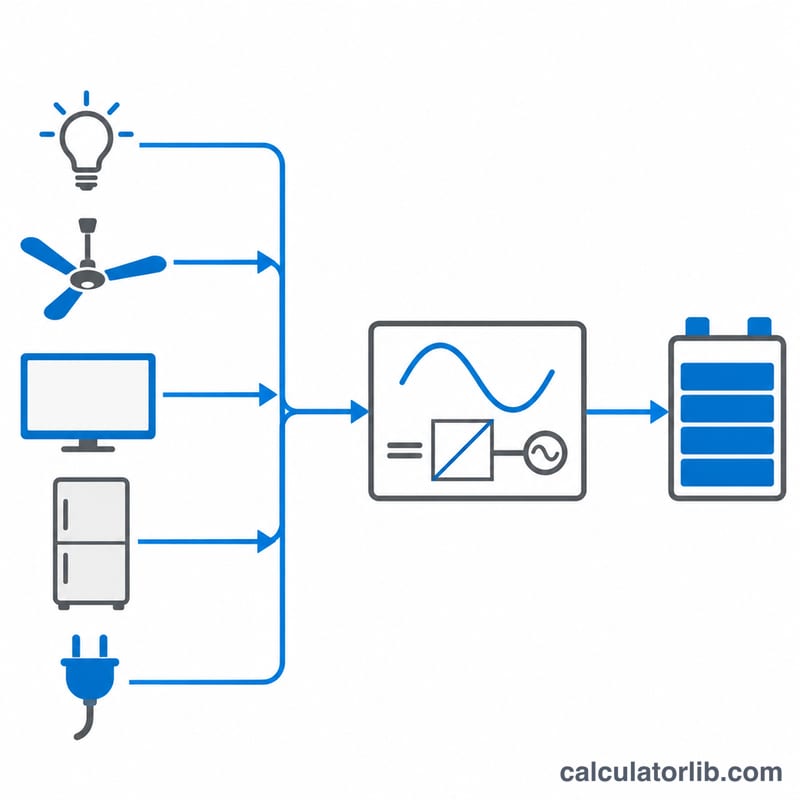
A home inverter converts battery DC power into AC power for your appliances. Choosing the wrong size either wastes money or causes overload trips when a fridge or pump starts. This calculator adds up your appliance loads, applies a safety margin and the power factor, checks motor starting surge, and gives a recommended rating in VA and watts.
How to use it
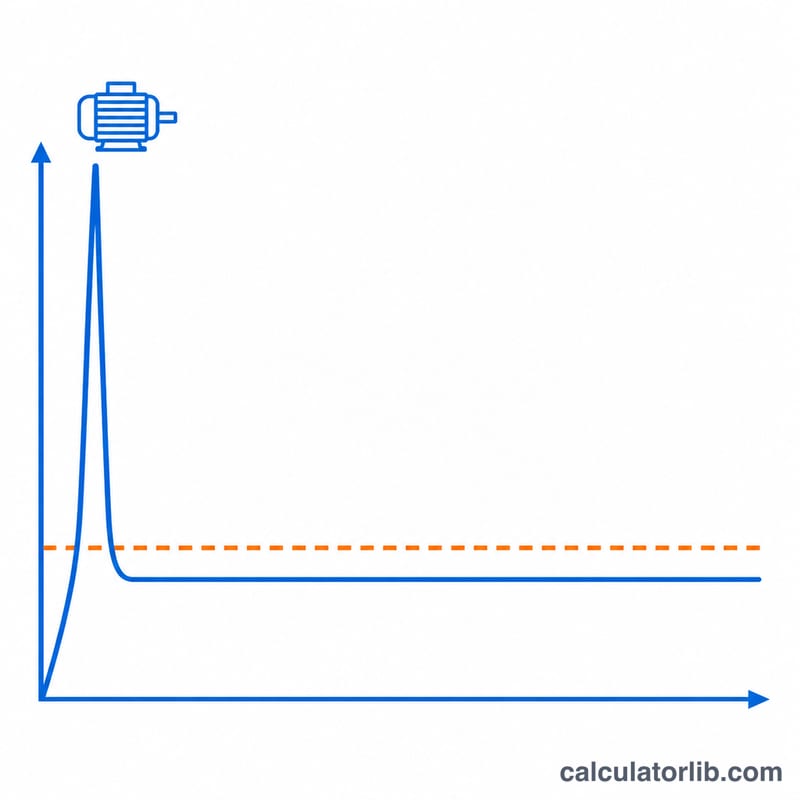
Enter the combined wattage of lights, fans, electronics, your refrigerator and other appliances you want to run at the same time. Add the extra starting surge of motor loads (for example the additional watts a fridge compressor or water pump draws for a second or two). Set the power factor (0.8 is a common default), a safety margin (20 to 25 percent is typical), the inverter surge ratio (many inverters tolerate about 2 times their rating briefly) and the battery voltage.
The formula explained
Let \(P\) be the total running load in watts, \(m\) the safety margin as a fraction, \(PF\) the power factor and \(k\) the surge ratio.
$$\text{VA}_{\text{cont}} = \frac{P \times (1 + m)}{PF}$$$$\text{VA}_{\text{surge}} = \frac{P + P_{\text{surge}}}{PF \times k}$$The recommended inverter is the larger of the two values. Battery current is estimated as \(I = \frac{P(1+m)}{0.9 \times V}\), assuming 90 percent inverter efficiency.
Worked example
Running load: 100 + 150 + 100 + 200 + 50 = 600 W, surge 600 W, \(PF = 0.8\), margin 25 percent, \(k = 2\), 12 V battery.
$$\text{VA}_{\text{cont}} = \frac{600 \times 1.25}{0.8} = 937.5$$$$\text{VA}_{\text{surge}} = \frac{600 + 600}{0.8 \times 2} = 750$$The larger value is 937.5 VA (750 W), so a 1000 VA inverter is the next standard size. DC current is \(750 / (0.9 \times 12) \approx 69.4\) A.
Typical Appliance Wattage and Motor Surge Reference
Use this table to fill in the load fields of the calculator. Values are approximate typical figures. Real appliances vary by brand, age and efficiency, so always use the wattage printed on the appliance nameplate or in its manual when you have it. Surge (starting) power only matters for motor and compressor loads and lasts a fraction of a second to a few seconds.
| Appliance | Typical running power (W) | Approx. extra starting surge |
|---|---|---|
| LED bulb | 5–15 W | None |
| Ceiling fan | 60–80 W | Small (brief) |
| TV (LED) | 50–120 W | None |
| Laptop (with charger) | 50–90 W | None |
| WiFi router / modem | 10–20 W | None |
| Refrigerator | 100–250 W (while compressor runs) | About 400–800 W extra at compressor start |
| Water pump, 0.5 HP | About 400–500 W | Roughly 2–3× running power |
| Mixer grinder | 300–750 W | Short motor start-up peak, often around 2× running |
| Small AC / heavy motor loads (e.g. 1 HP pump) | Roughly 750–1500 W | Often 2–3× running power; check the nameplate |
How to use it: add the running watts of everything you expect to run at the same time, then enter the largest motor start-up extra in the Surge (W) field. Only the biggest motor typically starts at any given moment, so you do not need to add every appliance's surge together.
Typical Power Factor, Margin and Battery Voltage Ranges
| Parameter | Typical range | Notes |
|---|---|---|
| Power factor (PF) | 0.7–0.8 for mixed household loads; 0.8 as a default | Use 1.0 only for purely resistive loads such as incandescent lamps or heaters. Motors, fans and electronics with power supplies pull the PF below 1. |
| Safety margin | 20–25% | Go up to about 30% if you expect to add appliances later. Margin avoids running the inverter at its limit, which reduces overload trips and heat stress. |
| Inverter surge ratio | About 1.5–3× the rated output, for short periods only | Check the datasheet. A higher ratio allows a larger motor start-up peak on the same inverter. |
Suggested battery voltage by inverter size
| Inverter size | Suggested battery voltage |
|---|---|
| Up to about 1 kVA | 12 V |
| About 1–2 kVA | 24 V |
| Above about 2–3 kVA | 48 V |
Why higher voltage for larger inverters: for the same power, DC current falls as battery voltage rises, following \(I_{DC} = \dfrac{P}{0.9 \times V}\), where 0.9 is an assumed inverter efficiency. Lower current means thinner, cheaper cables, smaller voltage drop, less heat at connections and lower fuse and breaker ratings. For example, 1000 W at 12 V draws about 93 A, while the same load at 48 V draws about 23 A.
Standard Inverter Sizes and Typical Loads
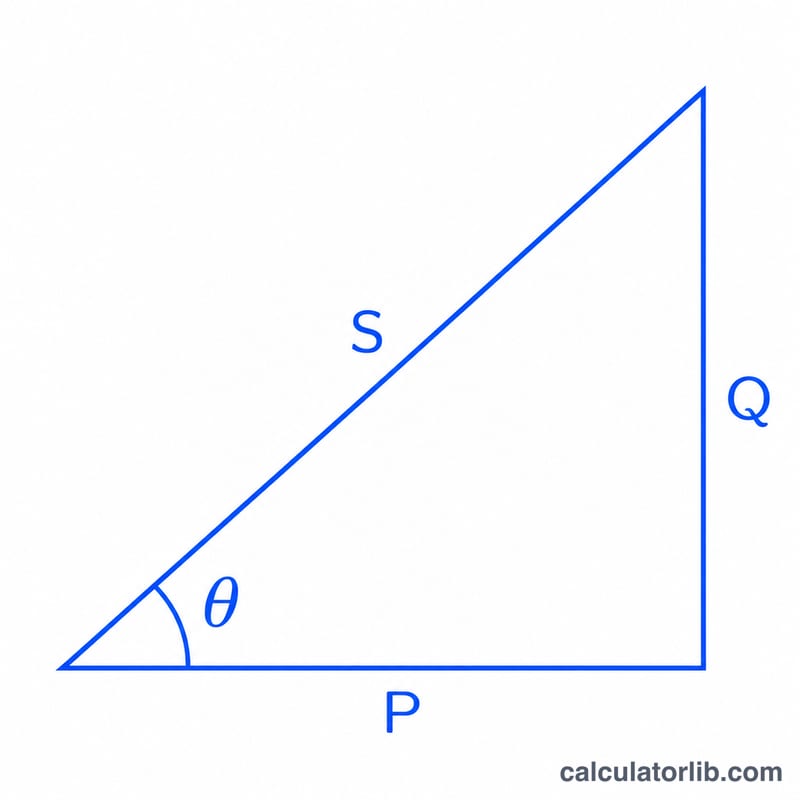
These are common market ratings; exact sizes, battery voltages and surge capabilities vary by manufacturer, so check the datasheet. The continuous watts column uses \(P_W = S \times PF\) with \(PF = 0.8\).
| Inverter rating (VA) | Max continuous watts at PF 0.8 | Usual battery voltage | Example loads typically supported |
|---|---|---|---|
| 600 VA | 480 W | 12 V | A few lights, 1–2 fans, a router and a small TV |
| 850 VA | 680 W | 12 V | Lights, 2–3 fans, TV, router, laptop charging |
| 1000 VA | 800 W | 12 V | Small home essentials plus a small refrigerator |
| 1500 VA | 1200 W | 12 V or 24 V (24 V is common) | Lights, fans, TV, refrigerator, and a small pump or mixer grinder |
| 2000 VA | 1600 W | 24 V | Essentials for a 2–3 room home plus a 0.5 HP pump |
| 3000 VA | 2400 W | 24 V or 48 V | Whole-home essentials, a larger pump, or a small AC |
| 5000 VA | 4000 W | 48 V | Large home loads, several motors, or an AC alongside other appliances |
Check the example: an 800 W load on a 12 V system draws about \(\dfrac{800}{0.9 \times 12} = \dfrac{800}{10.8} \approx 74\) A from the battery. Choose the next standard size above the calculator's result, and confirm that the inverter's surge rating covers your largest motor start-up.
FAQ
Should I add every appliance?
Only include appliances that will run at the same time. Loads that never overlap do not need to be summed.
What is the difference between VA and watts?
VA is apparent power; watts equal VA multiplied by the power factor. Inverters are often rated in VA, so size using VA.
Does this size the battery bank?
No. It gives the DC current the inverter draws; battery capacity also depends on backup hours and depth of discharge.