What this calculator does
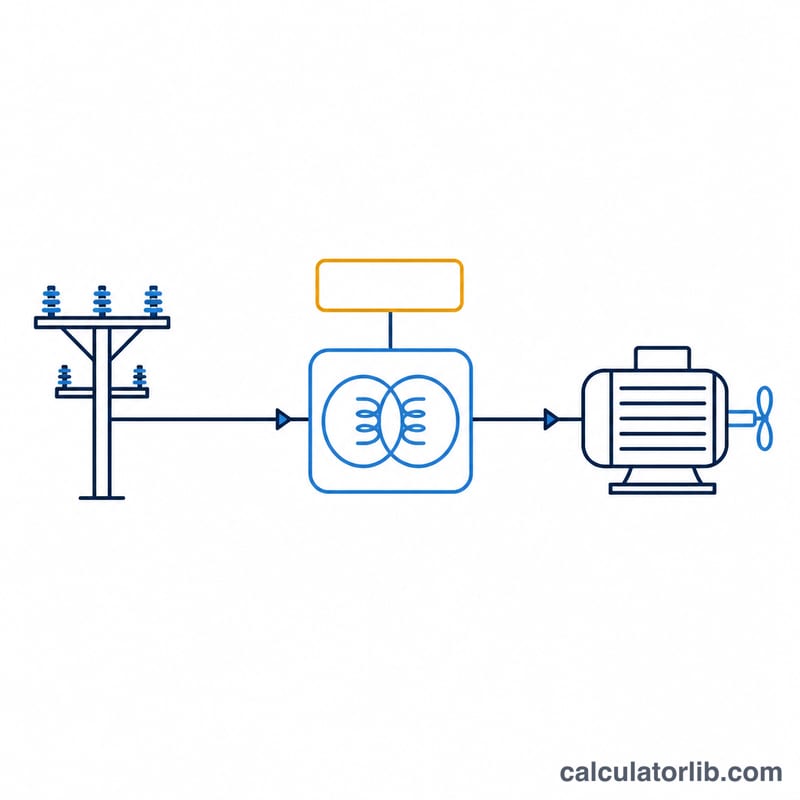
The Motor Transformer Sizing Calculator estimates the minimum transformer kVA rating required to safely run and start an electric motor. Undersized transformers cause excessive voltage dip on motor start, nuisance tripping, and overheating, while oversized units waste capital and run inefficiently. This tool bridges motor nameplate data and transformer selection.
How to use it
Enter the motor horsepower, its efficiency (as a percent), the operating power factor, the starting current multiple (locked-rotor current, typically 5 to 7 times full load), and a safety factor for headroom. The calculator returns the running load, the starting inrush load, and the recommended transformer size in kVA.
The formula explained
A motor draws real power equal to its shaft power divided by efficiency. Converting horsepower to kilowatts uses \(1\,\text{HP} = 0.746\,\text{kW}\). Dividing by power factor \(\text{PF}\) gives apparent power in kVA:
$$\text{kVA}_{run} = \frac{\text{HP} \times 0.746}{\eta \times \text{PF}}$$
Here \(\eta\) is efficiency as a decimal. The transformer is then sized by applying a safety factor \(\text{SF}\): $$\text{kVA}_{T} = \text{kVA}_{run} \times \text{SF}.$$ The starting load, \(\text{kVA}_{start} = \text{kVA}_{run} \times \text{LRC}\), is reported separately so you can check inrush against transformer impedance.
Worked example
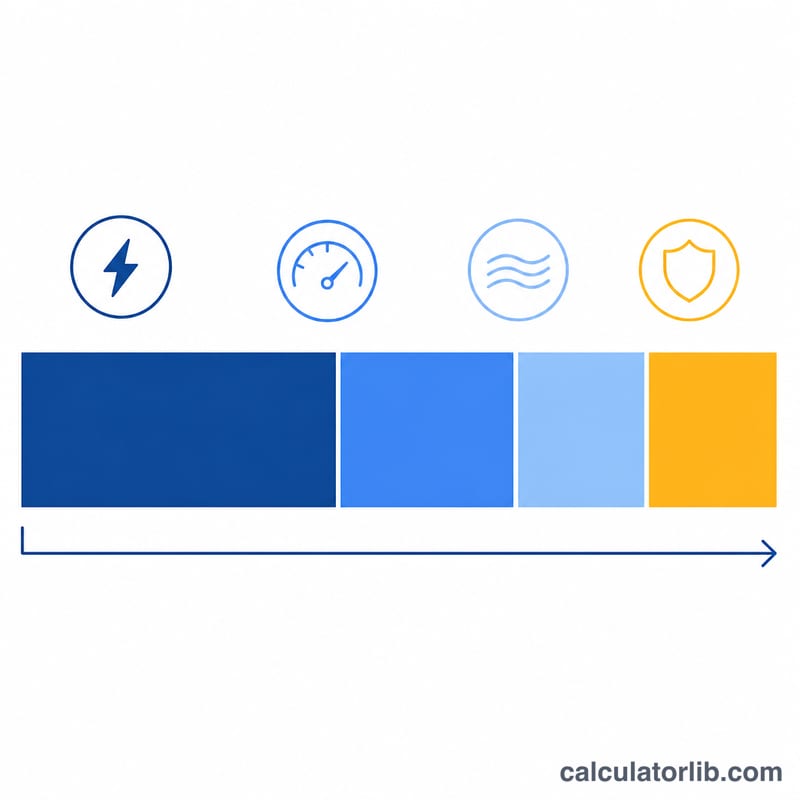
For a 50 HP motor at 90% efficiency, 0.85 power factor, a 6x starting multiple and a 1.25 safety factor:
$$\text{kVA}_{run} = \frac{50 \times 0.746}{0.90 \times 0.85} = 48.76\,\text{kVA}$$ $$\text{kVA}_{T} = 48.76 \times 1.25 = 60.95\,\text{kVA}$$
A standard 75 kVA transformer would be selected, with starting inrush of about \(292.5\,\text{kVA}\).
Standard Transformer kVA Ratings
Distribution transformers come in fixed standard sizes. The ratings below are the common sizes in the ANSI/IEEE C57 series, which is the North American standard. Regions that follow IEC 60076 use a somewhat different set of preferred sizes, such as 100, 160, 250, 400 and 630 kVA. If you are outside North America, check your local manufacturer's catalogue.
| Type | Standard kVA ratings (ANSI/IEEE C57) |
|---|---|
| Single-phase | 3, 5, 10, 15, 25, 37.5, 50, 75, 100, 167, 250, 333, 500 |
| Three-phase | 15, 30, 45, 75, 112.5, 150, 225, 300, 500, 750, 1000, 1500, 2000, 2500 |
How to choose: Pick the next standard size at or above the calculated transformer kVA (\(\text{kVA}_T\)). Do not round down. For example, take a 50 HP three-phase motor with 93% efficiency, a 0.88 power factor and a 1.25 safety factor:
$$\text{kVA}_T = \frac{0.746 \times 50 \times 1.25}{0.93 \times 0.88} = \frac{46.625}{0.8184} \approx 56.97\ \text{kVA}$$The calculated value is 56.97 kVA. The next three-phase standard size is 75 kVA, because 45 kVA would be too small. If the motor has a large starting inrush or the supply is weak, also check that the transformer can handle the voltage dip when the motor starts.
NEMA Locked-Rotor Code Letters (kVA per HP)
The code letters below come from NEMA MG 1 and the US National Electrical Code (NFPA 70), Table 430.7(B). Each letter shows how much kVA the motor draws per horsepower with the rotor locked, which is the condition at the moment of starting, at rated voltage. These are North American standards. IEC-rated motors usually list a locked-rotor current ratio (IL/IN) instead of a code letter. The letters I, O and Q are not used.
| Code letter | Locked-rotor kVA per HP |
|---|---|
| A | 0 – 3.14 |
| B | 3.15 – 3.54 |
| C | 3.55 – 3.99 |
| D | 4.0 – 4.49 |
| E | 4.5 – 4.99 |
| F | 5.0 – 5.59 |
| G | 5.6 – 6.29 |
| H | 6.3 – 7.09 |
| J | 7.1 – 7.99 |
| K | 8.0 – 8.99 |
| L | 9.0 – 9.99 |
| M | 10.0 – 11.19 |
| N | 11.2 – 12.49 |
| P | 12.5 – 13.99 |
| R | 14.0 – 15.99 |
| S | 16.0 – 17.99 |
| T | 18.0 – 19.99 |
| U | 20.0 – 22.39 |
| V | 22.4 and up |
Reading the nameplate: Look for the field marked "CODE" or "KVA CODE" on the motor nameplate. Don't confuse it with the "DESIGN" letter (NEMA Design A, B, C or D). The design letter describes the torque characteristics, not the starting kVA. To estimate the starting kVA, multiply the motor horsepower by the code letter's range:
$$\text{kVA}_{\text{start}} \approx \text{HP} \times \left(\text{kVA per HP}\right)$$For example, a 50 HP motor with code G draws roughly \(50 \times 5.6 = 280\) to \(50 \times 6.29 = 314.5\) kVA at the moment of an across-the-line start. Use the top of the range for a conservative estimate. This brief inrush is often several times the transformer's continuous rating. That is why large motors may need a reduced-voltage starter or a larger transformer to keep the voltage dip acceptable.
Typical Motor Efficiency, Power Factor and Starting Multiples
Use the motor's nameplate or datasheet values whenever you have them. If you don't, the typical values below are reasonable starting points for preliminary sizing. The efficiency figures are approximate full-load values for NEMA Premium motors as defined in NEMA MG 1, and for IE3 motors as defined in IEC 60034-30-1. These two efficiency classes are broadly comparable. Actual values depend on pole count, enclosure, frequency (50 vs 60 Hz) and manufacturer.
| Motor size | Typical full-load efficiency (NEMA Premium / IE3) | Typical full-load power factor |
|---|---|---|
| 1 – 5 HP | about 85 – 89% | about 0.75 – 0.85 |
| 10 – 50 HP | about 91 – 94% | about 0.80 – 0.88 |
| 100 HP and above | about 95 – 96% | about 0.85 – 0.92 |
Both efficiency and power factor drop noticeably when the motor runs well below full load. Small and lightly loaded motors therefore draw more kVA per useful horsepower.
| Starting method | Typical starting current (× full-load current) |
|---|---|
| Across-the-line (direct-on-line) | 6 – 8× |
| Wye-delta (star-delta) | about 2 – 2.5× (roughly one-third of across-the-line) |
| Soft starter | about 2 – 4× (adjustable) |
| Variable frequency drive (VFD) | about 1 – 1.5× |
Safety factor: A design margin of 1.15 – 1.25 is typical. It covers future load growth, ambient temperature, harmonics and voltage variation. Use the higher end for frequent starts, high ambient temperatures or VFD loads. This design margin is separate from the motor's nameplate "service factor" (S.F.), which describes how much the motor itself can be overloaded.
Sources: NEMA MG 1 (Motors and Generators) and IEC 60034-30-1 (efficiency classes of line-operated AC motors). These ranges are general guidance. Final transformer selection should be confirmed by a qualified engineer against the actual motor data and local electrical codes.
FAQ
Why add a safety factor? It provides headroom for load growth, ambient heat and voltage regulation, commonly 1.25.
Does this cover soft starters? Reducing the starting multiple approximates a soft starter or VFD, which lowers inrush and required capacity.
Is this for single or three phase? The kVA math is phase-independent; confirm the transformer winding configuration matches your motor supply.