
What Is a Transformer Turns Ratio?
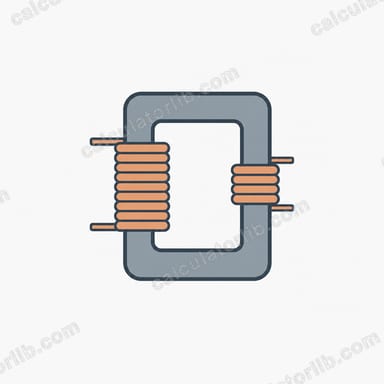
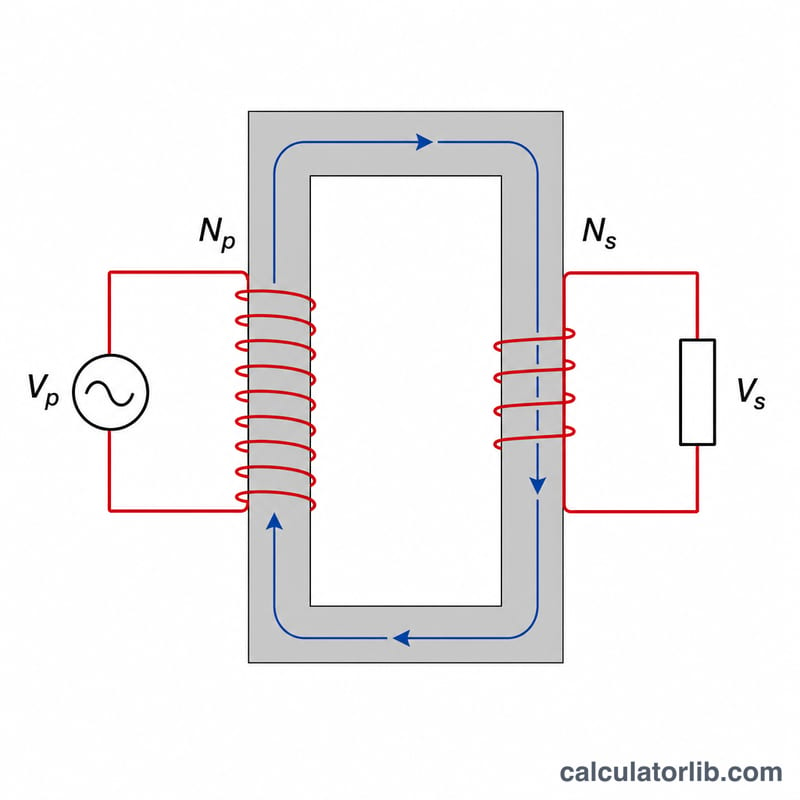
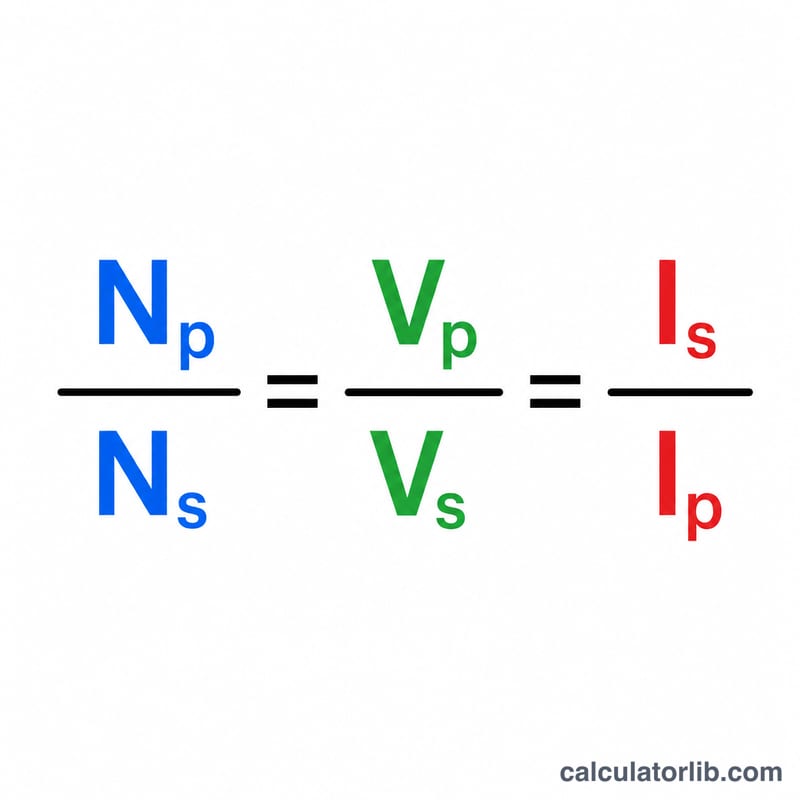
The turns ratio of a transformer describes the relationship between the number of wire turns on the primary winding (Np) and the secondary winding (Ns). In an ideal transformer this ratio equals the ratio of primary to secondary voltage, which is why a turns-ratio calculator can find one value when you know the others. The governing relationship is \(N_p/N_s = V_p/V_s = I_s/I_p\).
How to Use This Calculator
Enter the primary voltage (Vp) and secondary voltage (Vs). The calculator instantly returns the turns ratio and tells you whether the transformer is step-up or step-down. Optionally, enter the primary turns (Np) to compute the required secondary turns (Ns), and enter the primary current (Ip) to compute the secondary current (Is).
The Formula Explained
The ratio \(a = V_p/V_s\). A ratio greater than 1 means the secondary voltage is lower than the primary — a step-down transformer. A ratio less than 1 means the output voltage is higher — a step-up transformer. Because power is conserved (\(V_p \cdot I_p = V_s \cdot I_s\) in an ideal transformer), current scales inversely: \(I_s = I_p \times a\), and the secondary turns \(N_s = N_p / a\).
Worked Example
Suppose Vp = 240 V, Vs = 12 V, Np = 1000 turns, and Ip = 0.5 A. The turns ratio $$a = 240 / 12 = 20\!:\!1$$ (step-down). The secondary turns $$N_s = 1000 / 20 = 50 \text{ turns}.$$ The secondary current $$I_s = 0.5 \times 20 = 10 \text{ A}.$$ The lower-voltage secondary carries proportionally more current.
FAQ
Does this work for step-up transformers? Yes. Enter a smaller primary voltage than secondary (e.g. 120 V to 480 V) and the ratio will be less than 1, indicating step-up.
Why is secondary current higher than primary? Power in equals power out, so when voltage drops the current must rise to keep the product constant.
Is this for real transformers with losses? The formulas assume an ideal, lossless transformer with 100% coupling. Real units have small efficiency losses, but the ratios are an excellent design estimate.