
What Is Gay-Lussac's Law?
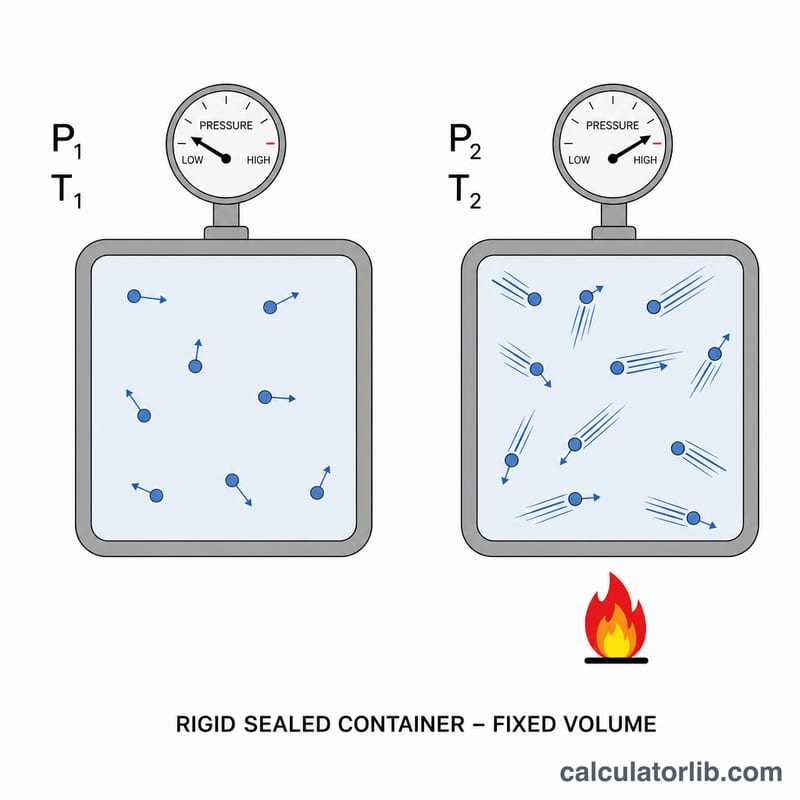
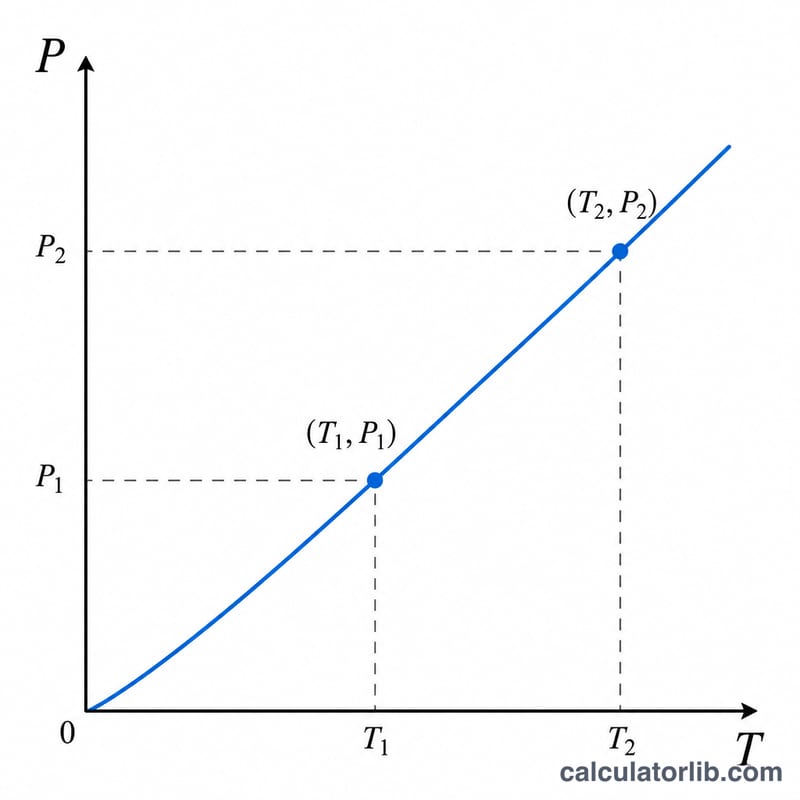
Gay-Lussac's Law describes how the pressure of a fixed amount of gas changes with temperature when the volume is held constant. It states that pressure is directly proportional to absolute (Kelvin) temperature: as a gas gets hotter, its molecules strike the container walls harder and more often, raising the pressure. The relationship is written as \(\text{P}_1/\text{T}_1 = \text{P}_2/\text{T}_2\).
How to Use This Calculator
Choose which variable you want to solve for, then enter the three known values. Pressure can be in any consistent unit (kPa, atm, psi) as long as both pressures use the same unit. Temperature, however, must be in Kelvin — convert from Celsius by adding 273.15. The calculator instantly returns the missing value.
The Formula Explained
Starting from \(\text{P}_1/\text{T}_1 = \text{P}_2/\text{T}_2\), you can rearrange to isolate any variable:
$$\text{P}_2 = \frac{\text{P}_1 \times \text{T}_2}{\text{T}_1}, \quad \text{P}_1 = \frac{\text{P}_2 \times \text{T}_1}{\text{T}_2}, \quad \text{T}_2 = \frac{\text{T}_1 \times \text{P}_2}{\text{P}_1}, \quad \text{T}_1 = \frac{\text{T}_2 \times \text{P}_1}{\text{P}_2}.$$Because the law uses ratios, the units of pressure cancel — only consistency matters.
Worked Example
A sealed canister holds gas at 100 kPa and 300 K. If it is heated to 350 K at constant volume, what is the new pressure? Using $$\text{P}_2 = \frac{\text{P}_1 \times \text{T}_2}{\text{T}_1} = \frac{100 \times 350}{300} = 116.67 \text{ kPa}.$$ The pressure rises because temperature increased while volume stayed fixed.
FAQ
Why must temperature be in Kelvin? The law relies on absolute temperature. Using Celsius (which can be zero or negative) gives meaningless ratios. Always convert: \(\text{K} = {}^\circ\text{C} + 273.15\).
Does volume change? No. Gay-Lussac's Law applies only at constant volume and a fixed amount of gas. If volume changes, use the Combined Gas Law instead.
Can I use atm or psi? Yes. Any pressure unit works as long as both pressure values are expressed in the same unit, since the unit cancels in the ratio.